
Choosing 2A friendly web hosting is a contract question rather than a technical one. The servers are the same everywhere. What differs is what the acceptable use policy permits, what notice you would get, and whether the company you pay actually controls the infrastructure – because a provider reselling someone else’s platform can only pass along a decision made above it.
Here is what to read before signing, and an honest note about the half of the problem hosting does not solve.
2A friendly web hosting starts with the acceptable use policy
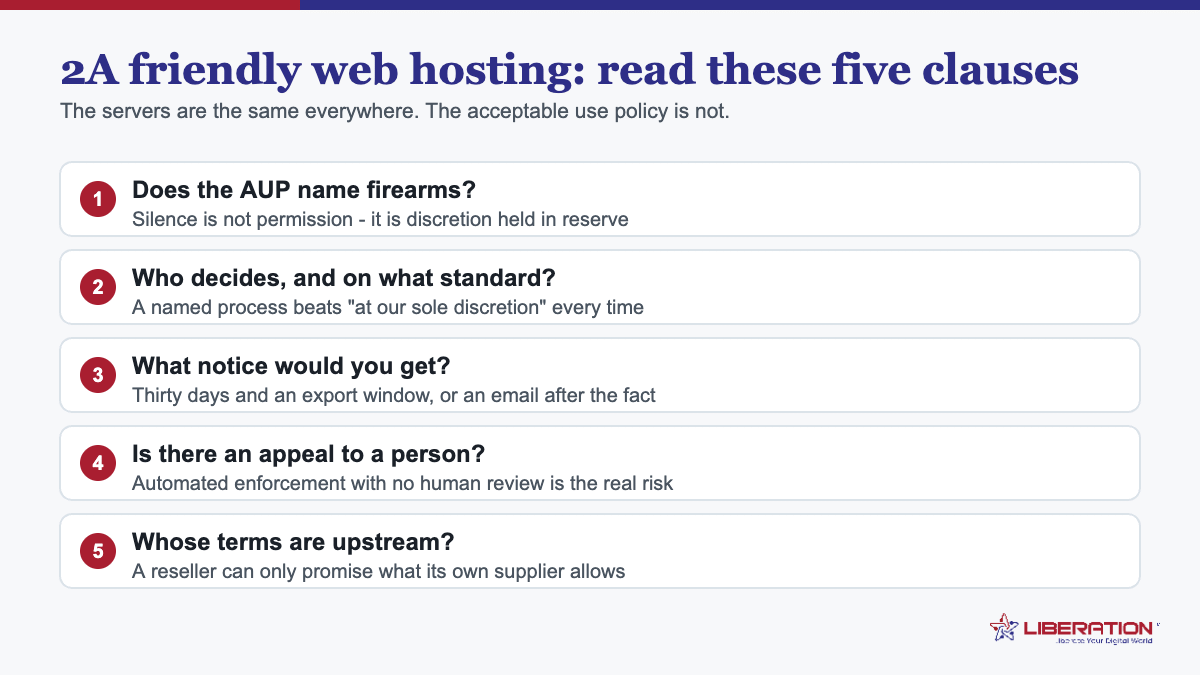
Four questions, answered from the policy text itself rather than from marketing copy:
- Does it name firearms, ammunition, or related content at all? Silence is ambiguous rather than permissive. Explicit language in either direction is more useful than none.
- Who decides, and against what standard? “Sole discretion” appears in almost every hosting contract. Knowing it is there is the point.
- What notice would you get? A policy permitting immediate suspension is a different risk from one promising a notice period and a chance to respond.
- Is there an appeal to a person? Automated enforcement with no human route is how businesses lose weeks.
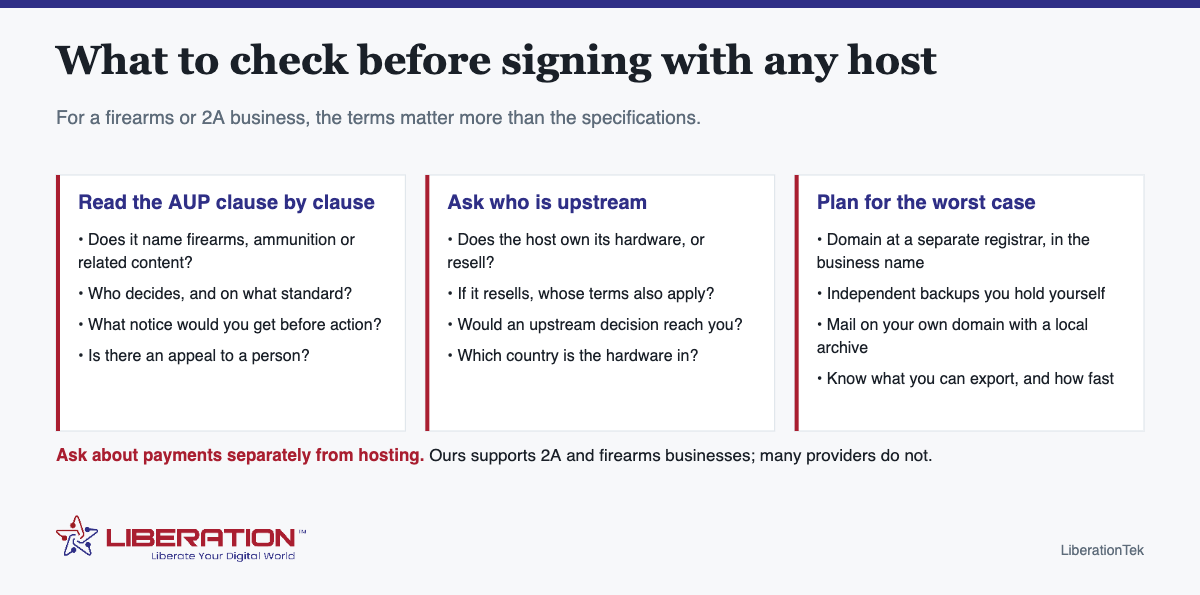
2A friendly web hosting: then ask who is upstream
This is the question that separates a promise from a marketing line. A great many hosting brands are a control panel, a logo and a support desk in front of a larger platform. That is a legitimate business model, and plenty of resellers give excellent service – but it changes who can actually keep a commitment.
If your provider does not own the infrastructure, then a decision made upstream about content, about an account, or about a whole category of customer arrives as something they relay rather than something they control. For most businesses that never matters. For a firearms business choosing a host specifically because of what it promises, it is the entire point.
Ask plainly: “Do you own your servers, and which country are they in?” A host that owns its hardware answers immediately.
Payments are a separate question – ask it anyway
Hosting a website and accepting card payments are separate arrangements, with separate providers and separate risk rules. A host can be entirely comfortable with firearms content while its payment partner is not, and for many firearms retailers payment acceptance is the actual reason they are shopping. A website that is online but cannot take an order has not solved the problem.
So ask it as its own question of every provider you consider, and get the answer before you move anything.
Ours is yes. LiberationTek payment processing supports 2A and firearms businesses, alongside hosting on US-owned hardware we operate ourselves and a written position on lawful content with no upstream provider able to overrule it. That combination – hosting, email and payments from one provider that has already decided where it stands – is uncommon in this market, and it is the reason to have one conversation rather than three.
Build so that being dropped is survivable
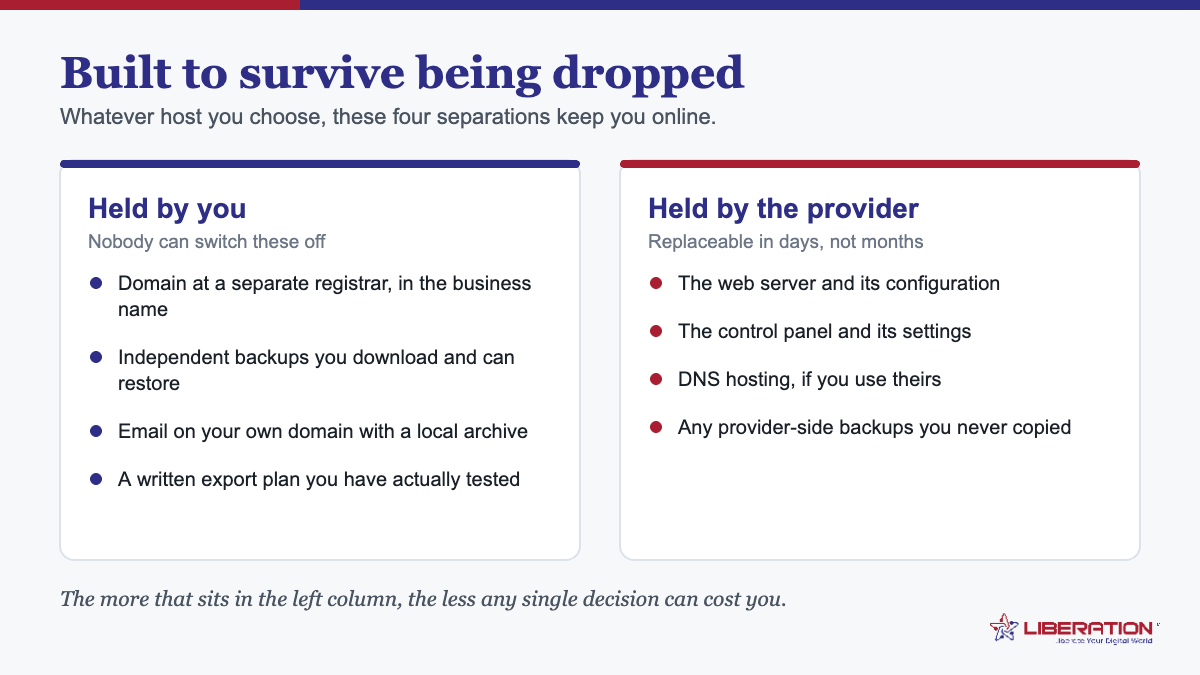
Whatever provider you choose, the resilient setup is the same, and it costs almost nothing to arrange at the start:
| Arrangement | Why it matters |
|---|---|
| Domain at a separate registrar, in the business’s name | The domain is the one thing that is genuinely hard to replace. Never register it with the same company that hosts you. |
| Independent backups you hold yourself | A backup held only by the provider is not a backup from the provider. |
| Mail on your own domain, archived locally | Correspondence is the least replaceable thing a business owns. |
| Known export path | Find out what you can take and how fast, before you need to. |
| Customer and order data exported regularly | Platform data is the hardest to reconstruct. |
None of this assumes bad faith from any particular provider. It assumes that businesses should not be one decision away from starting over, which is simply good practice.
What an FFL website actually needs technically
Once the contract questions are settled, the requirements are ordinary:
- Reliable hosting with cPanel – shared hosting from $7.99 a month covers a brochure site, transfers page and hours; a store wants guaranteed resources on a VPS.
- Free SSL, included rather than sold as an upgrade.
- Email on the business domain – Liberation Email from $1.95 per user per month, so correspondence is not tied to a consumer account that can be closed by automated decision.
- Backups and a tested restore.
- Multi-factor authentication on hosting, email and the registrar.
Nothing exotic. The distinguishing factor is whose terms govern it and who is able to stand behind them.
Questions worth asking any 2A friendly web hosting provider
- Do you own the hardware, and where does it sit?
- What does your acceptable use policy say about lawful firearms-related content?
- What notice would we get before any action on the account?
- Is there a person we can reach if there is a dispute?
- What can we export, and how quickly?
Put those to us in writing and you will get written answers – including a straight answer on payment processing rather than an implication.
Reading the terms without a lawyer
You are not looking for legal analysis. You are looking for four specific things, and they are usually findable in ten minutes with a browser search function.
- Search the acceptable use policy for your own industry terms. Firearms, ammunition, weapons. Finding nothing is informative; finding an explicit restriction is more so.
- Search the terms for “sole discretion” and “without notice”. Both are common. The point is to know whether the promises made elsewhere on the site are qualified here.
- Find the suspension clause and read what triggers it and what happens to your data afterwards.
- Check whether the terms reference an upstream provider whose policies also apply. If they do, you have two sets of terms to satisfy, not one.
Then ask pre-sales a direct question and keep the reply. A written answer from a company that owns its infrastructure is worth considerably more than a marketing page, and the response time tells you something about support as well.
Two setups that make a difference
Split the store from the brochure. If you sell online, consider running the catalogue and the marketing site as separate properties. It is slightly more work and it means a problem with one does not take the other down with it.
Keep an exportable customer list. Order and customer records are the hardest thing to reconstruct and the easiest to export regularly. Whatever platform you use, know how to get that data out and do it on a schedule rather than in an emergency.
A note on what this is not
None of this assumes any particular provider acts in bad faith. Most do not, and most firearms businesses never have a hosting problem at all. The argument is narrower: the cost of arranging things resiliently is close to zero at the start and considerable afterwards, and a business whose customers depend on it should not be one policy decision away from starting over. That is ordinary prudence rather than a political position.
Where the SERP stands today
Worth knowing what you are choosing between. The providers marketing directly to this audience are small independents rather than the large hosting brands, and a couple of the sites that rank are affiliate listicles rather than hosts at all. That is good news for a buyer – it means the market is served by companies that have thought about the question rather than by a general host that happens to tolerate it – but it also means the usual signals of scale are missing, so the contract questions above carry more weight than reputation does.
What 2A friendly web hosting costs, and what it does not
There is a persistent assumption that 2A friendly web hosting carries a premium, as though political tolerance were a paid add-on. It does not, and a provider charging one is worth a second look. The hosting is ordinary hosting. What you are selecting for is a company whose terms and ownership structure mean the question never comes up.
Expect to pay ordinary market rates. Shared hosting for a small firearms retail site, a range or a training business sits in the same range as any other small business site. A managed VPS costs what a managed VPS costs. If a host quotes you a “specialty” or “high-risk” rate for a lawful business, they are pricing their own discomfort, not your resource usage.
Expect payments to be the harder problem. This is the part most people underestimate. Hosting is a competitive market with many providers; card processing for firearms-adjacent merchants is a much narrower field. The federal government’s own ATF guidance on who needs a license to sell firearms is a useful grounding document when a processor’s onboarding team asks what exactly you do, because a precise answer moves faster than a vague one. Sort the processor before you sort the host.
Expect to do the resilience work yourself. No provider, us included, can promise that a registrar, a processor, an email filter or a marketplace will never make its own decision. What 2A friendly web hosting buys you is one fewer single point of failure, plus a company that will tell you plainly where it stands. The rest is the separation described above: your domain, your backups, your list, in your name.
Expect the terms to matter more than the specifications. Two hosts can offer identical NVMe storage, identical cPanel licensing and identical uptime figures, and be completely different propositions once you read the acceptable use policy. That is the whole argument of this page. Specifications are easy to compare and rarely decide anything; the contract is harder to read and decides everything.
If you want a short version to act on today: read the AUP, ask who is upstream, move your domain somewhere separate, and take a backup you hold yourself. That is most of the value of 2A friendly web hosting, and you can do three of the four this afternoon.
How to compare two 2A friendly web hosting providers in one afternoon
Comparing hosts on specifications is a trap, because the specifications are largely identical and the differences that matter are buried in documents nobody enjoys reading. Here is a comparison that takes about two hours and actually tells you something.
Open both acceptable use policies side by side. Search each one for “firearm”, “weapon”, “ammunition” and “regulated”. Note not just whether the words appear, but how. A policy that names firearms and permits them is the strongest signal available. A policy that names them among prohibited content rules the provider out immediately. A policy that says nothing leaves the decision to whoever reads your ticket on a bad day, which is the position most businesses are already in without realising it.
Search both policies for the discretion language. Phrases like “at our sole discretion”, “for any reason or no reason” and “we may terminate immediately without notice” tell you how much protection the contract actually offers. Every provider needs some discretion. The question is whether it is bounded by a process and a notice period, or unbounded. Genuine 2A friendly web hosting is usually recognisable by how specific the enforcement language is.
Find out who owns the hardware. Ask both providers directly: do you own and operate the servers, or do you resell another platform? This is a one-line email and the answer reshapes everything else, because a reseller’s promises are capped by its supplier’s terms. If they resell, ask whose terms sit above theirs and read those too. A lot of apparently 2A friendly web hosting turns out to be a friendly reseller on top of an indifferent platform.
Ask both what happens at renewal and at export. What is the renewal price, how much notice is given before a price change, and what exactly can you export if you leave – full cPanel backups, or a database dump and good luck? A provider comfortable answering both questions in writing is a provider you can plan around.
Ask both a payments question, even though it is not their job. Hosts that work regularly with firearms businesses usually know which processors onboard them, and the ones who have never thought about it will say so. That answer alone separates providers who serve this market deliberately from those who simply have not turned anyone away yet.
Then compare the numbers. Only after the four checks above does it make sense to look at storage, bandwidth, backup frequency and price. By that point you are usually choosing between two acceptable options rather than discovering in month seven that the cheap one was never viable.
Write the answers into a single page and keep it. If you ever need to move, you will have already done the research, and moving becomes a scheduling problem rather than an emergency. That is the practical difference 2A friendly web hosting makes: not a promise that nothing will ever go wrong, but a shorter path back when something does.
Frequently asked questions
What is 2A friendly web hosting?
It means a host whose acceptable use policy does not restrict lawful firearms-related content, and which is in a position to honor that – meaning it controls its own infrastructure rather than depending on an upstream provider whose terms also apply. The label matters far less than what the policy says and who can enforce it.
Can a web host refuse a firearms business?
Yes. Hosting is a private contract and most terms of service allow suspension or termination at the provider’s discretion. That is why the acceptable use policy, the notice provisions and the question of who owns the infrastructure are worth reading before signing.
Is web hosting the same problem as payment processing for firearms businesses?
No – they are separate arrangements with separate providers and separate risk rules, and a host being comfortable with firearms content does not mean its payment partner is. Ask both questions of any provider. LiberationTek payment processing supports 2A and firearms businesses, so hosting, email and payments can come from one provider.
What should an FFL check in a hosting contract?
Whether the acceptable use policy names firearms or related content; who decides and on what standard; what notice is given before suspension; whether there is an appeal; whether the provider owns its infrastructure or resells; and what you can export, how quickly, if the relationship ends.
How do I protect a firearms business website from being dropped?
Register the domain at a registrar separate from the hosting and in the business’s name, keep independent backups you hold yourself, run email on your own domain with a local archive, and choose a provider that owns its hardware.
Related reading
- Gun-Friendly Web Hosting — Hosting for firearms businesses, stated plainly.
- Conservative Web Hosting — Terms that name the risk instead of staying silent.