
A real estate brokerage website is built right when the brokerage owns every piece of it: the domain, the DNS, the agent email addresses, the site logins, the lead forms and the backups. Do that in seven steps, starting with a domain registered in the brokerage’s name and finishing with a tested restore. Anything held personally by an agent or vendor becomes a problem the day that person leaves.
This guide is for brokers, office managers and the person who “does the website” for a small to mid-size brokerage. Each step says what to do, what to check and the mistake we see most often. For a real estate brokerage website that someone else maintains, see our IT support for real estate brokerages, for help when a team wants this handled for them.
1. Register the domain your real estate brokerage website runs on
Everything else hangs off the domain name. Register it under the brokerage’s legal name, with a shared role address (such as a broker or office manager mailbox) as the contact, and turn on auto-renew. If you already have a domain, find out who is listed as the registrant and who holds the registrar login.
Check: the registrant is the brokerage, at least two people at the brokerage can log in, and the renewal card is a company card. Common mistake: a web designer or an agent registered the domain years ago on a personal account. If that person leaves or stops answering, moving the site becomes a negotiation. Our website transfer service covers domain transfers, but it works best when the current owner cooperates, so a real estate brokerage website should never depend on one person’s login.
2. Set up real estate agent email on the brokerage domain
Agents who use personal Gmail or Yahoo addresses take their client conversations with them when they go. Brokerage domain email ([email protected]) keeps those messages in a system the brokerage controls and tells clients who the agent works for.
Real estate agent email on your own domain can be hosted with your site or on a dedicated mail service. For plain mailboxes, Liberation Email starts at $1.95 per user per month (Mail Starter, 5 GB), with larger mailboxes on higher tiers.
Check: every agent has a named mailbox, shared addresses (info@, transactions@) go to more than one person, and agents agree in writing to use the brokerage address for client business. Common mistake: one shared password for a group mailbox. Give each person a login so you can revoke one without disrupting the others.
3. Authenticate brokerage domain email with SPF, DKIM and DMARC
Email that claims to come from your domain is easy to fake unless you publish authentication records in DNS. SPF lists the servers allowed to send for your domain. DKIM adds a cryptographic signature to each message. DMARC tells receiving servers what to do with messages that fail both checks.
Google’s sender guidelines (checked October 2026) say all senders should authenticate with SPF or DKIM, and that senders of more than 5,000 messages a day to Gmail accounts must use SPF, DKIM and DMARC, a rule that began February 1, 2024. A small brokerage will not hit that volume, but the same records help agent emails reach the inbox and make impersonation harder.
Check: every service that sends mail as your domain (your mailboxes, your CRM, your newsletter tool, your transaction software) is listed in SPF or signs with DKIM. Start DMARC in monitoring mode, read the reports, then tighten it. Common mistake: publishing two SPF records. A domain should have one, and extra senders go inside it. Our team does this DNS work for brokerages as part of managing their domain and email, so the real estate brokerage website and its mail stay in step.
4. Plan a real estate website for brokerages with agent pages
Every real estate brokerage website needs a small set of pages done well: home, search, agent directory, individual agent pages, neighborhoods or areas served, buyer and seller guides, and contact. Put every agent on a profile page inside the main site (for example, /agents/jane-doe/) before you consider separate sites. One site builds one body of search authority for the brokerage name.
Some top producers want their own domain and look. That is where reseller hosting fits: the brokerage holds a reseller account and creates a separate hosting account for each agent site, all under the brokerage’s billing and branding. cPanel’s documentation describes a reseller as an account owner who allocates purchased resources to the accounts they create (cPanel & WHM documentation, last modified July 8, 2026). Our reseller plans start at $98 per month for 5 accounts (monthly billing, October 2026).
This is the real estate website for brokerages that scales without handing the keys to each agent. Check: who is the admin on each agent site, and whether the agent’s domain is registered to the brokerage or to the agent by written agreement. Common mistake: agents buying their own hosting on personal cards, leaving outdated logos and compliance language on a dozen sites.
5. Build real estate lead capture and routing into the real estate brokerage website
Real estate lead capture decides whether the real estate brokerage website pays for itself. Every form (contact, home valuation, property inquiry, buyer registration) should post to a system the brokerage controls, not to one agent’s inbox. From there, routing rules send each lead to the right agent or to a shared queue, and a copy stays with the brokerage.
Check: submit a test lead from every form on a phone, confirm who receives it and how fast, and confirm the lead record can be exported. Common mistake: a third-party form that stores leads in the vendor’s account with no export.
If you pay for leads, or accept payment for sending them, talk to your attorney first. As of October 2026, the federal RESPA rule in 12 CFR 1024.14 states that no person shall give or accept any fee, kickback or other thing of value for referring settlement service business tied to a federally related mortgage loan. How that applies to lead-sharing with lenders or title companies depends on the arrangement, so confirm it with counsel rather than with a web developer.
6. Handle IDX listings the way your MLS requires
Showing MLS listings on your site is done through IDX, and the rules come from your MLS. NAR publishes a model IDX policy in its Handbook on Multiple Listing Policy (2023 edition, the latest edition we reviewed in October 2026). It says IDX displays must be under the actual and apparent control of the participant, presented as that participant’s display, and compliant with state law and MLS rules. It lists clear identification of the brokerage firm’s name as a factor showing control.
The same text says an MLS must act on a request for an IDX feed within five business days, barring extenuating circumstances. In practice, the brokerage, as the MLS participant, should sign up for the feed, and the vendor should hold only the access the brokerage gives it. Your MLS may add rules, so read its current policy.
Check: the feed is licensed to the brokerage, your firm name is visible on the listing pages, and the vendor contract lets you take the feed to another vendor. Common mistake: signing an IDX contract in an agent’s name, which leaves the brokerage without control of the display.
7. Put agent offboarding and backups in writing
Agent offboarding is where ownership gets tested. When an agent leaves, the brokerage should be able to act the same day. The routine we recommend for brokerage domain email has four steps:
- Change the mailbox password so the departing agent no longer has access.
- Forward the mailbox to a manager or shared address so new inquiries are not lost. In cPanel this is done in the Forwarders interface, and the mailbox must exist first (cPanel documentation, July 2026).
- Export files and mail the brokerage needs to keep, such as transaction records.
- Revoke access to the site, CRM, MLS tools and any shared drives, and remove the agent’s profile page or redirect it.
Backups protect the real estate brokerage website itself. Daily encrypted off-site backups, with the option to stage and test a restore, mean a bad plugin update or a hacked page is an inconvenience. We include CodeGuard on most hosting plans (confirm per plan) and recommend testing a restore every quarter. Our backup and disaster recovery page lists what is and is not covered.
Closings add a risk that needs its own attention. The FBI’s Internet Crime Complaint Center (IC3) 2025 annual report lists 12,368 real estate fraud complaints with $275.1 million in reported losses in 2025, up from 9,359 complaints and $173.6 million in 2024 (IC3 defines the category as fraud involving real estate investment, rental or timeshare property). The same report describes an August 2025 case in which buyers received an email impersonating their attorneys and sent a wire of more than $449,000. Authenticated brokerage domain email, plus a standing rule to confirm wire instructions by phone, reduces that exposure. Our law firm IT support guide covers the same closing risk.
What to do next
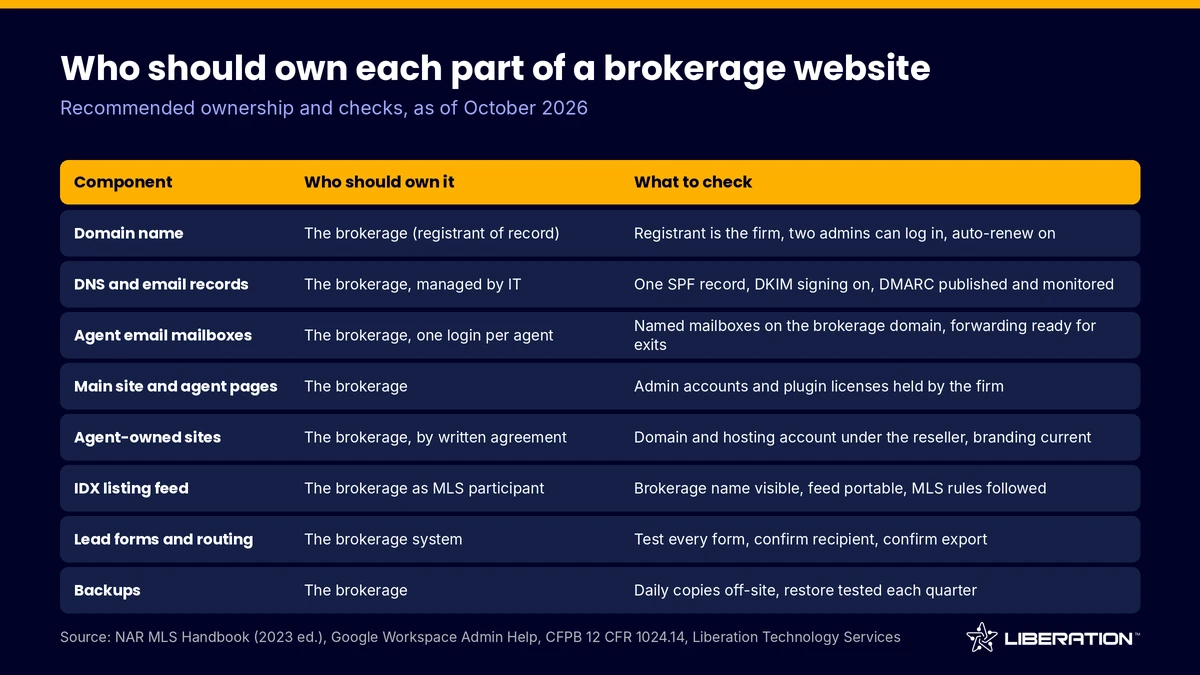
Print the table above and mark each row as owned by the brokerage or not. If you want a second pair of hands, talk to us about web development for a real estate website for brokerages, or move your existing site with our free WordPress migration. For the rest of the office, see managed IT services for small business.
Frequently asked questions
What should a real estate brokerage website include?
A real estate brokerage website should have, at minimum: a home page, listing search, an agent directory with individual agent pages, areas served, buyer and seller guides, lead forms and a contact page. Add a privacy notice, and show your brokerage name on every listing page.
Who should own a real estate brokerage website and agent sites?
The brokerage should register the domain and hold the hosting account for the main site and every agent site, with agents supplying content under a written agreement. If the agent buys it personally, the brokerage cannot control branding, compliance language or what happens when the agent leaves.
Do agents need email on the brokerage domain?
It is a strong practice. Real estate agent email on the brokerage domain keeps client conversations in an account the brokerage controls, supports SPF, DKIM and DMARC, and makes the offboarding routine simple. Check state licensing rules and brokerage policy on which address agents must use.
Can a real estate brokerage website show MLS listings?
Yes, through IDX, if the MLS allows it and the brokerage meets the MLS rules. NAR’s model policy expects the display to be under the participant’s control and to clearly identify the brokerage. Your MLS sets the actual terms, so confirm them first.
What happens to leads when an agent leaves?
If forms post to a brokerage-controlled system, the lead history stays. If leads went to the agent’s personal inbox or a vendor account, they leave with the agent. Keep routing in a brokerage-controlled system and export it regularly.
Sources
- FBI Internet Crime Complaint Center, 2025 IC3 Annual Report
- NAR, Handbook on Multiple Listing Policy, Internet Data Exchange (IDX) Policy (Policy Statement 7.58)
- CFPB, 12 CFR 1024.14, Prohibition against kickbacks and unearned fees
- Google Workspace Admin Help, Email sender guidelines
- cPanel & WHM documentation, Guide to Reseller Accounts
- cPanel & WHM documentation, Forwarders
Related reading: managed IT services for small business, law firm IT support and accounting firm IT support.