
A free and open internet is one where anyone can publish, connect and build without asking a gatekeeper for permission, and where the same rules apply to everyone. It rests on four things: open standards that no company owns, access that is not blocked or throttled based on who you are, freedom to speak and publish, and privacy for your data. It matters because it lets a small church, a local nonprofit or a two-person startup reach the same audience as a Fortune 500 company. It is also under pressure: Freedom House found that global internet freedom declined for the 15th consecutive year in 2025.
The encouraging part is that you do not have to wait for lawmakers or technology giants to fix it. Every organization controls a piece of the open internet — its domain, its email, its website, its lists and its data — and how you set those up decides how free you are to keep speaking.
Key takeaways
- A free and open internet rests on five traits: open standards, neutral access, freedom of expression, privacy and portability.
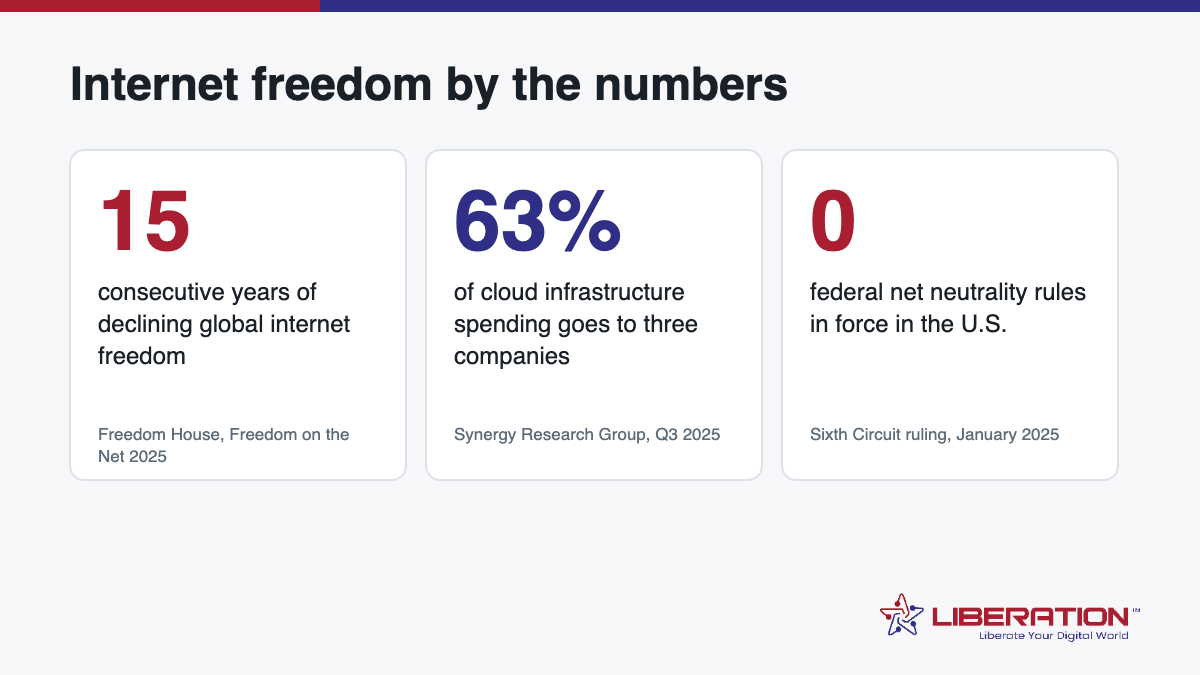
- Global internet freedom has declined for 15 straight years, and the U.S. score fell three points in 2025 (Freedom House, Freedom on the Net 2025).
- Three companies now hold 63 percent of cloud infrastructure spending, so a few policy decisions affect almost everyone (Synergy Research Group, Q3 2025).
- There is no federal net neutrality rule in the United States after the Sixth Circuit’s January 2025 decision.
- You control your own piece of it: your domain, your email, your website, your list and your backups. Seven steps to secure them are below.
What makes a free and open internet free and open?
Open standards. The internet runs on shared protocols that no single company owns: TCP/IP to move data, DNS to find websites, HTTP to load them and SMTP to deliver email. That is why a message sent from one provider arrives in an inbox hosted by another, and why a website built on one host can move to a different one.
Neutral access. Your connection should reach any lawful website or service without your provider blocking it, slowing it down or charging extra because of whose content it is.
Freedom of expression. People and organizations can publish their ideas, including unpopular ones, and others are free to read them.
Privacy. Your communications and files belong to you, not to whoever happens to store them.
Portability. This one gets overlooked. An open internet is one you can leave. If a provider’s terms, prices or values change, you can take your address, your files and your audience somewhere else.
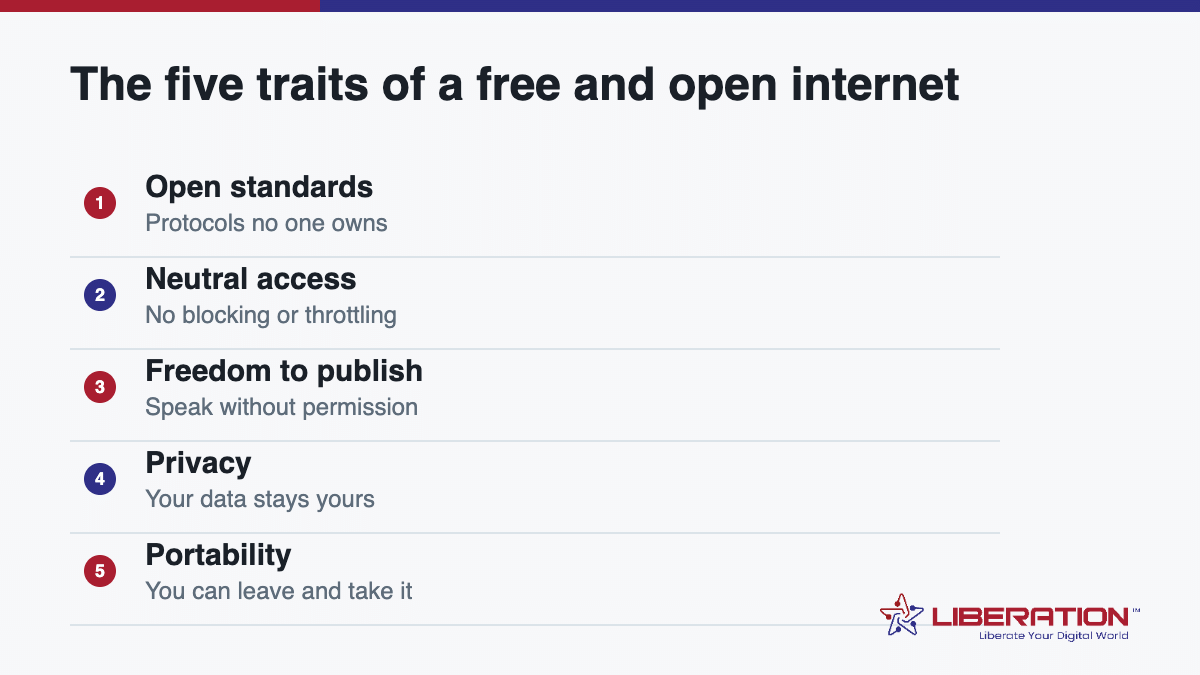
The five traits at a glance
| Trait | What it means | What breaks it | What you can do |
|---|---|---|---|
| Open standards | The backbone of a free and open internet: shared protocols no company owns (TCP/IP, DNS, HTTP, SMTP) | Proprietary formats and closed apps that only talk to themselves | Choose services that speak IMAP, SMTP and CalDAV |
| Neutral access | Your connection reaches any lawful site at the same speed | Blocking, throttling or paid prioritization | Know your state’s rules and pick ISPs that publish their policy |
| Freedom of expression | You can publish, and others can choose to read | Account suspensions and opaque appeals | Publish on a site you own, then syndicate to platforms |
| Privacy | Your mail and files are not mined for other purposes | Ad profiling, scanning and AI training on customer data | Read the terms; prefer providers that say plainly what they do not do |
| Portability | You can leave and take everything with you | Vendor lock-in and export tools that lose data | Test a full export once a year |
Why a free and open internet matters
Small organizations compete on equal footing
A ministry’s website loads as quickly as a megachurch’s. A local business can rank beside a national chain. Open access is what keeps the playing field level.
Ideas travel without permission
On a free and open internet, sermons, research, local news, product reviews and political speech reach people directly, with no central authority deciding what deserves to be published.
Innovation does not need approval
Because the underlying protocols are open, anyone can build a new tool on top of them without permission from the owners of existing platforms. Much of what we use daily began as a small project built on those shared standards.
A free and open internet lets communities organize
A free and open internet is civic infrastructure. Churches coordinate volunteers, nonprofits raise funds, campaigns reach voters and parents share information, all on infrastructure that no single company controls.
What is putting it at risk
Censorship and surveillance
Freedom House’s Freedom on the Net 2025 assessed 72 countries covering 89 percent of the world’s internet users. Conditions worsened in 27 of them and improved in only 17. The United States was not exempt: its score fell three points, to 73 out of 100.
Too much infrastructure in too few hands
Amazon, Microsoft and Google together accounted for 63 percent of enterprise spending on cloud infrastructure in the third quarter of 2025, according to Synergy Research Group. When a handful of companies host that much of the internet, their policy decisions become everyone’s rules, and one outage or terms change reaches millions of organizations at once.
Platform dependence
When your email, files, audience and website all live inside one platform, your access depends on that platform’s terms. A suspension, a policy change or a failed appeal can cut an organization off from its own members overnight. The real risk is not only deliberate removal. It is having no exit plan.
Rules that keep shifting
In January 2025 the U.S. Court of Appeals for the Sixth Circuit struck down the FCC’s 2024 net neutrality order. There is now no federal net neutrality rule, while several states keep their own. The debate over Section 230, the law that shapes how online services host and moderate content, continues as well. When the rules keep moving, the safest position is not to depend on any one platform’s goodwill.
Your data as raw material
One of the quieter pressures on a free and open internet is commercial. Organizations are discovering that the documents, messages and contact lists they store online may be analyzed for advertising or used to train artificial intelligence models, depending on the service’s terms. Read those terms before you trust a service with your members’ information.
What a free and open internet is not
Three misunderstandings about a free and open internet come up whenever the subject does, and clearing them up makes the rest easier.
It is not “free” as in no cost
A free and open internet is not free of cost. Servers, bandwidth, domains and people all cost money. Free is about freedom to participate: to publish, to connect and to compete without permission. In practice, the services that cost nothing are usually paid for with your data or your attention, which is the opposite of the openness people have in mind.
It is not the absence of rules
A free and open internet is not lawless. Every website, mailbox and forum sets its own rules, and a provider that refuses to act on fraud or abuse is not defending openness. What matters is that the rules are published, applied consistently, and that you can take your work elsewhere when you disagree with them.
A free and open internet is not only a policy problem
Regulation matters, but most of what decides your position on a free and open internet is practical and within your control: who holds your domain, where your email lives, whether your list is exportable and whether your backups exist anywhere but inside one vendor.
Open internet or walled garden: what actually changes for you
| Question | Inside a walled garden | On an open internet footing |
|---|---|---|
| Who owns your address? | The platform; it ends when your account does | You do, on a domain you registered |
| Who owns the audience? | The platform decides who sees you | Your list reaches everyone on it |
| What happens after a policy change? | You adapt or lose reach | You move providers and keep your address |
| How do you get your data out? | Whatever export the vendor offers | Standard formats and your own backups |
| Who do you appeal to? | A form, and often no reply | A provider with a phone number |
How to protect your part of the open internet
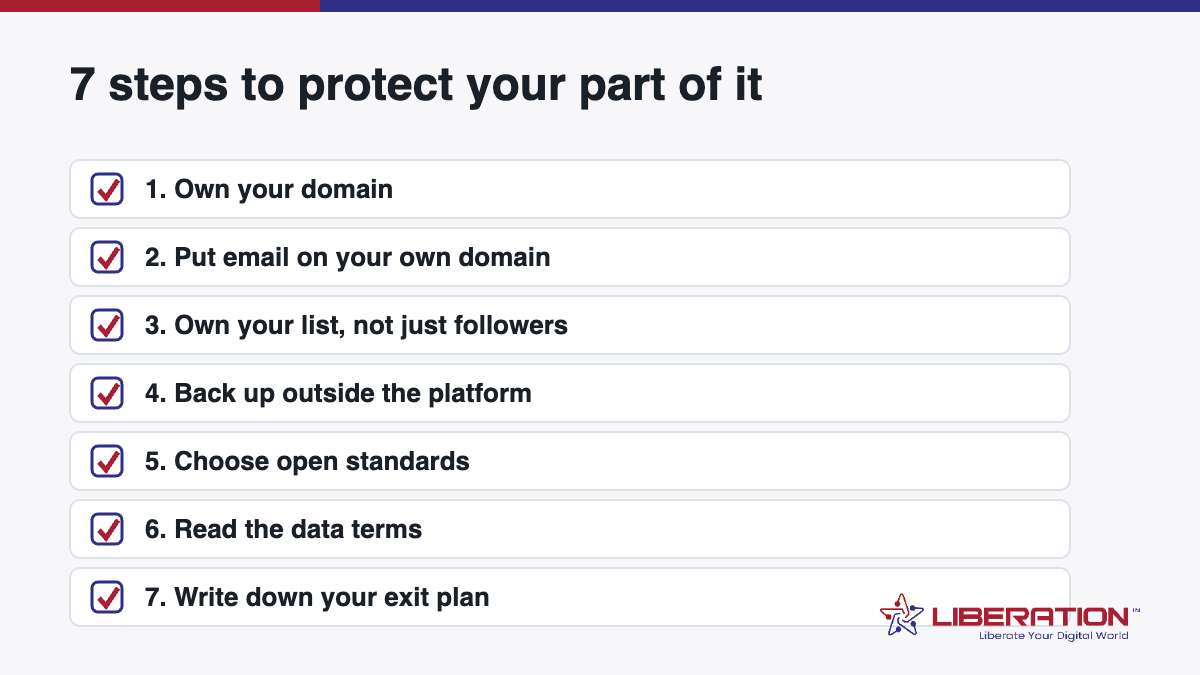
You cannot fix global policy on your own. You can make sure your organization stays reachable and in control. Here is a practical checklist.
- Own your domain. Register it in your organization’s name, not an employee’s or a web designer’s. Keep the registrar login under organizational control and turn on registrar lock.
- Put your email on your own domain. An address like [email protected] travels with you. A free address tied to a platform does not.
- Own your audience. Social media followers belong to the platform. An email list you can export belongs to you, so build it and back it up.
- Keep copies of everything. Back up your website, files and contact lists somewhere other than the service that hosts them, and test that you can actually restore them.
- Choose standards over lock-in. Favor services built on open standards — IMAP and SMTP for email, CalDAV for calendars, WordPress for websites — so that switching providers is a migration rather than a rebuild.
- Read the terms that matter. Before signing up, find out where your data is stored, whether it is sold, shared or used to train AI, what the content policy says, and how you export everything if you leave.
- Write down your exit plan. Know what it would take to move your email, website and files within a week. If the answer is that you could not, fix that first.
A 30-minute audit of your own setup
These eight questions measure how much of a free and open internet you actually control. Answer them honestly. Any “I don’t know” is the next thing to fix, and none of them requires a technical background.
- Who is listed as the registrant of your domain? If it is a former employee or an agency, move it into your organization’s name.
- Who can log in to the registrar? Two people in your organization should be able to, and no one else.
- Is your email on your own domain? If staff are using personal or free addresses for official business, that mail is not yours.
- Can you export your contact list today? Try it. An export you have never tested is a plan you do not have.
- Where are your website backups? They should exist somewhere other than the host that would be down when you need them.
- What do your providers’ terms say about your data? Look for selling, sharing, ad profiling and AI training.
- Could you move your email in a week? Standard protocols make this a migration; proprietary systems make it a rebuild.
- Who else depends on this? Members, donors, clients and volunteers all lose contact with you if the answer to any of the above is bad.
What this looks like for churches, nonprofits and small businesses
The stakes of a free and open internet are not the same for everyone, and a free and open internet matters most to organizations that cannot absorb losing their audience.
Churches and ministries depend on reaching members directly with service times, giving links and prayer requests. When that runs through a single platform’s feed, reach is rented. Email on the church’s own domain, a site the church owns and an exportable list keep that connection under the church’s control.
Nonprofits hold donor data that carries real obligations. Portability and clear terms about data use are not abstractions here; they are part of the duty of care that comes with a donor list.
Small businesses live on being findable and reachable. A business whose only contact point is a social profile has handed its front door to someone else. Owning the domain, the email and the website is the cheapest insurance in the business.
How AI answers change the picture
A free and open internet is also what makes AI answers possible. Search results increasingly summarize instead of linking, and assistants answer directly from the open web. That makes two things true at once. First, content published on your own site can be read, cited and summarized by anyone, including answer engines; content locked inside a closed platform usually cannot. Second, if your organization’s real information lives only on a platform, the answers people get about you will be assembled from whatever is public elsewhere, which may be out of date or wrong.
The practical response is the same as the rest of this guide to a free and open internet. Publish what matters on a site you own, keep it accurate and well structured, and let the platforms be a distribution channel rather than the archive of record.
How LiberationTek supports a free and open internet
We built LiberationTek so that organizations could keep their tools without giving up control. We run our own servers in the United States. Customer data is never sold, shared or used to train AI. Our services use the open standards described above, so your email works in the apps you already use and your data comes with you if you ever leave.
- Liberation Email — business email on your own domain, from $1.95 per user per month.
- Hub for Teams — email, file sharing, calendars and chat in one place, a private alternative to Big Tech office suites.
- Web hosting and managed VPS on U.S. servers, with free migration from your current host.
Churches and nonprofits receive 15 percent off. Support is available Monday through Friday, 8am to 8pm ET. If this is new ground for you, start with what digital liberation means and then work through the checklist above.
Last reviewed: September 2026.
Sources on the state of a free and open internet
- Freedom House, Freedom on the Net 2025: An Uncertain Future for the Global Internet — report summary
- Synergy Research Group, cloud market share, Q3 2025 — market share trends
- Congressional Research Service, Sixth Circuit Strikes Down Net Neutrality Rules — LSB11264
- 47 U.S.C. § 230 — Cornell Legal Information Institute
- IETF RFC 5321, Simple Mail Transfer Protocol — datatracker.ietf.org
Frequently asked questions
What is a free and open internet?
It is an internet where anyone can publish, connect and build without a gatekeeper’s permission, built on open standards, neutral access, freedom of expression, privacy, and the ability to move your data and audience elsewhere.
Is net neutrality the law in the United States?
Net neutrality is one piece of a free and open internet, and it is currently unsettled. At the federal level there is no rule: the Sixth Circuit struck down the FCC’s 2024 net neutrality order in January 2025, so no federal rule is currently in force. Several states have their own net neutrality laws.
Does a free and open internet mean there are no content rules?
No. Individual websites and services set their own rules. Openness means you are free to build your own space, choose providers whose rules you accept, and move when those rules change.
What is the easiest first step toward owning our part of the internet?
Move your email to your own domain. It makes your address permanent, portable and independent of any single provider.
Is a free and open internet the same as free internet access?
No. “Free” here means free to participate: anyone can publish, connect and compete without permission. Access itself is paid for by someone, and services that cost nothing are usually paid for with your data or your attention.
Who is responsible for keeping the internet open?
Three groups share it. Standards bodies keep the protocols open, regulators and courts set the access rules, and organizations decide day to day whether they own their domain, email, audience and backups or rent them from a platform. Only the third group is fully within your control.
Can a small organization really reduce its dependence on Big Tech?
Yes, and doing so is the most practical way to support a free and open internet. The core tools most organizations rely on — email, file sharing, calendars, websites and email newsletters — are all available from independent providers that use open standards.
Related reading
- How Much Do SEO Services Cost?
- Small Business Marketing — The wider marketing picture for a small team.
- Business Email Setup — The channel you own, on your own domain.