Ditch Microsoft & Google Today!

The Wire Instructions Email Looked Exactly Right

Law firm IT, encrypted email, secure client document exchange and trust-aware payments for solo and small firms

IT your team can rely on

Support, security and collaboration tools in one place.
law firm it support team workspace dashboard
Hub for Teams
Help deskRemote supportSecurity

Law Firm IT Support: The Short Answer

A law firm holds exactly what an attacker wants in one place: settlement amounts, closing dates, wire instructions, financial disclosures, and everything else covered by the duty of confidentiality. Most of it lives in a mailbox, and most firms have never been told what the rules actually require of that mailbox.

ABA Formal Opinion 477R sets the standard: a lawyer must make “reasonable efforts to prevent the inadvertent or unauthorized disclosure of, or unauthorized access to, information relating to the representation of a client.” It deliberately does not mandate encryption on everything. It asks you to weigh the sensitivity of the information, the likelihood of disclosure, the cost and difficulty of safeguards, and whether those safeguards get in the way of serving the client. We build the stack that lets you answer that question honestly. This is not legal advice — your state bar’s rules govern, and they vary.

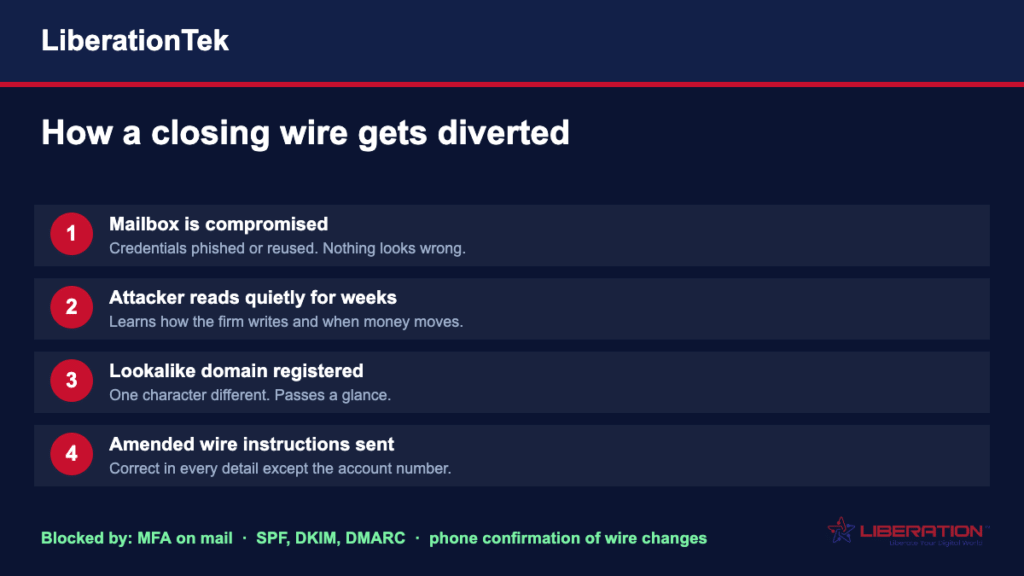
Law firm IT support diagram: how a closing wire gets diverted through mailbox compromise, a lookalike domain and amended wire instructions
Law firm IT support: how a closing wire gets diverted, and what blocks it

Confidentiality, In Practice

Reasonable efforts, not perfection

477R rejected a fixed checklist on purpose. What it asks is that you can show you thought about it: what you hold, who could reach it, what it would cost to protect, and what you decided. A firm that has made no decision has not made reasonable efforts.

When encryption stops being optional

The opinion names the situations that raise the bar: a client agreement or a statute requiring it, information sensitive enough to warrant it, matters touching healthcare, defense, trade secrets or a transaction in progress, and any circumstance suggesting elevated risk of intrusion. Most firms have at least one matter in that category open right now.

Email you actually control

Liberation Email includes end-to-end encryption on every plan, AES-256 at rest, malware scanning and your own domain, hosted in the United States on servers we own. It works with Outlook and Apple Mail over standard IMAP, so nobody has to change how they work.

The practical test is not whether you own security software. It is whether you could explain your arrangements to a disciplinary board without discovering something you did not know.

What A Compromised Mailbox Actually Costs

Not the IT bill. The wire that left, the client whose funds are gone, the malpractice notification, and the bar complaint that follows. A single diverted closing is larger than a decade of doing this properly, and it is the scenario every one of the controls above exists to prevent.

Firm Email, Documents And The Office

Seats that track your headcount

Partners, associates, paralegals, the legal assistant and the bookkeeper. Liberation Email from $1.95 per user a month; Mail Pro at $7.95 per user a month for larger mailboxes and longer retention. Add or remove a seat when someone joins or leaves, without renegotiating a contract.

Intake, matter and role addresses

intake@, billing@ and practice-specific addresses that route to the right person rather than into one inbox that swallows everything. When a paralegal leaves, the address stays with the firm and the handover is a permission change rather than a password someone remembers.

Retention, backups and the file you need in year seven

Client files outlive matters by years, and most states set a minimum retention period. CodeGuard takes encrypted off-site backups from $2.09 a month with per-file version history; the data center is backed up daily with seven days of retention. We will also test a restore with you, which almost nobody does until the day it matters.

Your Website And Client Intake

Advertising rules for lawyers vary by state and some require specific disclaimers or record retention on firm advertising. We build the site; confirm the wording with your bar.

What It Costs

Published per-seat pricing, so you can work out the monthly number before you call us. Website work and IT support are quoted per firm because a two-person practice and a twelve-person firm are not the same job.

On card payments and your trust account. If you take retainers by card, the rule that catches firms out is that processing fees must not be netted out of a trust deposit. Under ABA Model Rule 1.15 the full retainer belongs in trust and the fee comes out of your operating account separately — a processor that deposits $4,850 of a $5,000 retainer has just used client money to pay a firm expense. Chargebacks should draw on operating rather than trust, and your statements need to support three-way reconciliation. Tell us how your trust and operating accounts are set up and we will tell you plainly whether we can support it or whether you need a specialist legal processor. We would rather say no than have you find out at an audit.

Law Firm IT Support FAQs

Not always, and anyone telling you otherwise is oversimplifying. ABA Formal Opinion 477R requires “reasonable efforts” rather than a fixed standard, and it lists the factors that decide how far you go: the sensitivity of the information, the likelihood of disclosure without safeguards, the cost and difficulty of the safeguard, and whether it would get in the way of serving the client. It also names the situations where stronger protection becomes appropriate — a client agreement or law requiring it, highly sensitive matters, industries like healthcare, defense and trade secrets, and any sign of elevated intrusion risk. Liberation Email includes end-to-end encryption on every plan, so the question becomes when to use it rather than whether you have it. Your state bar’s rules govern; this is not legal advice.

Business email compromise around closings and settlement disbursements. The pattern is consistent: an attacker gets into a mailbox, reads quietly for weeks to learn how your firm writes and when money moves, then sends amended wire instructions from a lookalike domain on the morning funds are due. It works because the email is correct in every detail except the account number. The defences are unglamorous — multi-factor authentication on mail, SPF, DKIM and DMARC on your domain, and a rule that wire instructions are confirmed by phone to a number you already had.

Yes, and it is usually the highest-value change available. Hub for Teams gives clients a place to submit and retrieve documents at $7.49 per user a month, so financial disclosures and settlement statements stop living as attachments in a mailbox for years after a matter closes. Access is visible and revocable, which matters when a matter ends or a paralegal leaves.

That is set by your state bar rather than by us, and the periods vary considerably. What we can do is make sure the files survive that long and are retrievable: CodeGuard takes encrypted off-site backups with per-file version history from $2.09 a month, and the data center is backed up daily with seven days of retention. We will also run a test restore with you, because an untested backup is a hypothesis rather than a retention policy.

You can, but the processing arrangement has to be right and this is where firms get into trouble. Processing fees must not be netted out of the trust deposit — the full retainer belongs in trust and the fee is debited separately from your operating account. A processor that deposits $4,850 of a $5,000 retainer has used client funds to pay a firm expense, which is commingling under ABA Model Rule 1.15. Chargebacks should also draw on operating rather than trust. Tell us how your accounts are structured and we will tell you honestly whether we can support it or whether a specialist legal processor is the right answer.

No. We are not replacing Clio, MyCase, PracticePanther or whatever you run — your matters, billing and calendaring stay where they are. What we host and secure is the email, the client document exchange, the firm website, the domain and the backups underneath all of it. Those are the pieces most firms have never consolidated and most often have wrong.

The per-seat products are published: Liberation Email from $1.95 a user a month, Mail Pro at $7.95, Hub for Teams at $7.49, CodeGuard from $2.09. A two-person practice that wants encrypted email, document exchange and backups is a small monthly number you can calculate from this page. Website work, network and endpoint support are quoted per firm, because the honest answer depends on how many people, how many locations and what is already in place.

Start With The Wire Confirmation Rule

Law firm IT support, in the order that actually matters

Most law firm IT support pitches lead with the expensive thing. The honest order is the opposite.

The three controls that would prevent the majority of losses at a small firm cost nothing. They are just nobody’s job.
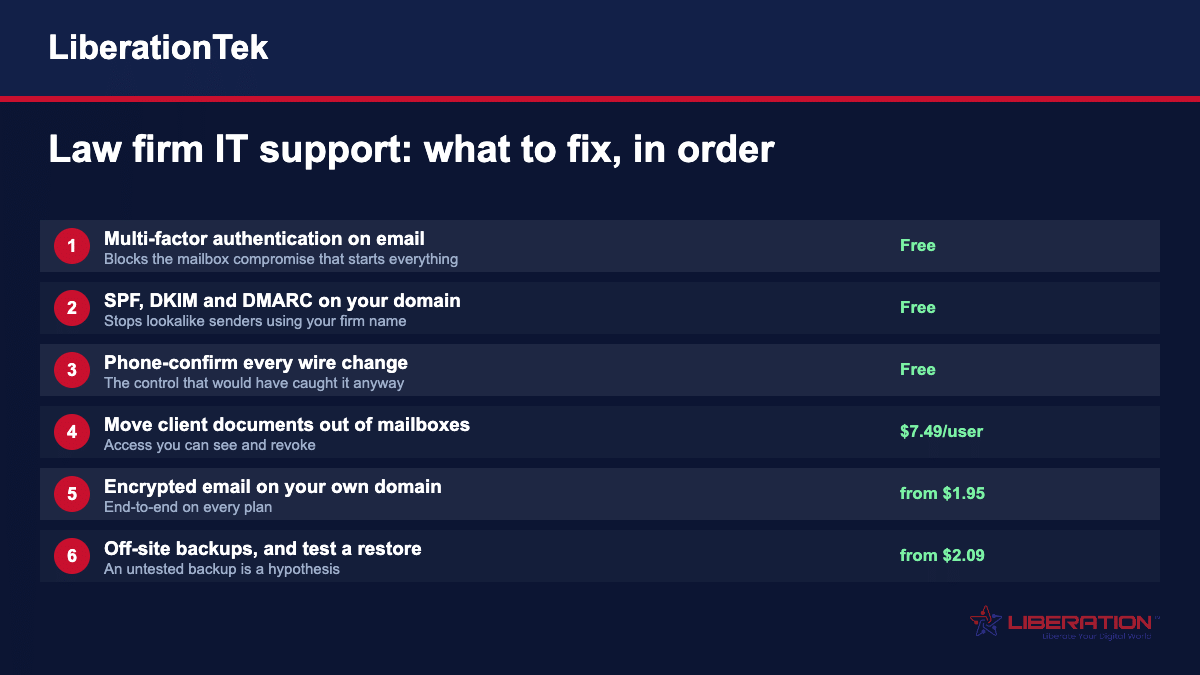
Law firm IT support priorities in order: multi-factor authentication, SPF DKIM DMARC, phone-confirming wire changes, document exchange, encrypted email, tested backups

Start with the three free ones

Multi-factor authentication on email. Every business email compromise begins with someone getting into a mailbox. MFA ends most of those attempts before they start.

SPF, DKIM and DMARC on your domain. These records tell the world which servers may send mail as your firm. Without them, anyone can.

A rule that wire instruction changes are confirmed by phone. Not to the number in the email. To the number you already had. This one control defeats the entire attack even if everything else failed.

None of these are products. If your current provider has not set them up, that tells you something.

Then move the documents

A mailbox is an archive nobody manages. Financial disclosures, tax returns, medical records and settlement statements arrive as attachments and stay for years after the matter closes.

When a paralegal leaves, all of it leaves in their mail client. When a laptop is stolen, all of it is on the laptop.

Moving client document exchange into a controlled space is the first thing on this list that costs money, and it is the first thing worth paying for.

What the confidentiality duty actually asks

Rule 1.6(c) requires reasonable efforts to prevent unauthorised disclosure of client information. Opinion 477R explains what reasonable means in practice.

It is deliberately not a checklist. It asks you to weigh how sensitive the information is, how likely disclosure would be without a safeguard, what the safeguard costs, how hard it is to deploy, and whether it would get in the way of serving the client.

That framing is good news for a small firm. You are not expected to run a bank’s security programme.

You are expected to have thought about it. A firm that has made no decision has not made reasonable efforts, and that is the finding that is hard to defend.

Where firms get caught on money

Trust accounting is the other place law firm IT support quietly becomes a compliance question.

If you take retainers by card, the processing fee must not come out of the trust deposit. The full retainer belongs in trust; the fee is debited separately from your operating account.

A processor that deposits $4,850 of a $5,000 retainer has used client money to pay a firm expense. Under ABA Model Rule 1.15 that is commingling, and trust violations sit at the serious end of attorney discipline.

Chargebacks should draw on operating rather than trust, and your statements need to support three-way reconciliation.

We will look at how your accounts are structured and tell you plainly whether we can support that setup or whether you need a processor that specialises in legal trust accounting. That is not a sale we are willing to fudge.

What we do not do

We do not replace your practice management system. Clio, MyCase, PracticePanther, Smokeball — your matters, billing and calendaring stay exactly where they are.

We do not give legal advice, and nothing on this page is legal advice. Your state bar’s rules govern, they vary meaningfully between states, and on retention periods and advertising they vary a lot.

We are also not the cheapest option for a firm that only needs mailboxes. If that is genuinely all you need, we will tell you.

What a two-person firm actually spends

Encrypted email for two people, client document exchange, and off-site backups with version history comes to a small monthly figure you can add up from the pricing on this page.

The free controls at the top of this list cost nothing but an afternoon.

Website work, network and endpoint support are quoted per firm, because a two-person practice and a twelve-person firm with a server room are not the same job and pretending otherwise produces a bad number for one of us.

Tell us how client documents and payment instructions move through your firm today. We will show you what to take out of email first, what to authenticate on your domain, and what it costs — and if the honest answer is that you only need two of these things, we will say so.

Help deskRemote accessSecurityBackupsEmailHelp deskRemote accessSecurityBackupsEmailHelp deskRemote accessSecurityBackupsEmailHelp deskRemote accessSecurityBackupsEmail

Custom Solutions

Take your business to the next level with Liberation's full suite of services & solutions.

Custom Management

Don’t like managing? We offer managed services for hosting, ecommerce, web sites, and more.

Custom Websites

We build custom, professional websites for small to large organizations. 

Custom Apps

Our team of expert developers can design custom applications for a wide variety of purposes.

Payment Processing

Cancel-Free payment processing for a variety of industries and custom solutions.

Expert Consulting

Liberation offers consulting on strategy, infrastructure, e-commerce, and more.

Custom Ecommerce

We customize your e-commerce to fit your business needs and goals for maximum profits.

Our Promise Of Digital Independence

Liberating Your Digital World Is Our Passion

LiberationTek global edge network map

Global Edge Network

Liberation’s global edge network provides enhanced performance & security.

Population Reach
90 %
Countries
90 +
Networks
2500 +

Ready For Digital Liberation?