
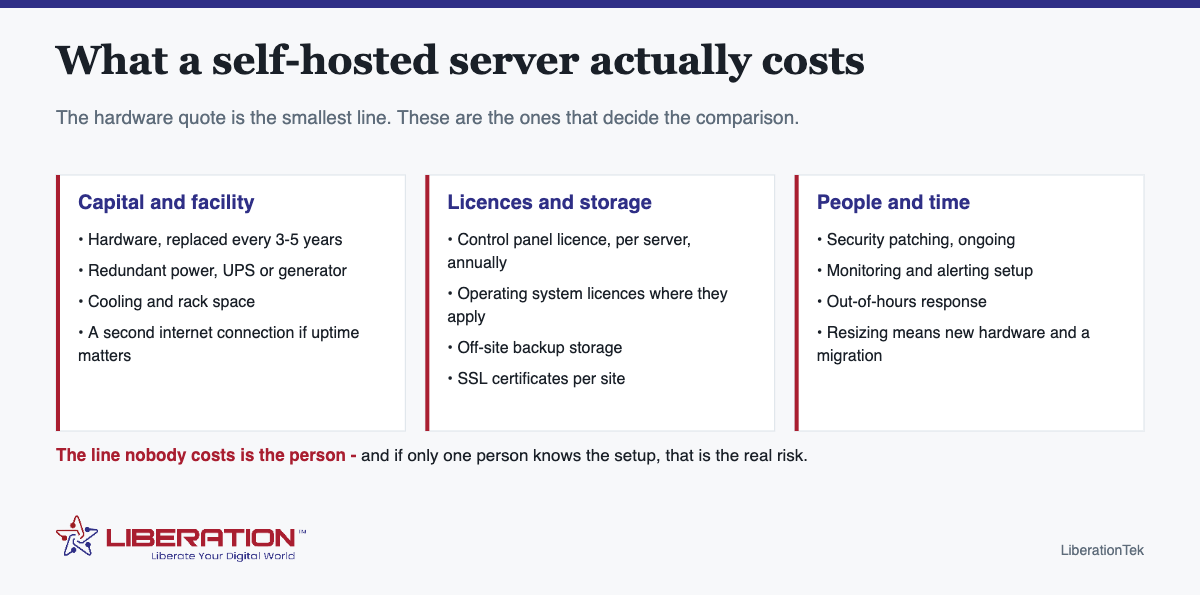
The hardware is the cheapest part of running your own server, which is why self-hosting budgets are usually wrong. The costs that decide it are redundant power, business-grade bandwidth, control panel and OS licenses, off-site backups, monitoring, spare parts, and the salaried hours someone spends patching at 11pm. A hosted private cloud converts all of that into one monthly line – $65.95 here – and the comparison only tips the other way at real scale.
This is the full list of line items, so you can price both sides honestly rather than comparing a server against a subscription and calling it analysis.
What people compare, and what they should compare
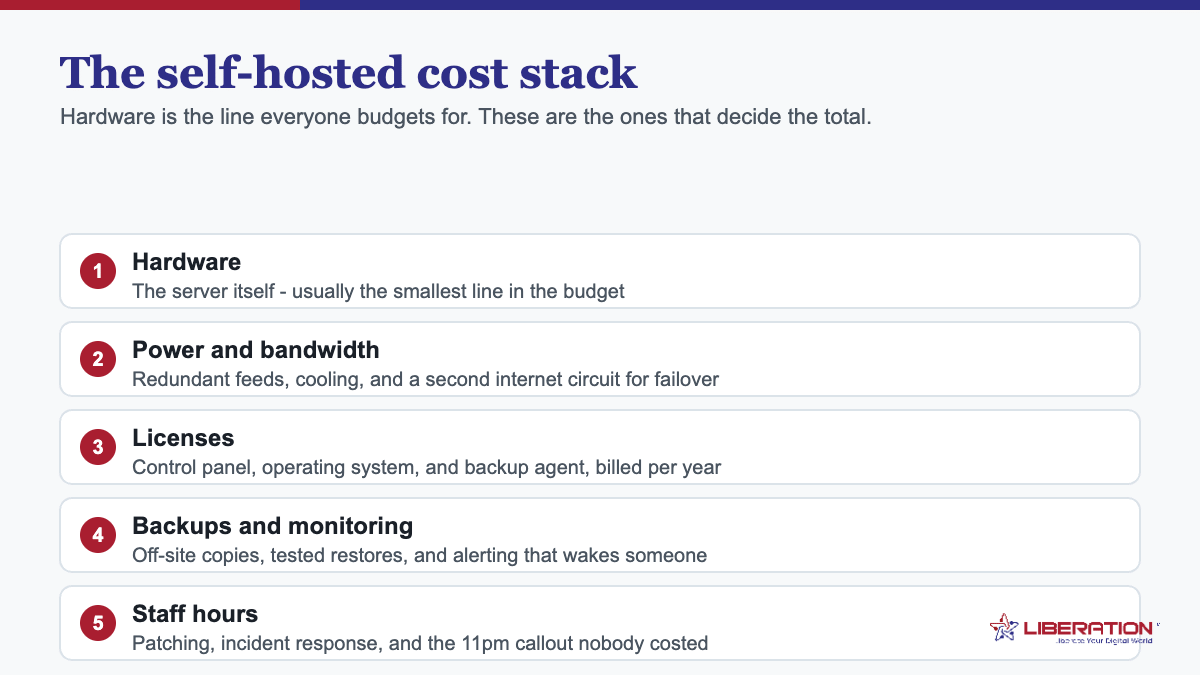
The usual comparison is a server quote against a monthly hosting price. That is not a comparison, because a server on its own does nothing. It needs somewhere to live, a way to reach the internet, software licenses, a backup destination, someone watching it and someone fixing it. Here is the same workload priced properly on both sides.
| Line item | Running your own | Hosted private cloud |
|---|---|---|
| Hardware | Capital up front, replaced every 3-5 years | Included |
| Redundant power and cooling | UPS, generator or an accepted risk | Included |
| Business bandwidth | A second connection if uptime matters | Included |
| Control panel license | Bought per server, renewed annually | cPanel and WHM included |
| SSL certificates | Bought or configured per site | Free SSL included |
| Backups | Storage plus somewhere off-site | Configured on the platform |
| Monitoring and alerting | Set up and maintained by you | Included |
| Security patching | Ongoing staff time | Platform-level; managed services available |
| Spare parts and failure | Your problem, at your speed | High-availability platform |
| Out-of-hours response | Someone’s phone | Support team |
| Resizing | New hardware, migration, downtime | Move up a plan or add resources |
The line nobody costs: the person
Every self-hosting plan quietly assumes an administrator who already exists and has spare hours. In a small business that person is usually the most technical employee, and the hours come out of whatever they were hired to do. Price a few hours a month of that person’s actual salary and the comparison usually resolves itself before you reach the hardware.
The related trap is the bus factor. If exactly one person knows how the server is configured, the real risk is not a disk failing – it is that person leaving, or being on holiday the week something breaks.
When running your own genuinely wins
This is not a one-sided argument, and three cases are real:
- Scale. Past a certain number of servers, owning the hardware and employing the team is cheaper per unit. That threshold is a rack, not a server.
- A specific legal or contractual requirement that the hardware sit in a named building you control.
- Unusual workloads – specialist hardware, enormous local storage, or something that simply is not offered as a service.
If none of those apply, the honest answer is that self-hosting is usually a preference rather than an economy, and preferences are allowed – they just should not be mistaken for savings.
The middle option people forget
The choice is not only “rent a standard plan” or “buy a server”. Build Your Own lets you choose the operating system, vCPU, RAM and storage from $16.00 a month, which covers most of the reasons people think they need their own hardware – an unusual OS, a specific memory-to-core ratio, a workload that does not fit a standard tier – without any of the capital or the pager.
What you are actually buying with a hosted private cloud
On Dedicated Cloud, the resources are yours: dedicated Intel cores, RAM and NVMe storage on a high-availability platform, with cPanel and WHM licenses, free SSL and multi-tiered security included. The servers are owned and operated by us in the United States, and nothing in your cloud account is tracked or shared.
Plans start at $65.95 a month. Note that the 30-day money-back guarantee applies to first-time Shared, Reseller and VPS accounts and not to Dedicated Cloud, which is a good reason to size it in a conversation rather than a checkout.
See Dedicated Cloud plans, or book a call and we will work through the line items above against your actual numbers.
Where the hosted private cloud crossover actually sits
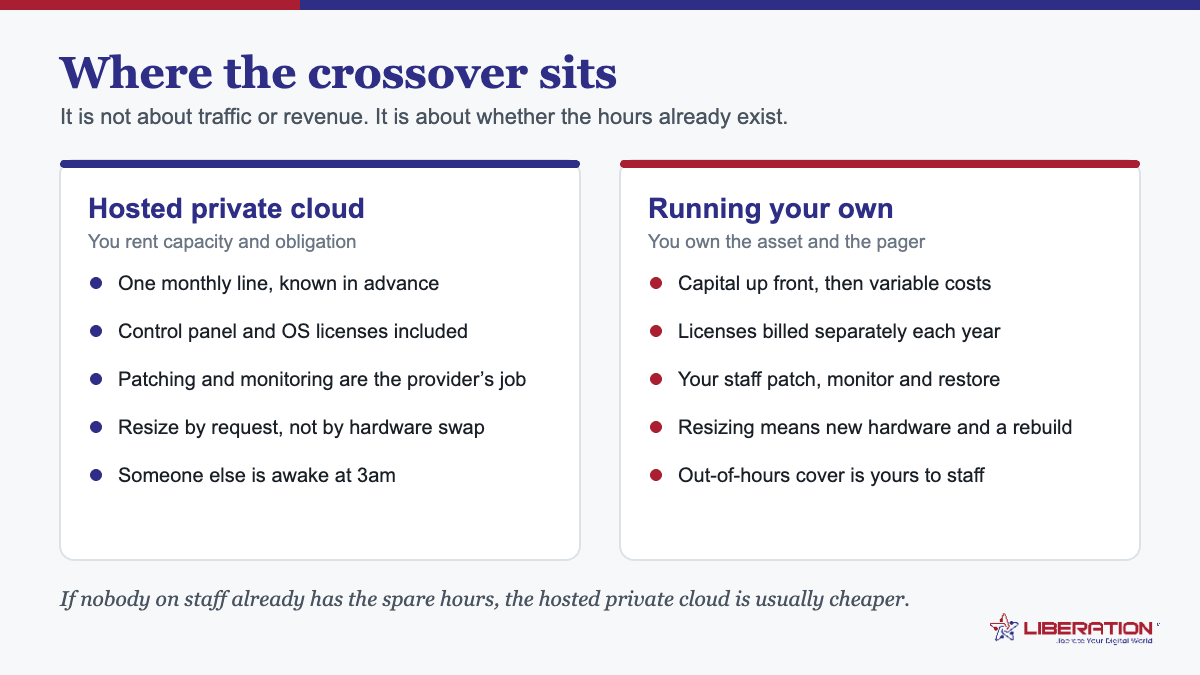
People ask for a number, so here is the honest shape of one. The crossover is not about traffic or revenue – it is about how many servers you need and whether you already employ someone to run them.
- One to three servers, no dedicated sysadmin. Hosted wins clearly. Every line in the table above has to be bought or improvised, and the improvised ones are the expensive ones.
- Several servers, someone technical on staff. It gets closer. The licenses and facility costs still apply, but the labor is already paid for.
- A rack or more, with an operations function. Owning starts to win on unit cost, because the fixed costs spread and the team is a real team rather than one person’s evenings.
The mistake is comparing at the wrong scale: pricing a single server as though it carried a rack’s economics, and quietly assuming the labor is free.
What you are actually buying when you rent
It is worth naming the thing that does not appear on either side of a spreadsheet: somebody else’s obligation. When a disk fails at 3am on a hosted platform, it is somebody’s job to deal with it, and that job exists whether or not you are awake. When it fails on a server you own, the obligation is yours, and it competes with everything else you were going to do that day.
That is most of what the monthly fee buys. The cores and the storage are the visible part.
Three costs people discover late
- Bandwidth overage. Ask what happens when you exceed the allowance – a fee, a throttle, or a conversation. Egress charges on large platforms are the classic version of this, and they arrive as a surprise because the pricing page describes the entry point rather than the exit.
- Licenses at renewal. Control panel and OS licenses renew annually and rarely get cheaper. On Dedicated Cloud, cPanel and WHM are included in every package rather than billed separately, which removes an entire renewal cycle from the budget.
- Migration when you outgrow it. Resizing an owned server means new hardware and a migration, which costs money and a maintenance window. Moving up a hosted plan means adding resources.
How to price a hosted private cloud against your own in an afternoon
- Take the table above and fill in a real number for every row on the self-hosted side. Leave nothing blank – a blank is an assumption that it is free.
- Price the labor at the actual hourly cost of whoever would do it, not at zero and not at a contractor rate you have not agreed.
- Add a replacement cycle: divide the hardware cost by four years to get a monthly figure.
- Compare the total to $65.95 a month for a Dedicated Cloud plan, or $16.00 for Build Your Own if you need a specific configuration rather than more capacity.
- Then decide – and if it still comes out in favor of owning, you now have the numbers to defend that decision, which is worth having either way.
If you would like a second pair of eyes on the comparison, send the numbers over. We would rather lose a sale to an honest spreadsheet than win one that unravels in month six.
A note on comparing against the big clouds
Large public clouds price the entry point attractively and charge for movement – egress, requests, transactions between services. That is a legitimate model, but it makes the monthly total hard to predict for a small business, and it is the single most common reason people arrive asking about a flat-priced alternative. When you build the comparison, price a realistic month of traffic, not a quiet month of capacity.
What a hosted private cloud does not solve
It is worth being straight about the limits, because a hosted private cloud is not a cure for every kind of risk. It moves the hardware, the power and the patching off your plate. It does not move the responsibility for your own data, your own configuration or your own people.
Backups are still yours to verify. A provider snapshot is not a restore test. Whoever owns the application should be restoring a copy somewhere harmless at least twice a year and timing how long it takes. The guidance CISA publishes for small organizations puts tested, offline copies near the top of the list for good reason.
Outages still happen to everyone. Uptime Institute’s annual survey of data center operators has found for several years running that the majority of serious outages trace back to power and to human error rather than to exotic hardware failure – and the Uptime Institute research library is worth a read before anyone promises you five nines. What a hosted private cloud buys is redundancy you would have to build yourself, plus somebody whose job it is to be awake for it.
Bad architecture stays bad. Moving a single fragile server onto managed infrastructure makes it a better-hosted fragile server. If the application has no health checks, no staging environment and no way to roll back a bad deploy, fix that first. It is cheaper than any hosting decision on this page.
Electricity is not free on either side. When you price your own rack, use the real commercial rate for your state rather than a national average – the U.S. Energy Information Administration publishes it monthly, and the spread between states is wide enough to change the answer on its own. A hosted private cloud simply folds that number into the monthly line instead of leaving it on your utility bill.
None of this argues against owning hardware. It argues for costing the whole obligation, on whichever side of the line you land.
Frequently asked questions
Is it cheaper to host your own server or use a hosted private cloud?
The hardware is usually the smallest line in a self-hosted budget. Once redundant power, business-grade bandwidth, control panel licenses, backup storage, monitoring and the staff time to patch and respond are added, a hosted private cloud is normally cheaper for anything under a rack. Self-hosting starts to win at scale, or when a specific requirement forces the hardware in-house.
What is a hosted private cloud?
A hosted private cloud gives you dedicated cores, memory and storage on infrastructure a provider owns, operates and keeps online. You get resources nobody else draws on, without buying, housing or replacing hardware.
What hidden costs does self-hosting have?
The ones most often left out are redundant power and cooling, a second internet connection, control panel and operating system licenses, off-site backup storage, monitoring and alerting, replacement parts, and the salaried hours spent patching and responding out of hours.
Does a hosted private cloud include the control panel?
On Dedicated Cloud plans, cPanel and WHM licenses are included in every package rather than billed separately, along with free SSL and advanced site security.
How quickly can a hosted private cloud be resized?
Plans can be upgraded or given more resources as a site grows, without the hardware swap and rebuild that resizing an owned server involves.
Related reading
- Does a Small Business Actually Need a Private Cloud?
- Private Cloud Security Solutions: What They Cover and Who Owns What
- Private Cloud Hosting: What You Get That Shared and VPS Don’t
- Sovereign Cloud — Infrastructure you can point at on a map.
- Cloud Computing for Small Business — The wider picture, by use case.