
Where is my data stored? Your website and email live on a physical machine, in a building, in a country, owned by a company. Most hosting pages never say which. It is a fair question with a short answer, and the fact that it is so often unanswered is itself informative – a lot of providers resell capacity, so the company you pay and the company actually holding your data are not the same.
Here is why the answer matters, how to find yours, and what to do with it.
Three reasons “where is my data stored” matters
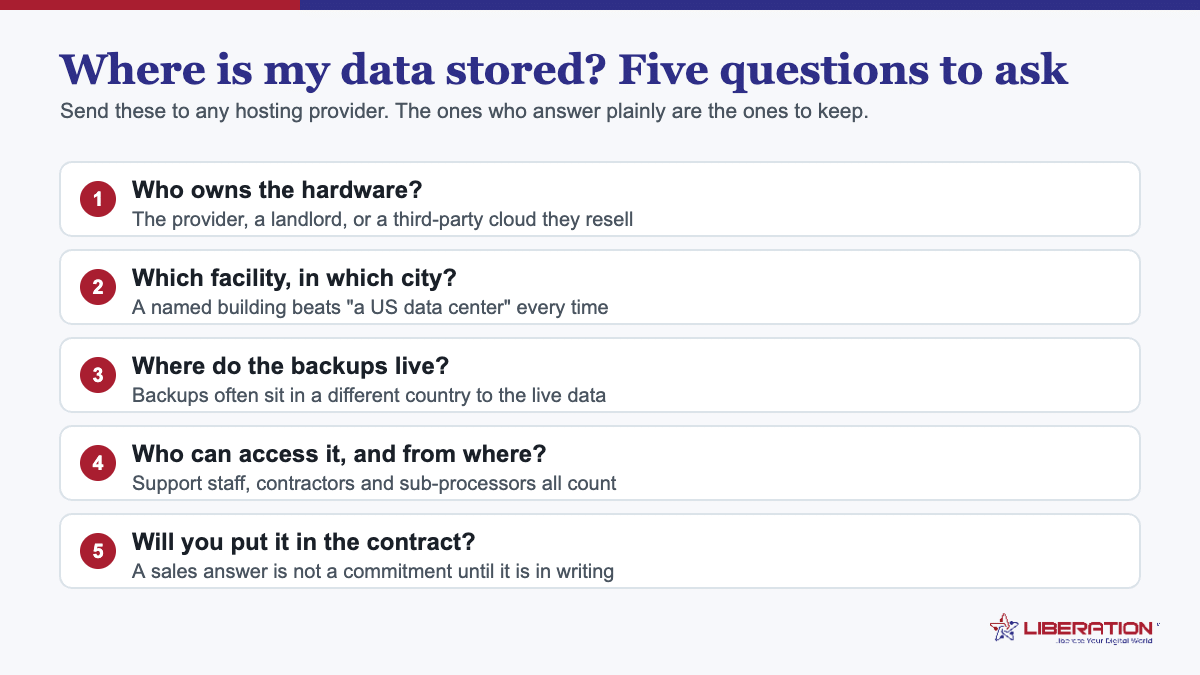
- Jurisdiction. Data is subject to the laws of the place it sits and the company that holds it. For most small businesses this is an abstraction right up until a client’s procurement form asks about it.
- Accountability. If the company you pay does not own the hardware, then the people who can actually reach your data are one contract removed from you – and so is any conversation about access, incidents or removal.
- Latency. Distance costs milliseconds. It matters less than page weight and caching for an ordinary site, and more than either for an interactive application.
Where is my data stored? Find out in two questions
Ask your provider both of these, and treat a vague answer as an answer:
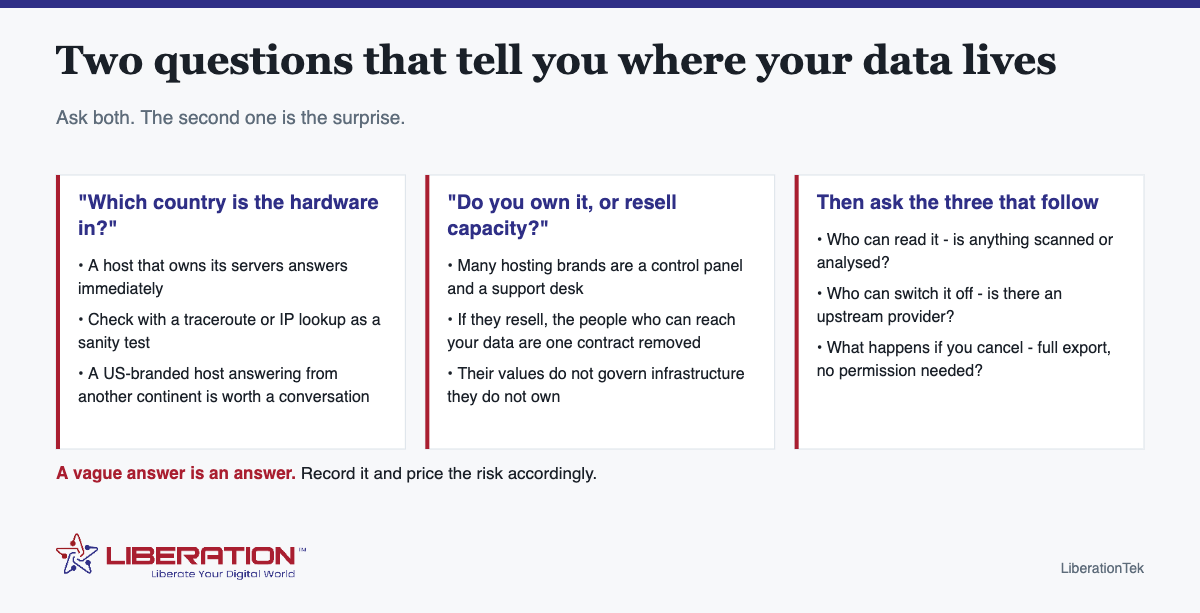
- “Which country is the hardware in?”
- “Does your company own it, or are you reselling capacity?”
The second question is the one that surprises people. A great many hosting brands are a control panel and a support desk in front of somebody else’s infrastructure. That is a legitimate business model, but it changes who is really responsible for your data, and it is worth knowing which kind of provider you are with.
You can also check technically: a traceroute or an IP geolocation lookup will show you roughly where the server answering for your domain sits. It is not authoritative – networks do odd things – but a US-branded host answering from another continent is worth a conversation.
What to do with the answer
| What you find | What it means | What to do |
|---|---|---|
| Provider owns hardware, states the country | Clear accountability | Record it; you will be asked in procurement one day |
| Provider resells, but says so | Honest, one step removed | Find out whose platform, and read that platform’s terms too |
| Provider will not say | Either does not know or would rather not | Treat as a risk you are carrying without a price on it |
| Data spread across regions automatically | Common on large public clouds | Check whether you can pin a region, and whether that costs more |
The question behind “where is my data stored”
People rarely ask where their data lives out of geographic curiosity. They ask because they want to know who can look at it, who can switch it off, and what happens to it if they leave. Those are the three worth asking outright:
- Who can read it? Is anything scanned, analyzed or used to train anything – and is that in the terms, or just in the marketing?
- Who can switch it off? Is there an upstream provider whose decision could take you offline regardless of your relationship with the company you pay?
- What happens if you cancel? Can you export everything, in a format you can use, without asking permission?
Our answer to “where is my data stored”
The servers are owned and operated by LiberationTek in the United States. Not rented capacity on a larger platform, and not a support desk in front of someone else’s cloud. Nothing in your hosting or cloud account is tracked or shared with third parties, and there is no advertising business here that would create a reason to.
That applies across shared hosting from $7.99 a month, VPS, and Dedicated Cloud from $65.95 a month, where the cores, memory and storage are yours rather than pooled.
If you are mid-way through a procurement form and need this in writing, ask us and you will get it in writing.
Why this question is arriving more often
Three things have made data location a live question for businesses that never thought about it before. Procurement forms now routinely ask; cyber insurers ask as part of underwriting; and clients in regulated sectors pass their own obligations down to suppliers. None of these are hypothetical – they arrive as a form with a deadline, usually attached to a contract you want.
The practical consequence is worth planning for: find the answer once, write it down, and keep it where whoever fills in the form can reach it. Businesses lose deals to a slow answer more often than to a wrong one.
What “we use a US data center” does and does not tell you
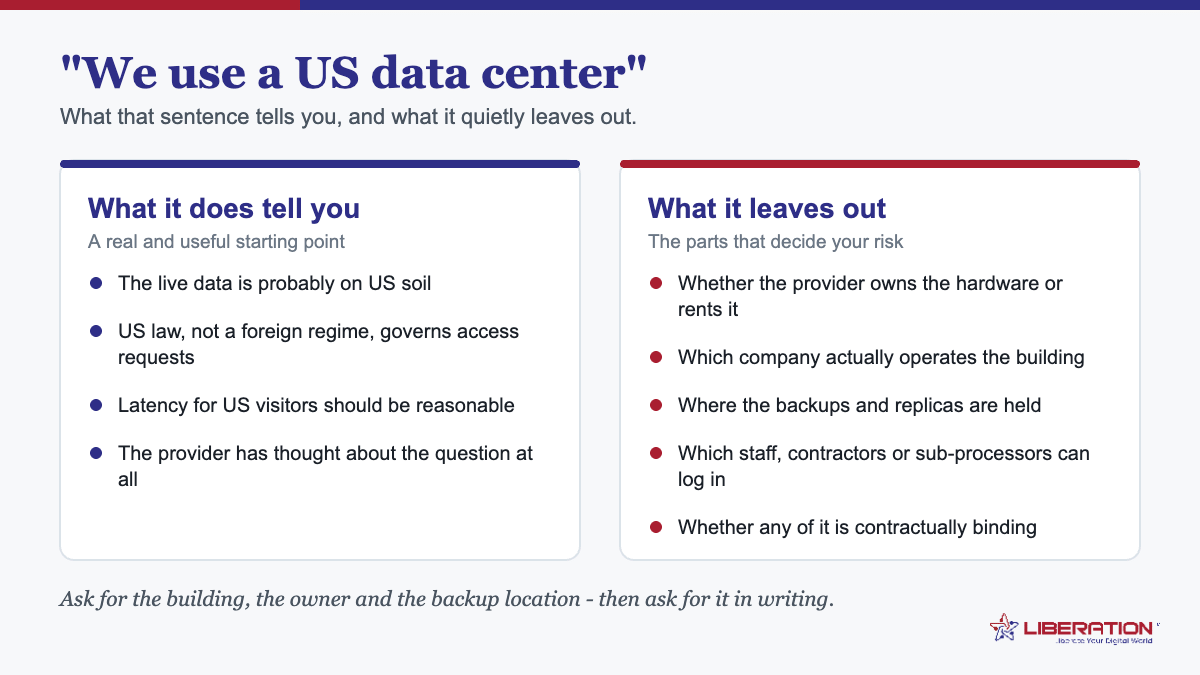
It tells you where a building is. It does not tell you who owns the equipment inside it, who has administrative access, whether backups are replicated somewhere else, or whether a parent company elsewhere has authority over the account. Those are four separate questions and it is reasonable to ask all of them.
Backup replication is the one most often missed. Primary data in one country and backups in another is common, sensible for resilience, and precisely the detail a procurement form is asking about.
Latency: what data location is actually worth for speed
| Type of site | How much location matters |
|---|---|
| Brochure site, blog, church or ministry site | Very little – caching does more than proximity |
| Store with a catalogue | Some – it shows up at checkout more than on product pages |
| Logged-in application or portal | A lot – every interaction pays the round trip |
| Audience concentrated far from the server | A lot – and a CDN fixes static content, not the dynamic part |
For most small business sites, page weight and caching matter more than distance. That changes the moment users are logged in and clicking rather than reading.
Putting “where is my data stored” in writing
When you have it, record four lines somewhere findable: the country the primary data sits in, whether the provider owns the hardware, where backups are held, and what the export path is. That is the whole answer to almost every procurement question on the subject, and assembling it takes one email.
Ours, for the record: servers owned and operated by LiberationTek in the United States, not rented capacity on a larger platform; hosting and cloud data not tracked or shared with third parties; full export available whenever you want it. If you need that on letterhead for a form, ask and you will get it.
Answering a supplier questionnaire without a week of email
Most of these forms ask the same handful of things, and having the answers written down converts a two-week delay into a ten-minute job. Keep a short internal note covering:
- Primary data location – country, and the provider’s legal entity.
- Whether the provider owns the infrastructure or resells it, and if it resells, whose platform sits underneath.
- Backup location and retention – where copies are held and for how long.
- Sub-processors – anyone else who touches the data, such as a backup service or a CDN.
- Export and deletion – what you can take out, and what happens on cancellation.
- Incident notification – who tells you, and within what period.
Six lines. Update it once a year, or whenever you change provider. It is the difference between looking organized to a prospective client and looking like you have never thought about it.
Where is my data stored when the law asks, not just the customer
Plenty of organizations only chase this question once a regulator, an auditor or an insurer asks it for them. It is a better experience to have the answer already filed.
Regulated industries ask in writing. If you handle client financial records, the FTC’s Safeguards Rule expects you to oversee your service providers rather than assume they are fine – the FTC’s plain-language guide is short and worth ten minutes. “Where is my data stored” is one of the first items on most of these checklists, and “I’ll ask our web guy” is not an answer that survives an audit.
Cross-border transfer rules exist even for small firms. If a single client, donor or member is in the EU or the UK, where their records physically sit stops being trivia. The European Data Protection Board’s guide for small businesses lays out what is expected without the legal vocabulary. You do not need a compliance department. You do need to know which country the servers are in.
Insurers are starting to ask too. Cyber liability applications increasingly include a question about data location and sub-processors. Answering it accurately from a document you already maintain is a fifteen-minute job. Reconstructing it under deadline, from a host who will not answer the phone, is not.
So the practical version of “where is my data stored” is really three questions: which country, which company, and can you prove it. Write the answers down once, keep them with your other vendor records, and revisit them whenever you change hosts.
One thing worth checking today
Look up your own domain’s hosting IP and see which organization it resolves to. It takes a minute, and for a surprising number of businesses the name that comes back is not the name on their invoice. That is not necessarily a problem – but it is worth knowing before a client asks you rather than after.
Where is my data stored? A one-page answer you can keep
The point of all this is not to win an argument with a hosting provider. It is to be able to answer one question, quickly, whenever somebody asks. Here is the shape of a document worth keeping – one page, updated when anything changes.
Line one: the live data. Name the provider, the city and the country. “Website and email, LiberationTek, servers owned and operated in the United States” is a complete answer. If you cannot write that line for your current host, that is the finding, not a formatting problem.
Line two: the backups. This is where most one-page answers fall apart. Backups frequently live somewhere other than the production data, sometimes with a different company in a different jurisdiction. Write down where they are, how long they are kept and who can restore from them.
Line three: everything else that holds a copy. Your CRM, your email marketing tool, your accounting software, your file sharing and your form submissions all store customer data somewhere. When people ask “where is my data stored” they rarely mean only the website. List each service and its country.
Line four: who can see it. Support staff, contractors, sub-processors and anyone you have given an admin login. Names are not necessary; roles and companies are.
Line five: what is contractual. Mark which of the lines above are promises in a signed agreement and which are simply what you were told on a call. The difference matters the moment something goes wrong.
That document takes an afternoon to build the first time and about ten minutes a year after that. It answers supplier questionnaires, insurance applications and the occasional nervous client email without a scramble. And it turns “where is my data stored” from a question you dread into one you can answer in a single reply.
If the exercise turns up a host who will not give you a straight answer, you have learned something useful. A provider that owns its own hardware can tell you exactly where your data lives, because there is no chain of resellers between them and the machine. That is the whole reason we answer this question on our own site rather than making people ask.
Frequently asked questions
Where is my website data actually stored?
On a physical server in a data center somewhere. Which country that is, and which company owns the hardware, is decided by your hosting provider and is often not stated on the pricing page. Any provider should be able to tell you the country on request; if they cannot, that is your answer.
Why does it matter which country my data is stored in?
Data is subject to the laws of the country it sits in and the jurisdiction of the company holding it. Location also affects latency, and it is increasingly something enterprise clients, insurers and regulators ask about during procurement.
How can I find out where my host stores my data?
Ask directly, and ask two questions rather than one: where is the hardware, and who owns it. Many providers resell capacity on a larger platform, so the company you pay and the company holding your data are not always the same.
Does LiberationTek own its servers?
Yes. The servers are owned and operated by LiberationTek in the United States rather than rented from a larger cloud platform, and cloud data is not tracked or shared with third parties.
Does data location affect website speed?
Yes, though less than most people assume for ordinary sites. Physical distance adds latency, but page weight, caching and application performance usually matter more. Location matters most for interactive applications and audiences far from the server.
Related reading
- Hosted Private Cloud vs Running Your Own: The Cost Nobody Adds Up
- Does a Small Business Actually Need a Private Cloud?
- Private Cloud Security Solutions: What They Cover and Who Owns What
- Sovereign Cloud — Infrastructure you can point at on a map.
- Cloud Computing for Small Business — The wider picture, by use case.