
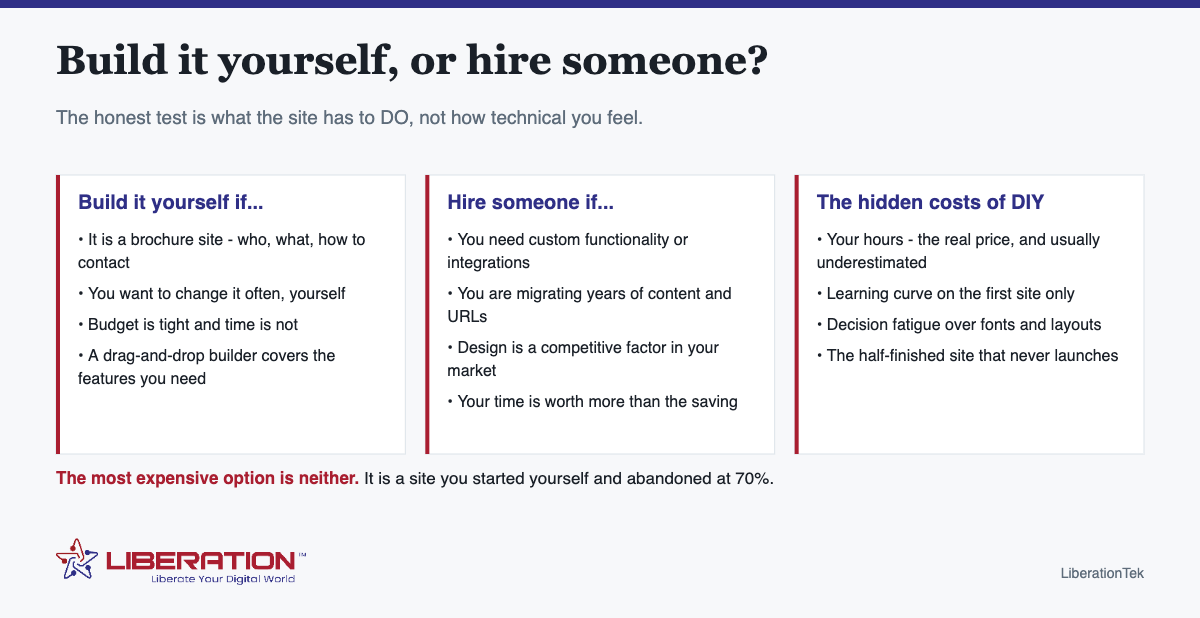
Whether to build a website yourself or hire someone is not a question about how technical you are. It is a question about what the site has to do. A brochure site – who you are, what you do, how to reach you – is a drag-and-drop builder job that you will be able to update yourself afterwards. Custom functionality, integrations, or a migration that must preserve years of URLs is a project worth paying for.
Start with the features, not the feeling
Write down what the site must actually do. Not how it should look – what it does.
| Requirement | Builder | Developer |
|---|---|---|
| Pages describing your business | Yes | Overkill |
| Contact and enquiry forms | Yes | Overkill |
| Blog or news | Yes | Overkill |
| A simple shop | Usually | For anything unusual |
| Bookings with availability rules | Sometimes | Often needed |
| Customer logins or a members area | Rarely | Yes |
| Integration with your CRM or accounts | No | Yes |
| Migrating hundreds of existing pages | No | Yes |
If everything you need sits in the top four rows, hiring someone is buying design and time rather than capability – which is a legitimate purchase, but you should know that is what you are buying.
The real cost of doing it yourself
The subscription is the small part. A builder with hosting and SSL included is $10.99 a month, which is not the number that decides anything.
The real cost is your hours, and they are systematically underestimated because the first site is the slowest you will ever build. Expect a weekend for a simple site if you are decisive, and considerably longer if you are not – most of the time goes on choosing, not building.
Three honest warnings:
- Decision fatigue is the main enemy. Fonts, colors, layouts and photographs are endless. Set a deadline and accept “good” rather than pursuing “right”.
- Content is the bottleneck, not design. Writing the words about your own business is harder than arranging them, and it is where DIY projects stall.
- The abandoned site is the worst outcome. It costs the subscription, the hours, and every enquiry you did not get while there was nothing to send people to.
The real cost of hiring
A project fee, which varies with scope – and two things people forget.
You still have to supply the content. Almost no quote includes writing, and the project will wait on you. If you were going to struggle to write copy for your own site, hiring a developer does not remove that job.
You will need them again. Every change after launch is a booking unless you have a maintenance arrangement or the site was built so you can edit it. Ask specifically: which parts will I be able to change myself?
The middle path most people should take
Launch something simple yourself, learn what visitors actually do, then pay for the parts that turn out to matter.
This works for three reasons. You are online in a weekend rather than in three months. You discover which pages people actually visit, which is rarely what you predicted. And when you do brief a developer, you brief them with evidence instead of guesses – which produces a better result for less money, because the expensive part of any build is deciding what to build.
Whichever you choose: own the foundations
Two things should be in your business’s name, on accounts you control, regardless of who builds the site:
- The domain name. It is the one thing that is genuinely hard to replace, and the one most often registered in a designer’s account “to make things easier”.
- The hosting account. Convenient bundling is fine until the relationship ends.
A good developer will agree to both without discussion. Any hesitation is worth noticing early rather than discovering later.
A quick self-test
- Can you describe what every page needs to say? If not, that is the first job either way.
- Does anything on your list need logins, bookings, payments or an integration? If yes, hire.
- Do you have a free weekend and a decisive streak? If yes, try it yourself first.
- Will you finish? Answer honestly. If not, hire.
- Is design a competitive factor in your market? If yes, pay for design specifically.
Where we fit
Both, and we will tell you which. The Website Builder is $10.99 a month with hosting and SSL included, and includes an AI generator that drafts a first layout so you are editing rather than staring at an empty page. Custom development is a consultation, because the honest quote depends on what the site has to do.
If you are not sure which side of the line you are on, describe what you need it to do and we will say plainly – including when the answer is that you do not need us.
What a builder genuinely cannot do
Deciding whether to build a website yourself or hire someone gets much easier once you know where the ceiling is. Modern website builders are far more capable than their reputation suggests, and most small business sites never approach their limits. The honest boundaries are these:
- Bespoke functionality. A booking system that has to follow your particular rules, a quoting calculator, a members area with unusual permissions. Builders handle standard versions of these well and unusual versions not at all.
- Deep integration with systems you already run. If the website has to write into your existing inventory or scheduling software, that is development work regardless of platform.
- A design nobody else has. Builders produce good-looking sites from templates. If visual distinctiveness is central to how you compete, that is a designer’s job.
- Very large content structures. Hundreds of products with complex filtering and relationships between them will strain a builder well before it strains WordPress.
Everything else, and that is most things, is within reach of a careful owner with a weekend.
What the DIY route really costs you
The subscription is the visible number and the least important one. The real cost is your attention, and it is worth being honest with yourself about it before starting.
| Cost | DIY | Hiring |
|---|---|---|
| Money up front | Subscription only, from $10.99/mo | Project fee |
| Your time | A weekend for a simple site, more if you iterate | A few hours of meetings and review |
| Writing the content | Yours | Usually still yours |
| Decisions | All of them, including ones you did not know existed | Framed for you |
| Changes later | Free and immediate | Billed, and scheduled |
| Risk | It looks amateur and you cannot tell | It is generic and you paid for it |
That last row is the honest framing of the trade. Both routes have a characteristic failure, and neither is rare.
The content problem nobody warns you about
Here is the thing that stalls more websites than any technical obstacle: whichever route you choose, somebody has to write the words. Developers build the structure. They do not know your business, your customers’ objections, or why people choose you over the firm down the road.
A large share of half-finished websites are not stuck on design or development. They are stuck on an About page nobody has written. If you are deciding between building it yourself and hiring out, notice that this particular work lands on you either way, and that it is usually the binding constraint. Writing the content first, before touching a builder or briefing a developer, is the single best thing you can do for the project.
A reasonable sequence for most businesses
- Write the content first. Homepage, services, about, contact. In a document, not on a website.
- Register the domain in your own name. Ten minutes, and it prevents the most common expensive problem in this whole area.
- Build a simple version yourself and put it live. A modest site that exists beats an ambitious one that does not.
- Run it for a few months and note what customers actually ask for.
- Hire against evidence. A brief informed by real use is a far better brief, and the work is cheaper because the thinking is done.
This sequence is available to almost everyone and it removes the risk from both routes. You are never choosing permanently.
When you can build a website yourself with confidence
Plenty of owners can build a website yourself style, with a modern builder, and get a result they are proud of. The question is whether you should. Four things decide it: your time, your skill, your budget and the cost of a mistake.
If you have a few hours a week, enjoy learning tools and run a simple brochure site, building a website yourself is a sensible choice. If the site takes payments, books appointments or holds customer data, the risk goes up and the case for professional help gets stronger. Our website builder is designed for owners who want to build a website yourself without writing code.
- List the pages you need before you open any tool.
- Gather your logo, photos and plain text first, because content slows most projects.
- Check how the site looks on a phone before you publish.
- Set a launch date, or a website yourself project can drag on for months.
How to build a website yourself and still get a professional check
A hybrid plan keeps costs down. You build a website yourself, then pay an expert for a short review before launch. That review can catch broken links, slow pages and missing security settings that are hard to spot when you are close to the project.
Accessibility is a good example of something owners often miss. The W3C introduction to web accessibility explains why readable text, good contrast and labelled images matter. When you build a website yourself, run through those basics before launch. A reviewer can then confirm them quickly.
Be honest about the time involved. Many people who build a website yourself projects underestimate the writing, the photos and the testing. A weekend project can become a month. If your time is worth more than the fee, hiring help is the cheaper choice. If you enjoy the work, a website yourself approach teaches you the tool, which makes later edits easy. Learn more about the paid route in our guide to web development, or contact us to talk through your project.
Whichever way you go, own the foundations. Register the domain in your own name, keep your own logins, and keep a copy of your content. A website yourself project is only a good deal if you can still move it later. Not legal advice, but check any contract you sign for who owns the finished site.
In short, build a website yourself when the site is simple and you have time. Hire help when the site is complex or the stakes are high. Use the hybrid path when you want the best of both. Many owners who start a website yourself plan end up hiring a pro for the finishing touches, and that is a perfectly good outcome.
Questions to ask before you build a website yourself
Before you commit, ask yourself a few direct questions. Do you have a clear goal for the site? Have you seen examples that you like? Can you keep a website yourself project moving when you get busy? If you answer no to most of these, you may be better off hiring help, even for a small site.
It also helps to look at your competitors. Notice which pages they have, how they explain their services and how easy it is to contact them. Then decide whether you can match that quality if you build a website yourself. If you can, go ahead. If not, a professional can close the gap. Either way, a website yourself approach works best when you start with a plan and a realistic schedule.
Finally, set a budget for the first year, including the domain, hosting, any paid builder features and a small reserve for fixes. A website yourself budget should be low, but it should never be zero.
One last tip: write down why you want to build a website yourself. Saving money, learning a skill and keeping control are all good reasons. If your reason is only to avoid a bill, remember that a website yourself project has hidden costs in time. If you still choose to build a website yourself, schedule short work sessions each week, finish one page at a time, and ask a friend to test the result. A tested website yourself launch is a calm launch, and a calm launch is easier to fix when something small goes wrong.
Frequently asked questions
Should I hire a WordPress developer or build my site myself?
Decide by what the site has to do rather than how technical you feel. A brochure site is a drag-and-drop builder job and you will be able to update it yourself afterwards. Custom functionality, integrations, a content migration or design as a competitive factor are reasons to hire.
Can I really build a website myself without coding?
Yes, for the majority of small business sites. Modern drag-and-drop builders require no code, include hosting and SSL, and produce a mobile-friendly result. The limitation is functional rather than visual – when you need something the builder does not offer, effort will not get you there.
How much does it cost to build a website yourself versus hiring someone?
Building it yourself costs the subscription – around $10.99 a month with hosting included – plus your own time, which is the part people underestimate. Hiring costs a project fee that varies with scope.
What is the most expensive outcome?
A site you started yourself and abandoned at seventy per cent. It costs the subscription, the hours already spent, and the business you did not win while there was nothing to send people to.
Can I start with a builder and hire someone later?
Yes, and it is often the sensible order. Launch something simple, learn what visitors actually do, then pay for the parts that turn out to matter – briefing a developer with evidence rather than guesses.
Do I have to write the website content myself?
In almost all cases, yes, whichever route you take. Developers and builders provide the structure; the words about your business, your services and your customers have to come from you unless you separately hire a copywriter. This is the step that stalls most website projects, so writing the content before you start building is worth doing deliberately.
Can a website builder handle an online store?
Yes, for a normal product catalogue with standard shipping and payment. Builders handle the common case well. Where they struggle is unusual pricing rules, deep integration with existing inventory systems, or very large catalogues with complex filtering, and those are the cases that point towards WordPress and a developer.