
Small business AI adoption is rising quickly, with the Census Bureau reporting that 23.8% of US employer businesses used AI in a business function in the period ending September 6, 2026, up from 17.3% in November 2025. Larger firms lead, but businesses with fewer than 50 employees are not far behind. This guide shows the figures by size and sector and what they imply for a small team.
Last reviewed: October 6, 2026. Figures were calculated from Census data files. This is general information.
Key takeaways
- 23.8% of employer businesses used AI in any business function in the latest Census cycle.
- That is up from 17.3% in the November 2025 cycle under the same question wording.
- Firms with 250 or more employees reported 44.0%, against 21.1% to 24.5% for firms with 5 to 49 employees.
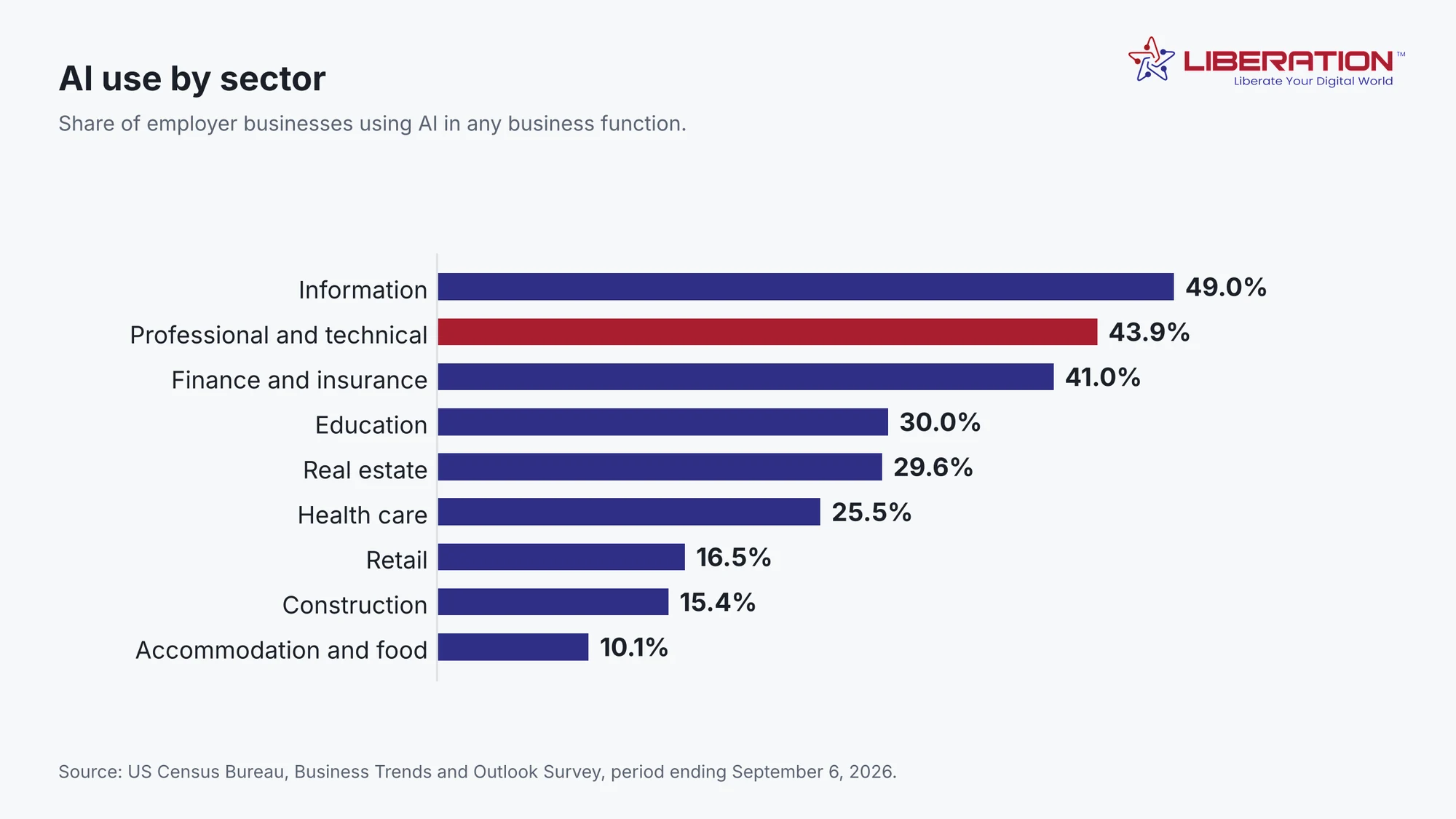
- Information (49.0%) and professional and technical services (43.9%) led among sectors.
- The Census changed its question wording in late 2025, so older and newer figures should not be compared directly.
The trend
The Census Bureau’s Business Trends and Outlook Survey asks businesses every two weeks whether they use AI. Until fall 2025 the question covered AI used in producing goods or services, and the share rose from 3.7% in September 2023 to 10.0% in September 2025. From the November 2025 cycle the question covers any business function, and the share has risen from 17.3% to 23.8%. The latest cycle also found 27.6% of firms expecting to use AI in the next six months.
Adoption by business size
The survey has no small business flag, so Figure 1 uses the smallest employee classes as a proxy. Firms with 1 to 49 employees all sit near 21% to 25%, and the share climbs for larger firms.
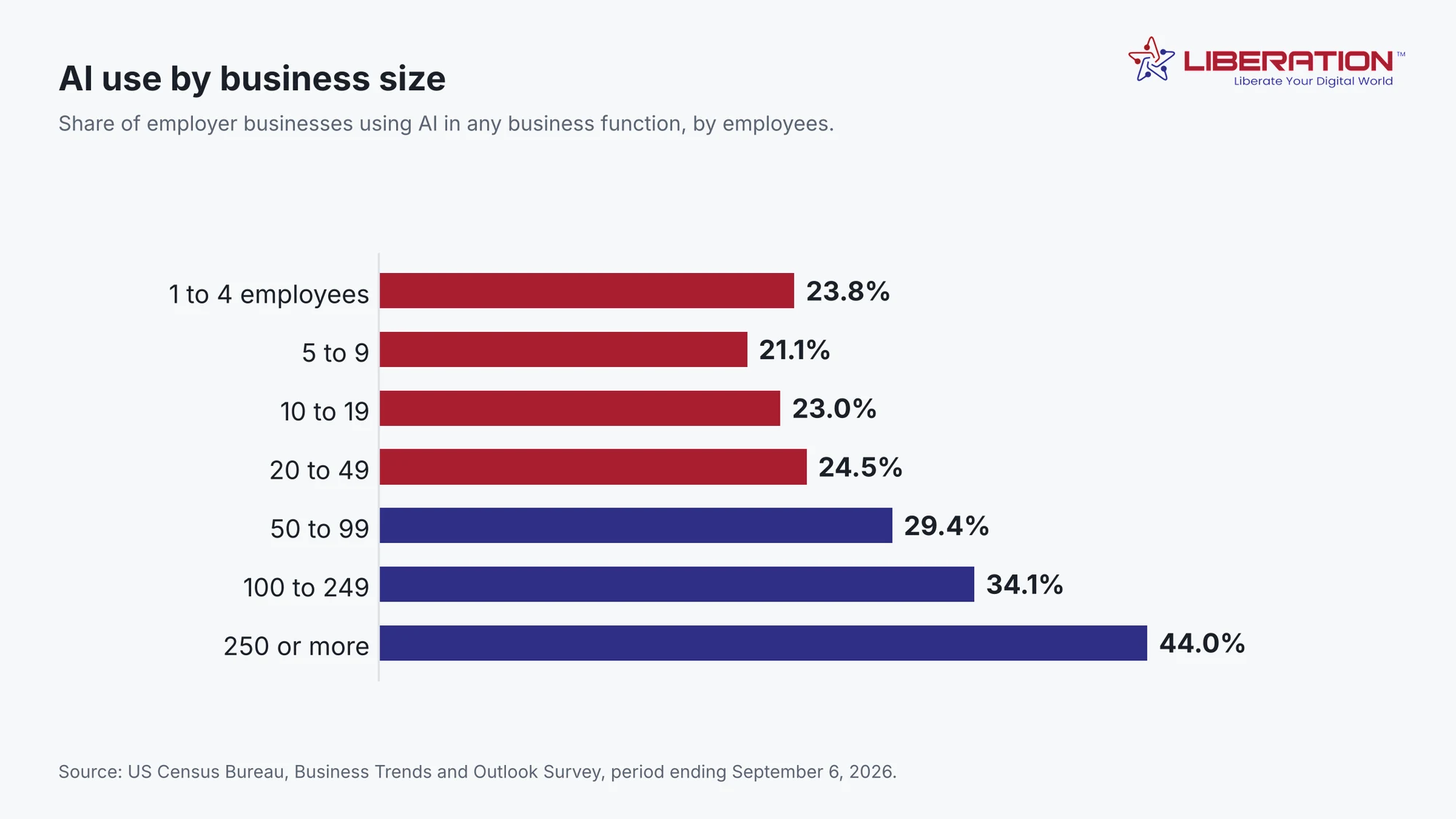
Estimates for the larger classes move more from cycle to cycle because there are fewer such firms in the sample.
Adoption by sector
Sector differences in small business AI adoption are wider than size differences. Firms that work mostly with information and documents lead, and those that work mostly with physical goods and people trail.
What this means for a small business
Small business AI adoption has reached roughly one in four small employers, so staff, vendors and competitors probably do too. The same tools also make scams more convincing, which raises the stakes for basic security habits. The table lists common uses and the care each needs.
| Use | What to check |
|---|---|
| Marketing and content drafts | Check facts, brand voice and any claims before publishing |
| Customer email and chat | Keep a person in the loop for anything involving money or complaints |
| Spreadsheets and records | Do not paste customer or financial data into tools without reviewing their data terms |
| AI-written scam messages | Train staff and verify payment requests through a second channel |
Three steps to start sensibly
1. Write a short policy
Small business AI adoption works best with clear limits. Say which tools staff may use and what data may never go into them. One page is enough.
2. Prepare for AI-written scams
Small business AI adoption has a security side too. Fraudulent emails are better written than they used to be. Our guide to AI phishing scams explains what to look for.
3. Make your business easy to find
Small business AI adoption includes buyers who ask assistants for advice. Some buyers now ask AI assistants for recommendations. Clear, accurate pages help, and our SEO services can help with that.
Frequently asked questions about small business AI adoption
What percentage of small businesses use AI?
In the Census Bureau’s Business Trends and Outlook Survey, 23.8% of employer businesses reported using AI in any business function in the period ending September 6, 2026. Among firms with 1 to 4 employees it was 23.8%, and for 20 to 49 employees 24.5%.
How fast is AI use growing among businesses?
Under the newer survey wording, the share rose from 17.3% in the November 2025 cycle to 23.8% in September 2026. Under the older wording, it rose from 3.7% in September 2023 to 10.0% in September 2025.
Why are the old and new Census figures different?
Census broadened the question in late 2025 from using AI in producing goods or services to using it in any business function. The two series are not comparable, so they should be read separately.
Which industries use AI the most?
Information (49.0%), professional, scientific and technical services (43.9%) and finance and insurance (41.0%) led in the latest cycle. Accommodation and food (10.1%) and construction (15.4%) were among the lowest.
Does the Census define a small business?
The survey has no small business flag. We used the 1 to 4 through 20 to 49 employee classes as a proxy, and the survey covers all employer businesses.