
A newsletter marketing strategy fails for two reasons that have nothing to do with writing: a cadence nobody can sustain, and a list nobody maintains. Fix those and an average newsletter outperforms a beautifully written one sent erratically to a decaying list. This is the strategy in the order that actually matters.
Newsletter marketing strategy: decide four things first
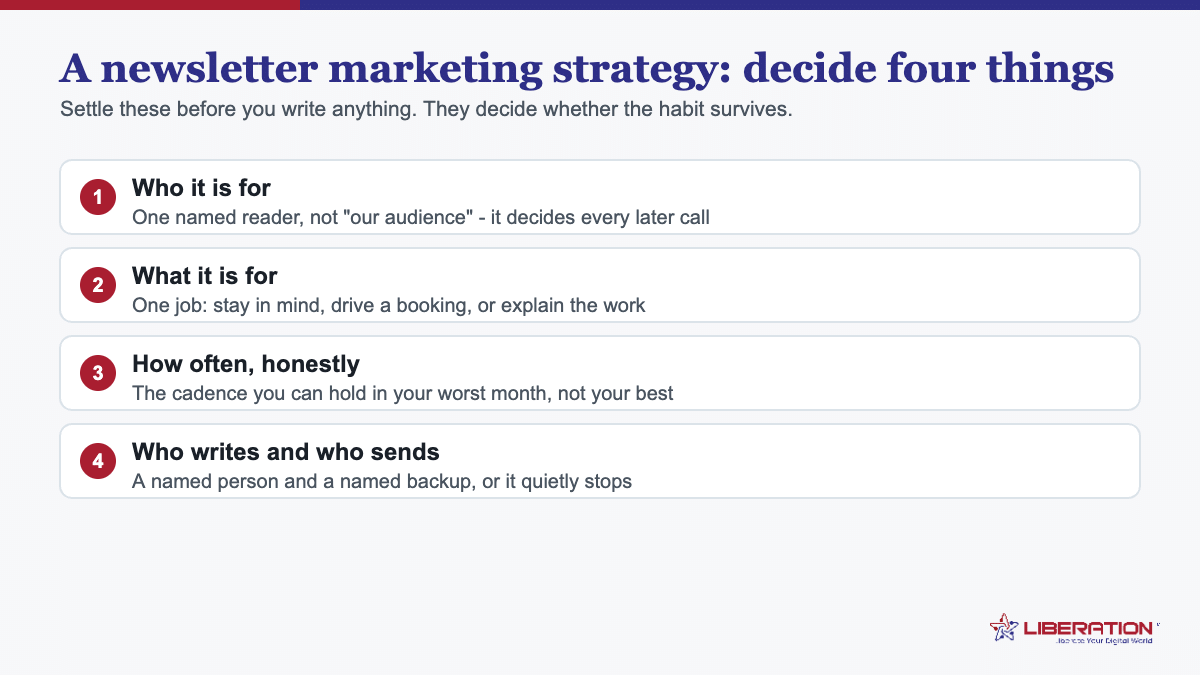
- What is the one job of this newsletter? Drive enquiries, keep existing customers warm, establish expertise, or announce things. Pick one. A newsletter trying to do all four reads as a company update nobody asked for.
- What cadence survives your busiest month? Not your quietest. Monthly done consistently beats weekly done for three weeks and then abandoned – an irregular list decays, because subscribers forget who you are and start marking you as spam.
- Who writes it when the usual person is away? Newsletters die in July. Decide the answer before it happens.
- What will you stop doing to make room? If nothing, the newsletter is competing with the work that already fills the week, and you know how that ends.
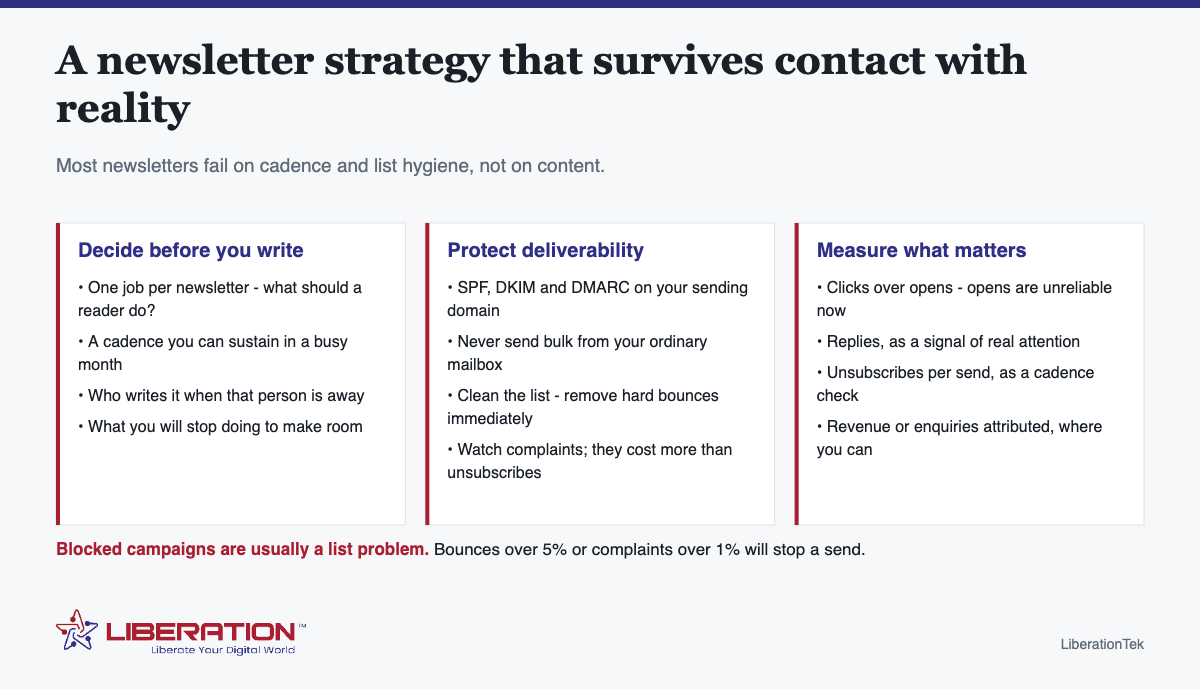
Deliverability is a technical problem, not a writing one
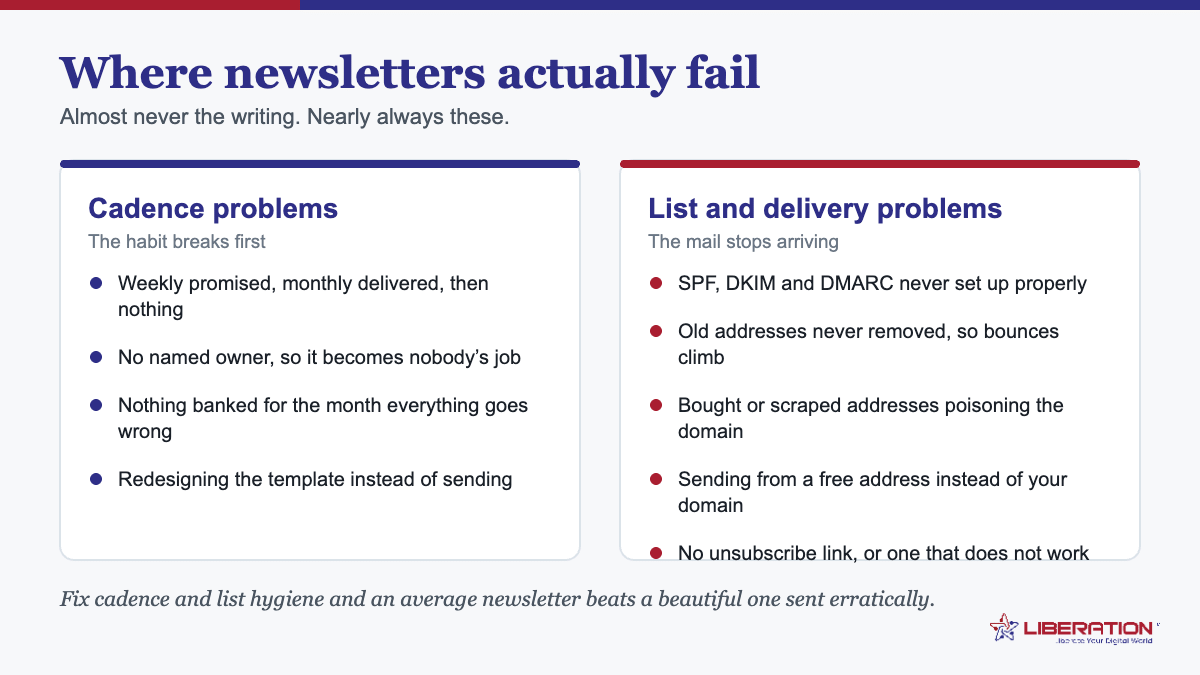
A newsletter nobody receives is not a content failure. Three technical points carry most of the risk.
Authenticate the sending domain
SPF, DKIM and DMARC have to be configured for whatever platform you send through. Without them your campaigns will increasingly be filtered regardless of how good they are, and the failure is silent – your open rate simply looks disappointing.
Never send bulk from your ordinary mailbox
This is the single most damaging shortcut available. Bulk sending from your day-to-day business mailbox risks the deliverability of your actual correspondence – quotes, invoices, replies to customers. Keep campaigns on a platform built for them, with its own sending configuration, so a bad campaign cannot take your business mail down with it.
Clean the list, continuously
Remove hard bounces immediately – they are the clearest signal to receiving servers that you are not maintaining your list. Watch complaint rates, which cost far more than unsubscribes: an unsubscribe is a person leaving politely, a complaint is a mark against your sending reputation.
As a working threshold, bounce rates above 5% or complaint rates above 1% will typically get campaigns blocked, and the block usually arrives at the worst moment. Make an unsubscribe link obvious – a reader who cannot find it will use the spam button instead, which is materially worse for you.
Measuring a newsletter marketing strategy: the metrics still worth trusting
| Metric | Worth tracking? | Why |
|---|---|---|
| Open rate | Weakly | Mail clients pre-fetch tracking pixels, inflating it inconsistently |
| Click rate | Yes | Someone chose to do something |
| Replies | Yes | The strongest signal of real attention, and usually ignored |
| Unsubscribes per send | Yes | A direct check on whether cadence and relevance are right |
| Enquiries or revenue attributed | Yes, where possible | The only one that answers “is this worth doing” |
Asking a question and inviting replies is underrated. It produces the most useful signal available and it tells the receiving mail servers that people engage with you, which helps everything else.
Growing the list without damaging your newsletter marketing strategy
Slowly, and with consent. Bought or scraped lists generate bounces and complaints that damage the sending reputation every future campaign depends on – the damage outlasts whatever the list cost.
What works is unglamorous: a sign-up on the pages people actually read, a clear statement of what they will get and how often, and honoring that. A small engaged list beats a large indifferent one on every metric that matters, including the ones that keep you out of spam folders.
A monthly newsletter that a small team can sustain
- One useful thing – something you learned, fixed or noticed that the reader can use.
- One piece of news – a change, a launch, an event.
- One clear action – a single link, not six.
- Written in an hour, because a format that takes a day will not survive a busy month.
That structure is dull to describe and it ships every month, which is the entire point.
The tooling behind a newsletter marketing strategy
Liberation Campaign handles the sending side – your own sending domain configuration, list management and reporting – separately from your day-to-day mail, which is the separation that protects your business correspondence.
Keep ordinary business mail on Liberation Email from $1.95 per user per month, on your own domain and on hardware we own and operate in the United States. The two jobs are different and should not share a mailbox.
One practical note: campaigns are blocked when bounce rates exceed 5% or complaint rates exceed 1%, so list hygiene is not optional housekeeping – it is what keeps you able to send at all.
What to send when your newsletter marketing strategy has nothing to announce
This is the real reason newsletters stop. The month arrives, nothing has launched, and it feels like there is nothing to say – so nothing goes out, and then nothing goes out the month after either.
Four formats that always exist:
- Something you fixed. A problem a customer had and how it was solved. Useful, specific, and always available.
- Something you noticed. A change in your industry, explained plainly for someone outside it.
- A question you get asked constantly. Answer it properly once and you have both a newsletter and a page for the website.
- A short recommendation. A tool, a book, an approach. Low effort, high reply rate.
None of these require anything to have happened, which is the point. A newsletter that depends on news is a newsletter that stops.
Two things worth automating, and one that is not
Worth automating: a welcome message so a new subscriber hears from you immediately rather than waiting three weeks for the next send, and a simple re-engagement message to people who have not clicked anything in six months – followed by removing those who still do not.
Not worth automating: the newsletter itself. Elaborate branching sequences are where small teams spend a fortnight building something that sends less often than a person writing an hour a month would have managed.
The legal minimum, briefly
A working unsubscribe link that actually works, honored promptly. A real postal address in the footer. No misleading subject lines. Clear identification of who is sending. These are ordinary commercial-email requirements in most jurisdictions and every reputable platform supports them by default – the failures come from disabling something to look tidier, which is never worth it.
A simple monthly newsletter marketing strategy workflow
| When | What | Time |
|---|---|---|
| Week one | Note the one useful thing while it is fresh | Ten minutes |
| Week three | Draft it – one useful thing, one piece of news, one action | An hour |
| Week four | Send, then remove hard bounces the next day | Twenty minutes |
| Quarterly | Check clicks and unsubscribes against cadence | Fifteen minutes |
Under two hours a month, which is a commitment a small business can actually keep for a year – and consistency over a year is what produces results, not any individual send.
Segment only when it earns its keep
Segmentation advice is usually written for teams with a marketing department. For a small list, one good newsletter to everyone beats four mediocre ones to segments nobody has time to maintain.
Two splits are usually worth it once a list grows: separating existing customers from prospects, because the relevant message genuinely differs, and separating people who have bought recently from those who have not. Everything beyond that adds maintenance faster than it adds results.
The last word on strategy: the newsletter that works is the one that arrives. Everything on this page is in service of that single outcome, and every elaboration that makes a send less likely is working against you.
Building a newsletter marketing strategy that survives December
Every organization has a month where everything else takes priority – the end of the tax year, the Christmas programme, the busy season, the audit. A newsletter marketing strategy that only works in quiet months is not a strategy; it is a hobby that will be dropped the first time it is inconvenient. Three habits make the difference.
Bank two issues ahead. The single most effective thing a small team can do is keep a finished issue in the drafts folder at all times. It turns a bad month into a non-event: you send the banked one and write the replacement when things calm down. Evergreen pieces work best for this – an explainer, a frequently asked question answered properly, a short piece about how you do something.
Keep a running notes file. The hardest part of writing a newsletter is starting from an empty page, and that is a self-inflicted problem. Keep one document where anyone on the team drops a line when a client asks a good question, when something changes, or when a project finishes. By the time you sit down to write, the raw material is already there and the job becomes editing rather than inventing.
Lower the production standard on purpose. A plain text email from a real person, sent on time, consistently outperforms a designed template sent whenever there is capacity to build one. If your newsletter marketing strategy depends on a designer being available, it will fail in exactly the month you most need to stay in front of people.
Protect the sending side while you are busy too. List hygiene is the part that quietly rots when nobody is watching: bounced addresses accumulate, complaints go unnoticed, and deliverability drops just as you return to sending. Both Google and Yahoo now publish explicit requirements for bulk senders, and the Google email sender guidelines are the clearest statement of what is expected – authentication, easy unsubscribe, and keeping spam complaints low. Meeting those is a one-time setup plus a few minutes a month.
Decide in advance what “skipping” means. If you genuinely cannot send, send something short rather than nothing – three lines and a link is a perfectly good issue. A gap with an explanation is recoverable. A silent six-month gap followed by a full-length newsletter is what makes people forget who you are and mark it as spam.
None of this is about writing better. A newsletter marketing strategy is mostly an operations question, and the organizations that keep one going are simply the ones that made it small enough to survive a bad month.
The short version of a newsletter marketing strategy for a small team: pick one reader, pick one job, pick a cadence you can hold in a bad month, name an owner, get authentication right once, and keep a spare issue banked. Everything else is refinement, and a newsletter marketing strategy built that way tends to still be running a year later – which is the only measure that really counts.
Frequently asked questions
How often should a business send a newsletter?
Whatever cadence you can sustain in your busiest month, not your quietest. Monthly beats weekly if weekly means three sends and then silence, because an irregular list decays – subscribers forget who you are and mark you as spam.
Why do newsletters land in spam?
Usually authentication or list hygiene rather than content. SPF, DKIM and DMARC must be configured on the sending domain; bulk mail should never go from an ordinary business mailbox; and hard bounces must be removed immediately. Bounces above 5% or complaints above 1% will typically get campaigns blocked.
Should I use email open rates to measure success?
Open rates have become unreliable because mail clients pre-fetch tracking pixels. Clicks are a better signal, replies better still, and unsubscribes per send are a useful check on cadence.
Can I send a newsletter from my normal business email?
You should not. Bulk sending from an ordinary mailbox risks the deliverability of your day-to-day correspondence, and mail hosting is not built for it. Use a platform designed for campaigns.
How do I grow a newsletter list properly?
Slowly and with consent. Bought or scraped lists produce bounces and complaints that damage the sending reputation you depend on. A small engaged list outperforms a large indifferent one.
Related reading
- Is SEO Worth It for a Small Business?
- What Is a Free and Open Internet? Why It Matters and How to Protect Your Part of It
- How Much Do SEO Services Cost?
- Small Business Marketing — The wider marketing picture for a small team.
- Business Email Setup — The channel you own, on your own domain.