
Is SEO worth it for a small business? Yes, when people already search for what you sell. If customers type your service and your town into Google, appearing there is valuable and compounds over time. If nobody searches for what you do, or you sell entirely on referral, the same effort is usually better spent elsewhere. Check demand before committing.
This question is normally answered by people who sell SEO, which makes the answer predictable. The honest version has conditions attached, and the conditions are easy to check yourself in about twenty minutes.
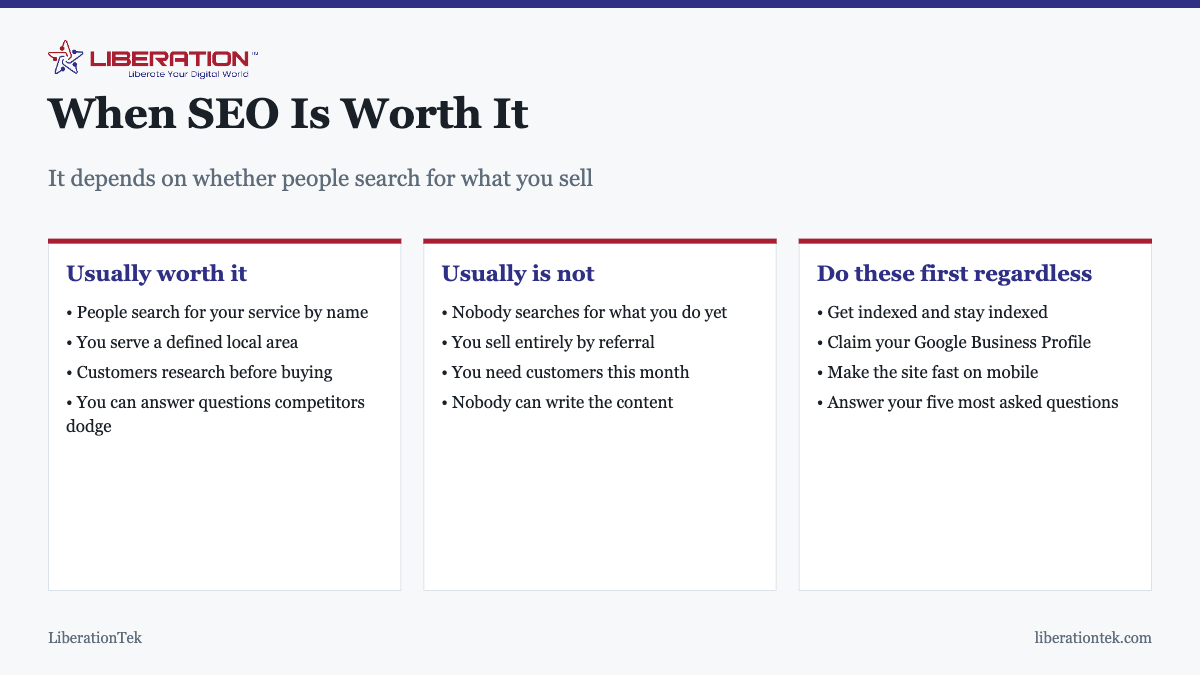
So, is SEO worth it? Start with this question
Does anyone search for what you sell?
Everything else follows from this. SEO captures demand that already exists; it does not create it. A business solving a problem people do not yet know they have will find search a poor channel, not because the work is bad but because there is nothing to capture.
How to check, without buying anything
- Look in Search Console if the site has any traffic. It shows the actual queries you appear for. This is the best evidence available and it is free.
- Type your service into Google. Are there competitors? Are there ads? Paid advertising is a strong signal that a term produces business, because somebody is paying for each click.
- Read autocomplete and “people also ask”. These show how customers phrase it, which is often not how you phrase it.
- Ask recent customers how they found you. If several say they searched, you have your answer.
If competitors are advertising on a term and customers tell you they searched, SEO is worth doing. If search returns nothing resembling your business and nobody advertises, take the hint.
When is SEO worth it for a small business?
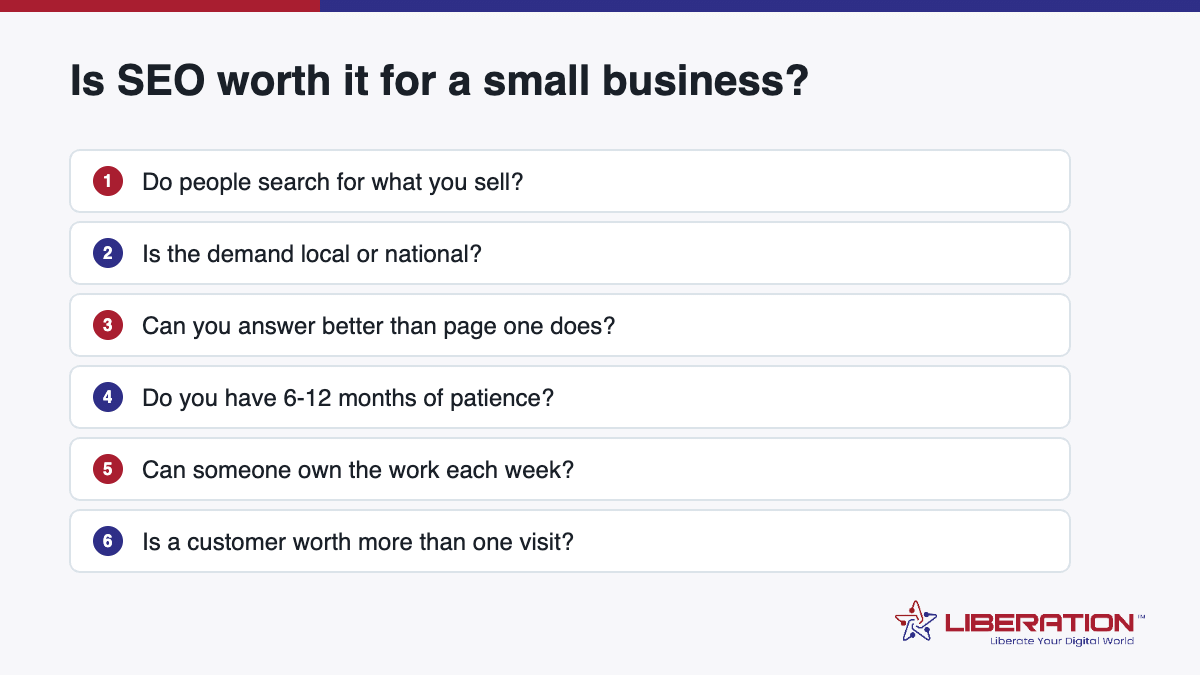
- People search for your service by name. Plumbers, accountants, dentists, web hosts. The demand is established and the language is settled.
- You serve a defined area. Local search has less competition and far higher intent. Someone searching for a service plus a place is usually ready to act.
- Customers research before buying. Considered purchases involve reading, which is an opportunity to be the one they read.
- You can answer questions competitors avoid. Pricing, limitations, who a product is not for. This is where a small business can genuinely outrank larger ones, because larger ones are usually too cautious to be straight.
When is SEO worth it, and when is it not?
| Situation | Why SEO struggles | Better use of the money |
|---|---|---|
| Nobody searches for it yet | No demand to capture | Direct outreach, partnerships |
| You need customers this month | Takes months to move | Paid advertising |
| You sell entirely by referral | Buyers arrive pre-qualified | Make referring easier |
| Nobody can write the content | Content is most of the work | Fix that first, or pay for writing |
| Extremely broad, contested terms | Well-resourced incumbents | Narrow to specific long-tail terms |
| You cannot sustain six months | Stopping early wastes it entirely | Do the free basics only |
The last row is the most common failure. SEO abandoned at month three has produced almost nothing and cost real money. It is better to do the free basics well and nothing else than to start a program you cannot finish.
SEO against paid advertising for a small business
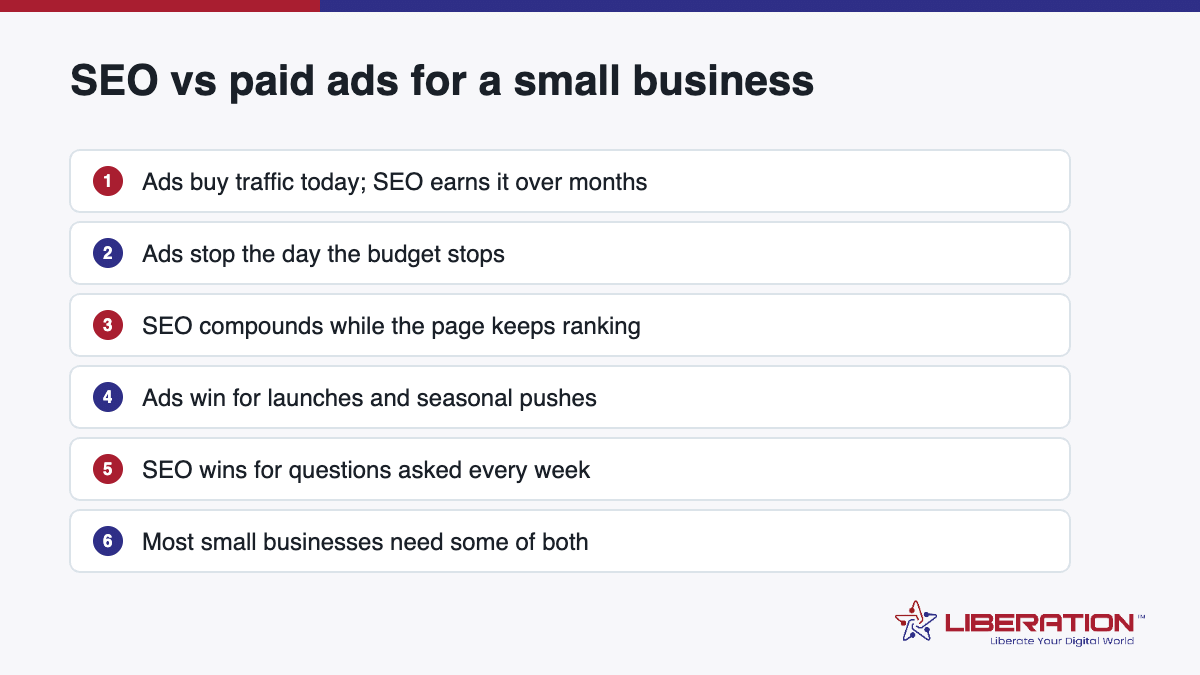
These are usually posed as alternatives and are better understood as different instruments.
Paid advertising produces traffic today, is straightforward to measure, and stops the moment you stop paying. It is the right answer when you need customers this quarter, when testing whether a market exists, or when demand is seasonal.
SEO takes months, then continues without a per-click cost, and compounds: work done in month two still earns in year two. It is the right answer when you are building something durable.
A sensible small business pattern is advertising to establish that the demand converts, then SEO to capture the same demand more cheaply over time. Our marketing team covers both, alongside social and email.
What to do regardless
Google publishes plain guidance on whether you need outside help and what a legitimate provider does: Do you need an SEO? For a local business, claiming and completing your Google Business Profile is the step that pays first.
Whether or not you commit to a program, some of this is free and worth doing for any business with a website:
- Be indexed, and stay indexed. Nothing else matters if Google does not hold your pages. See getting your website on Google.
- Claim your Google Business Profile if you serve a local area. Frequently the single highest-return hour available to a local business.
- Make the site fast on mobile. Most visitors are on a phone, often on a poor connection. See why WordPress sites get slow.
- Answer your five most-asked questions in writing, as pages. These are the questions you already answer on the phone, and they use the exact language your buyers use.
- Keep your name, address and phone number consistent everywhere they appear.
- Make sure hosting is not holding you back. Covered in does web hosting affect SEO.
Those six cost nothing but time and cover a surprising share of the available value. If you want the diagnostic side without a retainer, the LiberationTek SEO Tool is $9.99 a month. If you are weighing up an agency, how much SEO services cost covers what a quote should itemise.
Why is SEO worth it more for small businesses than they expect?
It is worth naming, because most SEO advice assumes you are competing on resources and losing.
You are not going to outspend a national competitor on content volume or outrank them on broad head terms, and chasing either is how small budgets get wasted. What you can do is be specific in ways a larger business will not.
- Publish your prices, or at least how pricing works. Large competitors frequently will not, because it has to be signed off by three departments. A page that answers “how much does this cost” honestly will outperform a dozen vague ones.
- Say who you are not for. Naming the customer you are a poor fit for builds more trust than any testimonial, and nobody with a marketing committee is allowed to do it.
- Answer the awkward questions. What goes wrong, what the limitations are, what happens if it does not work out. These are searched constantly and answered evasively.
- Write about your actual niche. A national firm writes for everyone. You can write for the specific trade, town or situation you serve, and match the search exactly.
This is the durable edge, and it also happens to be the cheapest content to produce, because it is what you already know and already say out loud to customers every week.
Is SEO worth it on a realistic timeline?
For a small business doing this properly, the honest shape is: little visible for two or three months, some movement on specific terms by month four to six, and meaningful traffic somewhere past that if the content is genuinely useful and published consistently.
Anyone describing a faster timeline is either selling paid advertising under another name or intending to do something that will cause problems later. The slowness is not a defect in how it is being done. It is the nature of the channel, and it is also why the result is durable once it arrives.
Frequently asked questions
Is SEO worth it for a small business?
It is worth it when people already search for what you sell, and much less so when they do not. If customers type your service and your town into Google, appearing there is valuable and durable. If nobody searches for what you do, or you sell entirely by referral, the same effort is usually better spent elsewhere. Check demand before committing.
How do I know if people search for what I sell?
Use Google Search Console if you have any traffic already, since it shows real queries you appear for. Otherwise, type your service into Google and see whether competitors and ads appear; paid advertising is a reliable signal that a term produces business. Autocomplete and the “people also ask” box show how customers actually phrase it.
Is SEO better than paid advertising for a small business?
They solve different problems. Paid advertising produces traffic immediately and stops when you stop paying. SEO takes months and then continues without per-click cost. If you need customers this quarter, advertising is the honest answer. If you want a channel that compounds, SEO is the better investment, and many businesses sensibly run both.
How long does SEO take to pay off for a small business?
Usually three to six months before meaningful movement, and longer in competitive sectors. Local search is often faster, particularly once a Google Business Profile is claimed and consistent. If you cannot sustain effort for at least six months, the work will not reach the point where it produces anything.
Do I need to blog to do SEO?
Not necessarily, but you do need pages that answer what people search for. For many small businesses that means good service pages and a handful of genuinely useful answers to common questions, not a weekly blog. Publishing frequently for its own sake produces thin pages that compete with each other and help nobody.
What is the cheapest SEO that actually works?
Answering, in writing, the questions customers ask you on the phone. It costs nothing but time, nobody is better placed to write it than you, and it targets exactly the language real buyers use. Combined with being indexed, a fast site and a claimed Google Business Profile, that covers most of the available value for a small business.
Can SEO work for a local business?
Often better than for a national one, because the competition is smaller and intent is higher. Someone searching for a service and a place is usually ready to act. Claiming and maintaining a Google Business Profile, keeping your name and address consistent, and having a page for each service and area covers most of it.
Related reading
- What Is a Free and Open Internet? Why It Matters and How to Protect Your Part of It
- How Much Do SEO Services Cost?
- Small Business Marketing — The wider marketing picture for a small team.
- Business Email Setup — The channel you own, on your own domain.