
HIPAA for therapists starts here: a solo therapist billing insurance electronically is a covered entity, with the same obligations as a hospital applied proportionately. Two things make a mental health practice different from other small clinics: psychotherapy notes get separate treatment under HIPAA, and teletherapy puts a video platform inside your compliance perimeter. Both are manageable; neither is automatic.
Psychotherapy notes are a distinct category
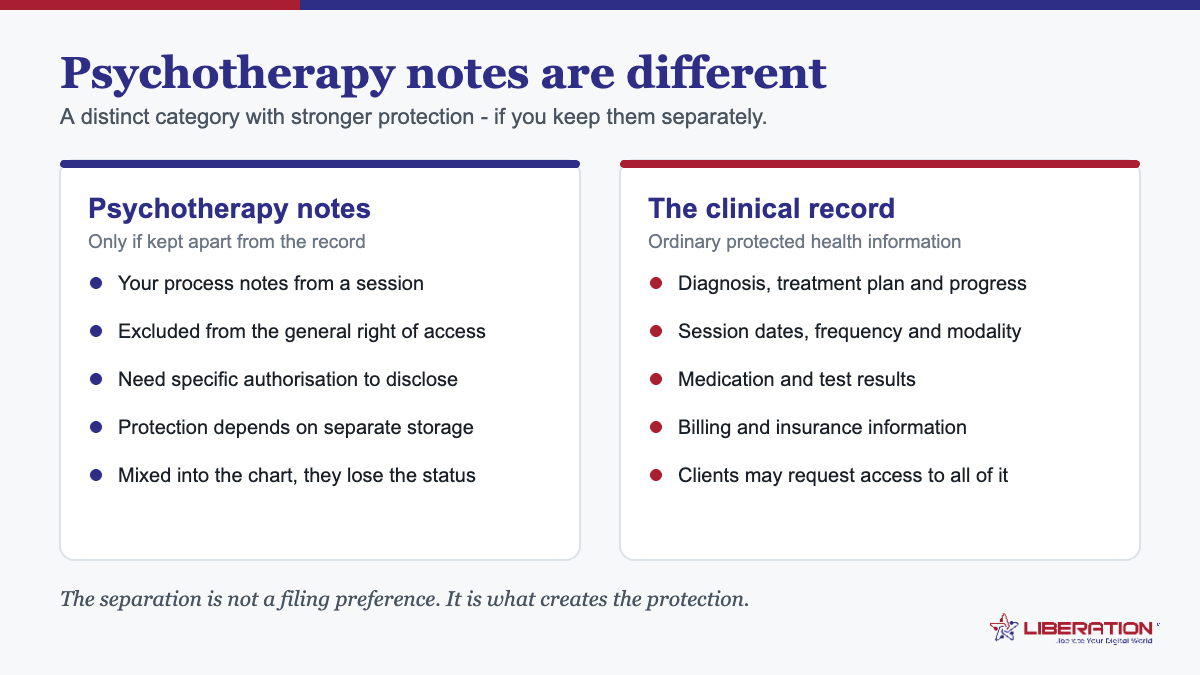
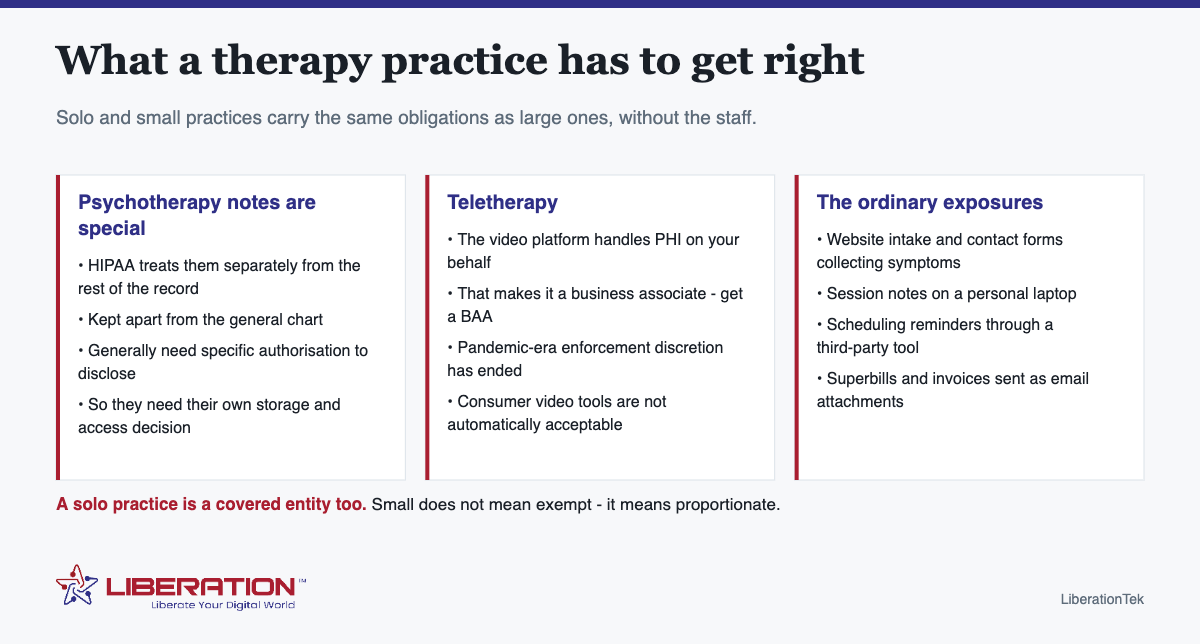
HIPAA treats psychotherapy notes separately from the rest of the record. They are the notes a mental health professional records analyzing or documenting a counseling session, maintained apart from the general medical record – and disclosure generally requires specific authorization rather than the ordinary permissions that cover treatment and payment.
That legal distinction has a practical consequence people miss: if the notes must be kept separate, then “separate” has to mean something in your systems too. In a paper practice that was a different folder. In a digital practice it means a deliberate decision about where they are stored, who can open them, and whether that access is logged – rather than everything living in one folder because that was convenient.
It is worth being clear that this is a storage and access question you decide once, not an ongoing burden. Deciding it badly is what creates the burden later.
Teletherapy: the platform is a business associate
A video platform used for sessions handles protected health information on your behalf, which makes it a business associate and means you need a business associate agreement with it.
This matters more now than it did a few years ago. During the public health emergency, HHS applied temporary enforcement discretion to telehealth platforms, and many practices adopted whatever consumer video tool was convenient. That discretion has ended. A tool adopted under it is not automatically acceptable now simply because it has been in use since – the question has to be asked again, and the answer should be a signed BAA or a different platform.
The same applies to anything else in the session chain: scheduling tools that store the reason for an appointment, transcription or note-taking assistants, and reminder services.
HIPAA for therapists: the ordinary exposures that carry most risk
| Exposure | Why it happens | What to do |
|---|---|---|
| Website intake forms | A form asking “what brings you to therapy” collects PHI | Collect a name and contact route only; take the clinical detail through a secure route |
| Notes on a personal laptop | Solo practice, work happens at home | Encryption, MFA, and a decision about what may be stored locally |
| Reminders through a third-party tool | Convenience, and it reduces no-shows | Get a BAA; keep clinical detail out of the message |
| Superbills and invoices by email | Clients ask for them; attachments are easy | Secure link with expiry rather than an attachment |
| Old records with no retention plan | Retention obligations are real; drift is easier | Set a period per record type and dispose on schedule |
The intake form is the one practices are most surprised by, because a website feels like marketing. A form that asks why someone is seeking therapy is collecting sensitive health information, and it typically lands in two places at once – the website database and an inbox – neither of which anyone reviews again.
What a proportionate HIPAA for therapists setup looks like
- Inventory where client information lives. EHR, notes, email, scheduling, video platform, laptop, phone, paper. Solo practices usually find six or seven places.
- Get BAAs from every vendor that needs one, and keep the signed copies somewhere you can find them.
- Multi-factor authentication everywhere – EHR, email, scheduling, video, and the domain registrar.
- Decide where psychotherapy notes live and who can reach them, separately from the general record.
- Trim the website form to a name and a contact route.
- Stop emailing documents. Superbills, invoices and letters go by secure link, not attachment.
- Write down what you decided. For a small practice, documenting a reasonable decision is most of what defensible looks like.
That is a day of work, not a project. The hard part is deciding to do it in a week where the calendar is full.
What we can and cannot do
Plainly: there is no HIPAA certification for hosting providers, and nobody can make your practice compliant by selling you a plan. What a provider can do is sign a BAA, carry specific technical safeguards, and answer vendor questions in writing so your documentation is real.
We sign a Business Associate Agreement. Hosting runs on hardware we own and operate in the United States, with encryption in transit and at rest, free SSL and multi-factor authentication configured in cPanel. Liberation Email from $1.95 per user per month keeps practice mail on your own domain with nothing scanned for advertising. Hub For Teams from $7.49 per user adds secure file sharing – the practical answer to superbills as attachments – plus video and shared inboxes on the same platform.
What we do not do is provide clinical systems or advise on your licensure board’s requirements, which sit alongside HIPAA and sometimes go further. See how we work with healthcare practices, or ask us the vendor questions and file the written answers with your documentation.
Scheduling, reminders and the detail that leaks
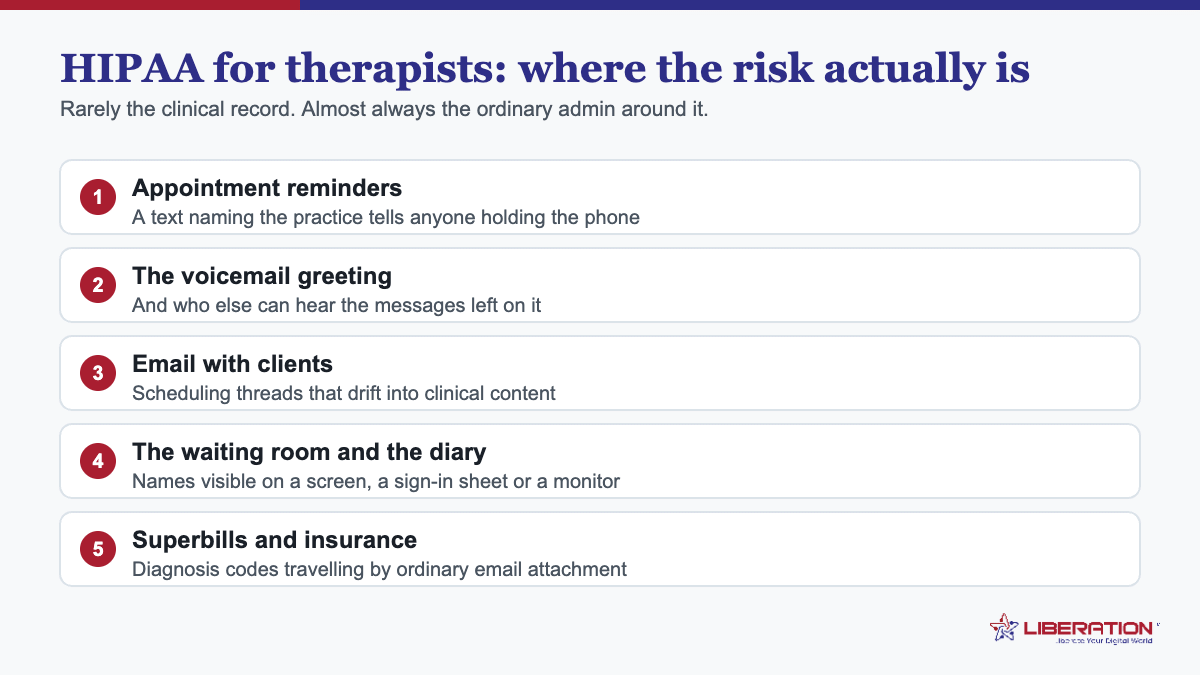
Appointment reminders reduce no-shows, which is why every practice uses them, and they are permitted as treatment communication. The care needed is in the content rather than the principle.
A reminder should get someone to the session without disclosing anything about it. “You have an appointment on Thursday at 4pm” is fine. Anything naming a service, a provider’s speciality or a reason is not, particularly given that a text message appears on a lock screen that other people can see. For therapy specifically this matters more than in general healthcare, because the existence of the appointment is itself sensitive.
Whichever tool sends the reminder is handling protected health information on your behalf, so the business associate question applies there as it does to the video platform.
Insurance, superbills and the paperwork route
Clients ask for superbills, letters and documentation regularly, and the default answer is an email attachment – which is the weakest possible handling of a document naming a diagnosis code. A secure link that expires, with the client notified by email rather than sent the file itself, takes the same amount of effort once it is set up and removes the copy that would otherwise sit in two mailboxes indefinitely.
A note on HIPAA for therapists in solo practice
Everything above is written knowing that a solo therapist has no IT department, no compliance officer and no spare afternoon. The honest minimum is smaller than the full list: multi-factor authentication everywhere, BAAs from the video platform and the EHR, a decision about where notes live, a trimmed website form, and a page of writing recording what you decided.
That is a morning’s work and it addresses most of the realistic exposure. Doing that and documenting it puts a solo practice ahead of most, and it is genuinely achievable – which matters more than a comprehensive plan that never gets started.
Where to start with HIPAA for therapists if this feels like a lot
Pick the two that carry the most risk for the least effort: turn on multi-factor authentication on every account today, and get a business associate agreement from your video platform and your EHR this week. Those two alone close the gaps most likely to matter, and neither requires you to reorganise how you practice. The rest can follow over a month.
The website questions specific to a therapy practice
A therapist’s website looks like any other small professional site, and it is not. The difference is that merely appearing in a practice’s records reveals something sensitive, which changes how a few ordinary features should be handled.
The contact form is the first issue. People write a great deal in that box. A prospective client describing why they are seeking therapy has just sent protected health information through whatever route your form uses – usually an email to an ordinary inbox. Form submissions should land somewhere secure, and the form itself should say plainly what it is and is not suitable for.
Tracking is the second, and it is the one attracting enforcement attention. Analytics and advertising pixels on a page about a specific condition can transmit the fact that a visitor viewed it, along with an identifier, to a third party. On a general business site that is unremarkable; on a therapy practice site it can reveal that a named individual was researching treatment. HHS has addressed online tracking by covered entities directly in its guidance on tracking technologies, and it is worth reading before anyone installs a pixel.
Online booking needs thought. A booking tool holding names, contact details and appointment times is holding PHI, and it is a business associate. Check that the agreement exists and look at what the confirmation emails actually say – “Your appointment with the Anxiety and Trauma Centre” in a subject line is the sort of detail HIPAA for therapists is really about.
Client testimonials are usually a mistake. Beyond the HIPAA question, most licensing boards and ethics codes restrict soliciting testimonials from current or former clients. Case studies, if used at all, need genuine de-identification rather than a changed first name.
Keep the site and the records apart. The public website is marketing; the clinical record belongs in a system built for it. Practices get into difficulty when intake forms, notes or scheduling end up on the same hosting account as the brochure pages, usually because it was convenient at the time.
A workable standard. Secure form handling, no tracking on condition-specific pages, a business associate agreement with the booking tool, and nothing clinical stored on the web host. That is most of what HIPAA for therapists asks of a website, and none of it requires a large budget.
HIPAA for therapists in solo and group practice
The obligations are identical whatever the size of the practice, but what proportionate compliance looks like differs considerably between a solo clinician and a group, and most guidance is written for neither.
Solo practice: you are the whole security programme. There is nobody to delegate to, which simplifies some things and complicates others. The risk analysis is short because there are few systems. The training log is a note saying you reviewed your own practices. What solo clinicians most often miss is the device question – a personal laptop and phone doing double duty, without encryption or a screen lock, holding the practice’s entire record.
Group practice: access is the issue. Once more than one clinician shares systems, the question becomes who can see whose clients. Most electronic record systems permit per-clinician restrictions, and most groups never configure them. HIPAA for therapists expects access to be limited to what each person needs, and in a group setting that is a setting to switch on rather than a policy to write.
Shared administrative staff need defined boundaries. A receptionist scheduling for six clinicians legitimately sees a great deal. Write down what they may access and why, and cover it in onboarding rather than leaving it to judgement.
Supervision and consultation. Case discussion with a supervisor or peer group is permitted, but the practical handling matters – identifying details in a shared document, a recorded session on a personal cloud drive, or case notes in an email thread are all common and all worth thinking about.
Contractors and associates. A clinician working as an independent contractor rather than an employee may need a business associate agreement with the practice. This catches groups out regularly, because the relationship feels internal even when the legal structure is not.
Leaving and closing. When a clinician departs, their access ends that day, and their clients’ records stay with whoever holds the responsibility. When a solo practice closes or the clinician retires, records still have to be retained and reachable for the period your state requires. Write down now what would happen, because it is the part nobody plans and it matters most.
Whatever the size, HIPAA for therapists comes down to the same four things: know what you hold, limit who can see it, protect it in transit and at rest, and write down what you did. A solo clinician can do that in an afternoon.
Frequently asked questions
Does HIPAA apply to a solo therapist?
Yes, if you transmit health information electronically in connection with a covered transaction – which billing insurance electronically does. A solo practice is a covered entity with the same obligations as a large one, applied proportionately. Small does not mean exempt.
Are psychotherapy notes treated differently under HIPAA?
Yes. HIPAA treats psychotherapy notes separately from the rest of the record – notes analyzing a counseling session, kept apart from the general chart, with disclosure generally requiring specific authorization rather than the ordinary treatment and payment permissions. That should be reflected in how and where they are stored.
Is my teletherapy video platform a business associate?
If it handles protected health information on your behalf, yes, and you need a business associate agreement with it. The temporary enforcement discretion HHS applied to telehealth platforms during the public health emergency has ended, so a consumer video tool is not automatically acceptable because it was used previously.
Can a therapy practice website have a contact form?
Yes, but decide what it collects. A form asking why someone is seeking therapy collects protected health information, which lands in the website database and an inbox. Ask for a name and a contact route, and have the clinical conversation through a secure route.
What should a small therapy practice fix first?
Inventory where client information lives – EHR, notes, email, scheduling, video platform, laptop, paper. Then get BAAs from every vendor that needs one, turn on multi-factor authentication everywhere, and decide where psychotherapy notes are stored.
Related reading
- HIPAA for Medical Billing Companies: 5 Essential Duties
- HIPAA Hosting for Dental Practices: 3 Essential Fixes
- HIPAA Hosting for Small Practices: 5 Essential Basics
- HIPAA Compliant Email With a Signed BAA — What a BAA-backed mailbox actually includes.
- HIPAA Compliant Hosting for Healthcare — Where the rest of a practice’s data lives.