
Nonprofit web hosting is ordinary website hosting, chosen and priced with a nonprofit’s realities in mind: a small budget, a volunteer or part-time web person, donors who trust your site with their information, and traffic that spikes around appeals and events. The best fit is a host that keeps your data private, handles updates and backups for you, and puts a real person on the phone when something breaks. At LiberationTek, we host on servers we own in the United States, and churches and nonprofits receive a 15% discount on every plan.
This guide is for executive directors, office managers, pastors and board members who have to pick a host without being technical. It covers what “nonprofit hosting” really means, the paperwork hosts ask for, what to check before you sign, and what the main plan types cost.
TL;DR
- “Nonprofit hosting” is usually a discount on a paid plan, not a free plan. Free tiers exist but are narrow, and domain renewals are billed separately.
- Hosts that offer nonprofit pricing typically ask for your IRS determination letter, your EIN and your official legal name.
- Judge a host on backups, security updates, support and where your data lives, not only on the monthly price.
- A small informational site fits Shared Cloud Hosting from $14.99 per month. A WordPress site with donations fits managed WordPress hosting from $35 per month.
- Churches and nonprofits get 15% off at LiberationTek, with free migration and a 30-day money-back guarantee on every plan.
Table of Contents
- What nonprofit web hosting actually means
- What documents hosts ask for
- Free hosting vs. discounted hosting
- What nonprofit hosting costs
- What to check before you choose a host
- Choosing the right plan for your organization
- How LiberationTek fits nonprofits
- Moving your site without downtime
- FAQ
- Sources
What nonprofit web hosting actually means
Hosting is the rented computer space that keeps your website online and answers visitors when they type your address. There is no separate technology called “nonprofit hosting.” The label means one of three things:
- A discount on a regular paid plan for verified nonprofits.
- A free or donated tier, usually a small shared plan with limits.
- A host that serves mission-driven groups and designs support and pricing around them.
Zeffy’s 2026 guide to nonprofit hosting notes that most nonprofit hosting offers are discounts on paid plans rather than truly free tiers. That matches what most boards find when they start comparing: the headline says “free,” the details say “first year” or “shared plan only.”
What separates a good fit from a poor one is less about the label and more about what your organization needs to do online. A church posting service times and livestream links needs something different from a charity taking online gifts, and both differ from a fire district publishing public notices.
What documents hosts ask for
If a host offers a nonprofit rate, it will want proof that you qualify. In the United States, the usual set is:
- Your IRS determination letter, the IRS’s written recognition that your organization is tax-exempt.
- Your EIN (Employer Identification Number), the nine-digit tax ID for your organization.
- Your official legal name, exactly as it appears on those documents.
A Paybee guide on nonprofit software discounts reports that most providers ask for the IRS letter, EIN and legal name. It adds that fiscally sponsored projects may need the sponsor’s documentation, and that the sponsor may need to own the account.
Some discount programs run through a third-party verification service. TechSoup, for example, requires that an organization be registered as a nonprofit or religious organization with the relevant government authority and show proof, such as a link to an official government database. Approval through such services can take days to weeks, so start before your current hosting renews, not after.
A practical tip: save a PDF of your determination letter in a shared folder that more than one person can reach. Hosting accounts, domain accounts and discount programs will all ask for it.
Churches deserve a note here. Many congregations are not required to apply for IRS recognition, so they may not hold a determination letter. If that is you, ask the host what it accepts instead. At LiberationTek, churches and nonprofits both receive the 15% discount, and our team can tell you what we need to apply it.
Free hosting vs. discounted hosting
Free hosting sounds ideal for a tight budget. Before you commit a donor-facing website to it, read the terms. According to Zeffy’s 2026 review, a free nonprofit tier typically covers shared hosting, SSL, email and standard support, and leaves out managed WordPress, VPS and dedicated hosting. The same guide says no .org domain is permanently free: a free first-year registration reverts to standard renewal pricing, and at least one free plan requires a backlink in your site footer with the domain billed separately.
Here is how to think about the trade:
| Question | Free tier | Discounted paid plan |
|---|---|---|
| Monthly cost | $0, with conditions | Reduced from the list price |
| Domain name | Often billed separately | Ask what renewal costs |
| Site type | Basic shared hosting | Shared, WordPress, private cloud |
| Backups and updates | Often your job | Depends on the plan |
| Who answers when it breaks | Standard support queue | Depends on the host |
| Data practices | Read the terms | Read the terms |
The last row matters more than it looks. Your donor list, volunteer contacts and event registrations sit on that server. Ask who owns the servers, whether the host shows ads or tracks visitors, and whether it shares data. We own and operate our servers in the United States rather than reselling capacity from large cloud companies, and we do not track or share customer data.
For most organizations, the sensible move is a discounted paid plan with predictable pricing, a plan you can keep as you grow, and no footer link advertising someone else’s business on your site.
What nonprofit hosting costs
Prices vary widely, and the sticker price is only part of it. Build your budget from four lines:
- Hosting plan, billed monthly or annually.
- Domain name, renewed every year at the standard rate after any promotional period.
- Email, which some hosts bundle and others charge per mailbox.
- Help, meaning migration, setup and any development work.
Here are LiberationTek’s published monthly prices for the plans most nonprofits consider, before the 15% church and nonprofit discount:
| Plan | Best for | Price |
|---|---|---|
| Shared Cloud Hosting, Starter | A small informational site | $14.99 per month |
| Shared Cloud Hosting, Ramping Up | A growing site with more pages and mailboxes | $19.99 per month |
| Shared Cloud Hosting, Growth | A busier site with more activity | $29.95 per month |
| WP Starter | A managed WordPress site | $35 per month |
| WP Growth | A WordPress site with steady traffic and campaigns | $69 per month |
| Commerce | Online store or heavy donation and merchandise pages | $129 per month |
| Private Cloud, Sentinel | Dedicated resources for sensitive data | $179 per month |
Shared plans include cPanel, the standard dashboard where you manage files, email accounts and domains. The shared hosting page lists exactly what each tier includes.
One budgeting habit helps: mailboxes consume the same disk allowance as your site. If you plan to give a dozen staff and volunteers their own addresses, count that space before choosing a tier.
What to check before you choose a host
Price gets a host onto your shortlist. These checks decide whether it stays there.
Backups you can restore
A backup is only useful if someone can restore it quickly. Ask how often copies are made, how long they are kept, and who performs the restore. If the answer is “you, from a control panel, on your own,” budget for the time that takes on a bad day.
Security updates
Websites get broken into mostly through outdated software, especially plugins. A Nebula Design guide citing Patchstack’s 2026 report says 11,334 new WordPress vulnerabilities were found in 2025, 91% of them in third-party plugins. The practical lesson: someone must keep plugins and themes updated, every week. On a managed WordPress plan, that routine is part of the service rather than a volunteer’s chore. Our guide on how to secure a WordPress website walks through the habits that matter.
Traffic spikes
A year-end appeal, a disaster-relief push or a viral post can send ten times your normal visitors in an hour. Ask what happens to your site then. Note that we do not promise unlimited speed or unlimited bandwidth, and you should be wary of any host that does. Instead, ask which plan is sized for your busiest day, not your average one.
Real support
When the site is down on a Sunday morning or the night before a gala, you need a person. Every LiberationTek plan comes with direct U.S.-based support. Test any host the same way before you sign: look for a phone number or live channel, not only a ticket form.
Data privacy
Donor and member information is sensitive, and many of our customers also serve people in vulnerable situations: ministries, pregnancy centers, advocacy groups. Look for a host that states plainly that it does not track or share customer data, and that owns its infrastructure.
Email on your own domain
An address like [email protected] looks credible and survives staff changes. Email is a separate decision from the website, and it is where privacy matters most because messages carry names, donations and pastoral or case details. Liberation Email offers end-to-end encryption and starts at $1.95 per user per month. See our overview of business email, setup, deliverability and privacy for the basics, including SPF and DKIM, the records that help your messages reach inboxes instead of spam folders.
Choosing the right plan for your organization
Match the plan to what your website does, not to what sounds impressive.
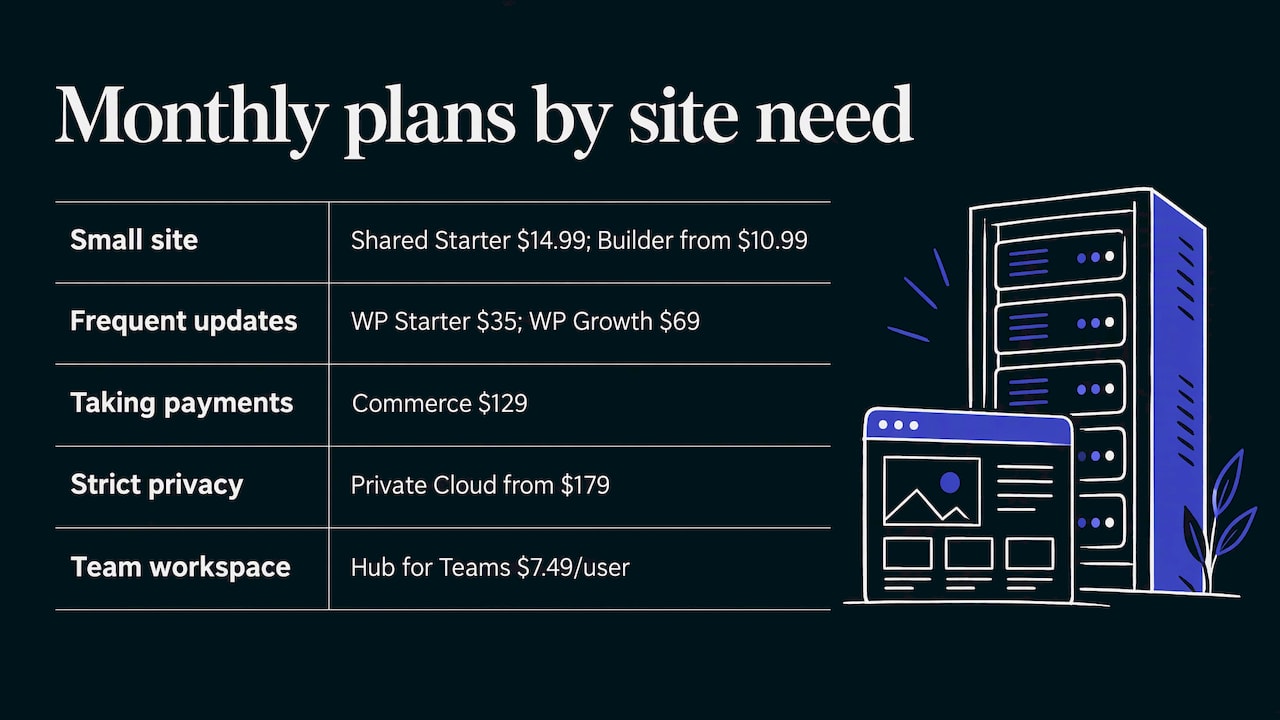
A small site that tells people who you are. Service times, a staff page, a contact form and a few events. Shared Cloud Hosting, Starter at $14.99 per month is the natural start. If you do not want to manage a site by hand, the Website Builder starts from $10.99 per month.
A site you update often. Blog posts, sermons, news, event pages and volunteer sign-ups, usually on WordPress. Managed WordPress hosting takes care of updates and keeps the platform tuned, so your team writes content instead of fixing errors. If your site has started to slow down or break after updates, our article on six signs shared hosting is failing you explains why. WP Starter is $35 per month and WP Growth is $69 per month.
A site that takes payments. Donation pages, a gift shop or ticketed events deserve more headroom and more care. The Commerce plan is $129 per month and is built for WooCommerce stores.
A site with strict privacy needs. Healthcare-adjacent nonprofits, legal aid groups and organizations holding case records may want resources that no other customer shares. Private Cloud Hosting starts at $179 per month with Sentinel, includes unmetered monthly data transfer and carries no egress fees. Our guide to private cloud hosting explains why organizations move up to it.
A team that needs more than a website. Hub for Teams puts email, files, office apps, chat, video and projects in one workspace, starting at $7.49 per user per month. Boards, volunteer coordinators and staff who now juggle several free tools can move to a single, private place. It is our alternative to Google Workspace and Microsoft 365, without ads or tracking.
Some organizations manage several websites, such as a main nonprofit site plus a program site and an event site. Our article on WordPress multisite hosting covers how to weigh networking them together.
How LiberationTek fits nonprofits
We built LiberationTek for organizations that want digital independence: churches, ministries, nonprofits and faith-based groups, along with campaigns, law firms and local governments. Everything runs on servers we own in the United States, and real people in the U.S. answer support. Churches and nonprofits receive 15% off.
Three things matter most when you move a site. Migration from your current provider is free. Every plan has a 30-day money-back guarantee. And you can start small, then move from shared to managed WordPress or private cloud when your needs grow, without changing providers.
If you are comparing options, start with the WordPress hosting plans for a managed site or the Shared Cloud Hosting plans for a simple one. For a wider look at what a managed IT setup could do for your staff, see our steps to start nonprofit managed IT services.
Moving your site without downtime
Switching hosts worries many nonprofits, because the person who built the site may have left years ago. The process is more routine than it sounds:
- Gather your logins. You need access to your current host, your domain registrar and your site’s admin area. Confirm who the legal owner of the domain is: it should be your organization, not a former volunteer.
- Pick a quiet week. Avoid your biggest giving season or an event launch.
- Have the new host copy the site. On our plans, migration is free, and our guide to WordPress hosting free migration shows the seven steps involved.
- Review the copy before it goes live: forms, donation buttons, images and links.
- Point the domain to the new host and keep the old account active for a short overlap.
- Check email. If mailboxes move too, confirm that sending and receiving both work on a few test messages.
Write down the renewal dates for your domain, SSL certificate and hosting plan in one place, and give two people access to it.
FAQ
Is there free web hosting for nonprofits?
Some providers offer a free shared tier to qualifying U.S. nonprofits, but it is narrow, and domain registration is usually extra. Most nonprofit offers are discounts on paid plans. Compare what the plan leaves out before you move a donor-facing site to it.
What documents do I need to get a nonprofit discount on hosting?
Expect to provide your IRS determination letter, your EIN and your official legal name. Fiscally sponsored projects may need the sponsor’s paperwork. Churches that have no determination letter should ask the host what it accepts, and we can tell you what we need for our 15% church and nonprofit discount.
How much does nonprofit website hosting cost?
It depends on the kind of site. At LiberationTek, shared hosting starts at $14.99 per month and managed WordPress at $35 per month, with 15% off for churches and nonprofits. Add your domain renewal and any email mailboxes to get the true annual figure.
Do I need WordPress hosting for my nonprofit?
If your site is updated often, uses plugins for donations or events, or is run by several people, managed WordPress hosting saves time and reduces risk because updates and backups are handled for you. A small site with a few static pages can run well on shared hosting or our Website Builder.
Can I move my site without losing it?
Yes. We migrate your site for free, and every plan carries a 30-day money-back guarantee. Keep your old account active briefly until you have confirmed that pages, forms and email all work on the new host.
Sources
- Zeffy: Best Web Hosting for Nonprofits (2026)
- Paybee: Nonprofit Discounts
- TechSoup: Eligibility Criteria
- Nebula Design: Choosing a Charity Website Platform