
Private cloud hosting gives your site or application its own dedicated Intel cores, memory and NVMe storage on a high-availability platform, rather than a slice of a machine shared with other customers. The provider still owns and runs the hardware, so you get dedicated capacity without buying servers. Plans here start at $65.95 a month.
The term gets used loosely, so this guide sets out what you actually get, how it differs from shared hosting and VPS, what it costs, and the point at which moving up is worth it.
What “private” actually means in private cloud hosting
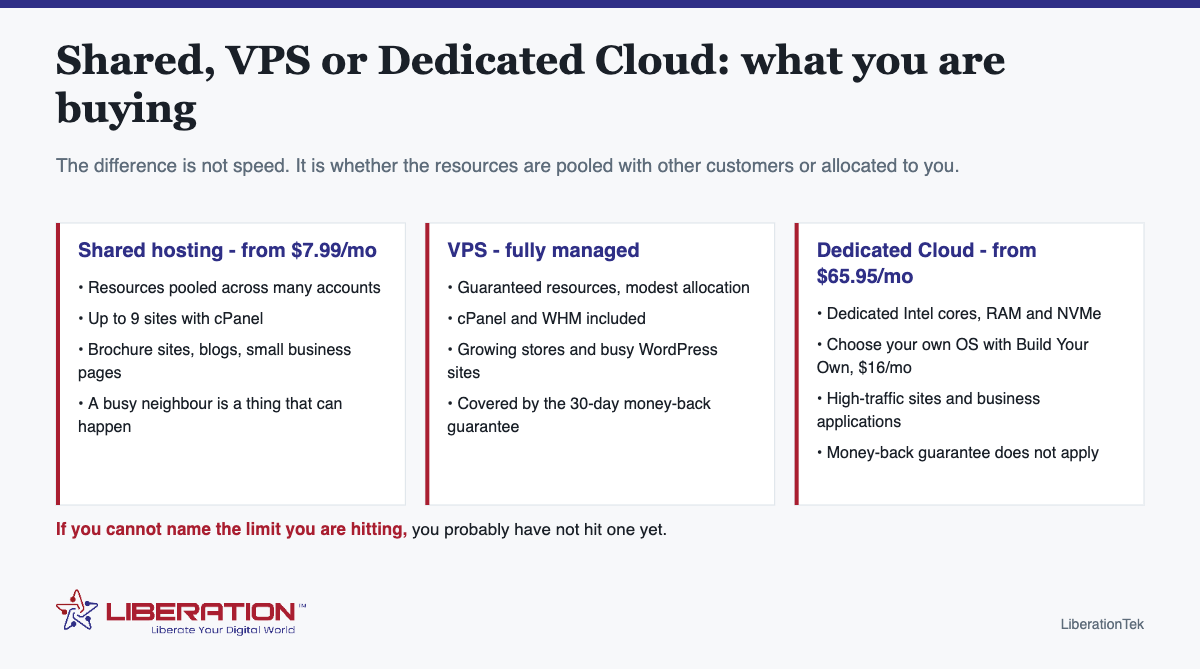
On shared hosting, hundreds of sites sit on one machine and draw from a common pool of CPU and memory. It works well for brochure sites and small business pages, and it is why shared plans start at $7.99 a month. The trade is that you are one of many: a neighbor having a busy day is a thing that can happen to you.
On a private cloud, the resources are allocated to you. Nobody else draws on your cores. That is the whole proposition, and everything else – performance consistency, capacity planning, the ability to run software that needs real memory – follows from it.
Shared hosting, VPS or private cloud hosting
| Shared hosting | VPS | Dedicated Cloud | |
|---|---|---|---|
| Resources | Pooled across many accounts | Guaranteed, modest | Guaranteed, substantially larger |
| Suits | Brochure sites, blogs, small business sites – up to 9 sites per account | Growing stores and busy WordPress sites | High-traffic sites and business applications |
| Control panel | cPanel | cPanel and WHM | cPanel and WHM |
| Choose your own OS | No | No | Yes, with Build Your Own |
| Starts at | $7.99/mo | See VPS plans | $65.95/mo, or $16.00/mo Build Your Own |
The honest summary: most businesses asking about private cloud are actually well served by a VPS, and the ones who genuinely need dedicated capacity usually know why. If you cannot name the constraint you are hitting, you probably have not hit one yet.
Five reasons businesses move up to private cloud hosting
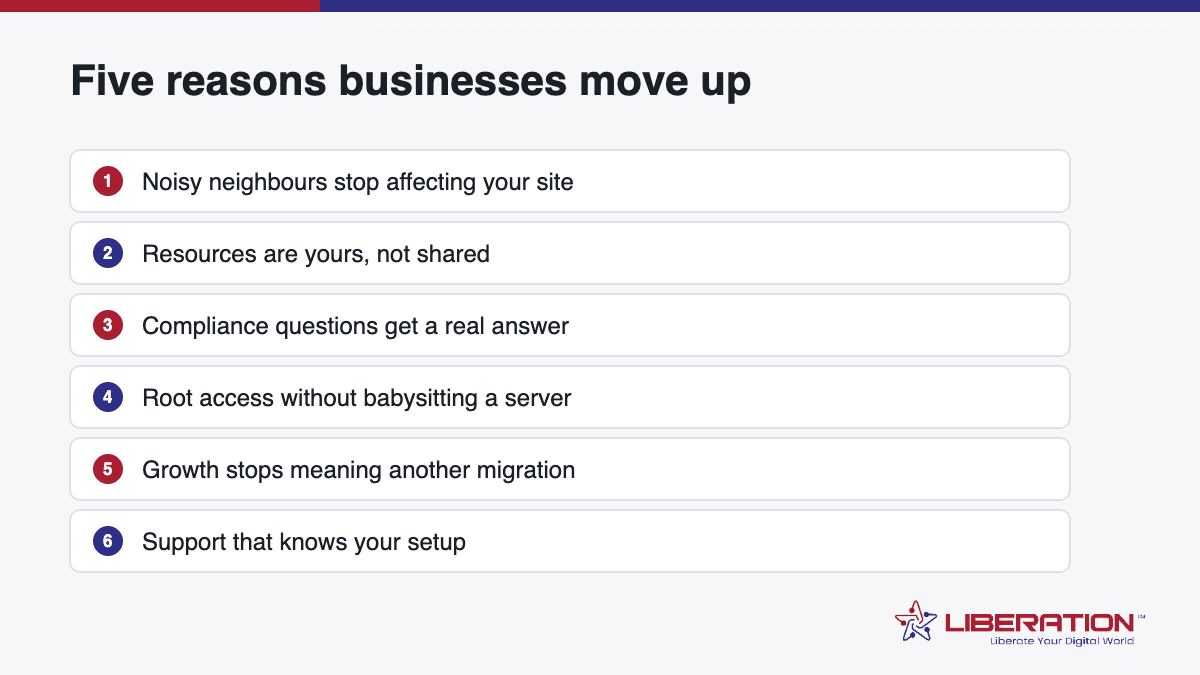
- A busy application starves everything else. One heavy database or reporting job on a shared account affects every other site in it.
- Traffic is spiky rather than high. Campaigns, seasonal peaks and launches need headroom that only exists if the resources are yours.
- The software needs real memory. Search indexes, media processing and analytics all fall over quietly on small allocations.
- Compliance or contractual requirements. Some clients will ask where data sits and who else is on the machine. “Dedicated resources on U.S.-owned hardware” is an answer; “shared hosting” is not.
- Predictability matters more than price. Once a site earns money, a slow afternoon costs more than the hosting does.
What is included with private cloud hosting here
- Dedicated Intel cores, RAM and NVMe storage on a high-availability cloud, not shared with other customers.
- cPanel and WHM licenses included in every package, rather than added to the bill later.
- Free SSL and multi-tiered security, including web application firewalls.
- Servers we own and operate in the United States. Not resold capacity on somebody else’s platform.
- No tracking or sharing of your cloud data.
- Build Your Own if the standard sizes do not fit – choose the operating system, vCPU, RAM and storage from $16.00 a month.
- Upgrades later without rebuilding: move to a larger plan or add resources as the site grows.
One thing worth stating plainly rather than burying: the 30-day money-back guarantee covers first-time Shared, Reseller and VPS accounts, and does not extend to Dedicated Cloud plans. That is exactly why it is worth a conversation about sizing before you order rather than after.
Managed private cloud hosting, or managed by you
Every plan ships with cPanel, free SSL and site security, which covers ordinary site administration – domains, mailboxes, databases, backups – through a control panel rather than a terminal. What that does not include is someone else taking responsibility for the operating system underneath. If nobody on your side wants that job, managed services are available as a separate arrangement. Buying a big server with no plan for who administers it is the most common and most expensive mistake in this category.
Getting the size of your private cloud hosting right
Two numbers decide it: peak concurrent visitors, and the memory footprint of the heaviest thing you run. Most people know the first and have never measured the second. Before ordering, check your current plan’s resource usage graphs at peak, not at average – the average always looks fine, which is why it is useless for this decision.
If you want a second opinion, book a call and we will size it with you. We would rather tell you a VPS is enough than sell you a server you do not need.
What private cloud hosting changes day to day
Two outside references worth reading before you size anything: NIST’s definition of the deployment models still sets the vocabulary vendors use (NIST SP 800-145), and if card data will touch the server, the PCI DSS standard is what your processor will hold you to.
The phrase is abstract until you see where it shows up. Four places, in the order businesses notice them:
- Consistency, not peak speed. A well-built site on shared hosting is fast most of the time. On dedicated resources it is fast at the same speed every time, which matters more for checkout and booking flows than a benchmark ever will.
- Behavior under load. Shared plans have limits that engage when you exceed them – the site slows or queues rather than failing outright. With your own cores, the ceiling is your allocation and nothing else.
- What you may run. Background jobs, scheduled imports, report generation and media processing are all things shared environments restrict, reasonably, because one account should not consume a whole machine.
- Answering procurement. “Dedicated resources on hardware the provider owns, in the United States” ends a line of questioning that “shared hosting” opens up.
Build Your Own: the option most people miss
A lot of businesses who think they need a private cloud actually need one specific thing – a particular operating system, more memory relative to cores, or a storage shape that no standard tier matches. Build Your Own covers exactly that: you choose the operating system, vCPU, RAM and storage, starting at $16.00 a month.
It is worth checking before buying a full dedicated plan, because “my workload does not fit the standard sizes” is a much cheaper problem than “my workload needs a dedicated server”.
What private cloud hosting still leaves to you
Dedicated resources solve a resource problem. They do not solve an application problem, and it is worth being clear about that before spending money.
| Symptom | Does a bigger plan fix it? |
|---|---|
| Site slow at all hours on modest traffic | No. Usually a bloated theme, unoptimised images or plugin count |
| Slow admin, fast public pages | Rarely. Usually database bloat – clean it first |
| Falls over during campaigns and launches | Yes. This is a headroom problem |
| One site drags the others down | Yes. This is a resource-sharing problem |
| Recovering from a compromise | No. Fix the entry point first, or it moves with you |
Two of those five are worth a bigger plan. The other three are worth an afternoon on the site itself, and moving them to dedicated resources buys you a faster version of the same problem.
Sizing private cloud hosting without guessing
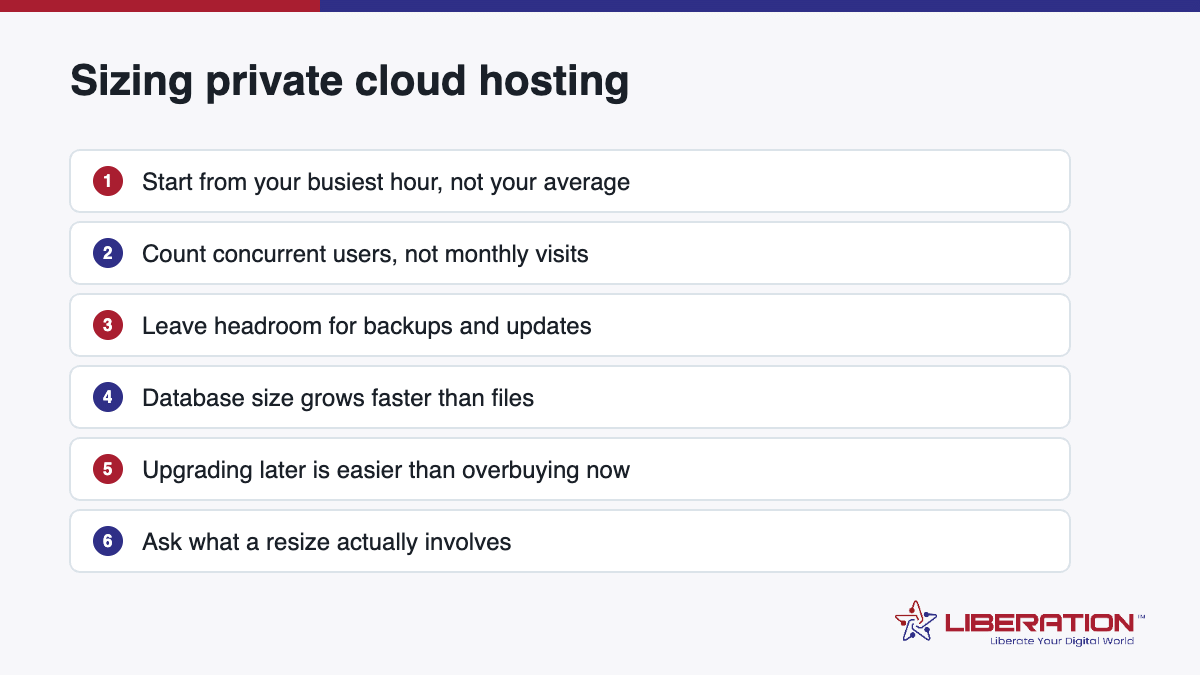
Open your current control panel and look at resource usage at peak, not on average – the average always looks comfortable, which is why it is useless for this decision. Then note three numbers: how often you hit a limit in the last 30 days, what your busiest day this year did, and the memory footprint of the heaviest thing you run.
Hitting limits daily is a ceiling. Hitting them during one campaign is a headroom question. Never hitting them means you have room, whatever the site feels like.
One practical note before ordering: the 30-day money-back guarantee covers first-time Shared, Reseller and VPS accounts and does not extend to Dedicated Cloud. That is a genuine reason to size it in a conversation rather than in a checkout, and we would rather talk you down a tier than sell you headroom you will not use.
Frequently asked questions
What is private cloud hosting?
Private cloud hosting gives a business its own dedicated compute resources – cores, memory and storage – on infrastructure that is not shared with other customers, while the provider still owns and operates the hardware. It sits between a VPS, where resources are guaranteed but smaller, and buying your own servers.
Is private cloud the same as a dedicated server?
Not quite. A dedicated server is one physical machine. A private cloud gives you dedicated resources on a high-availability platform, so the workload is not tied to a single box and capacity can be added without a hardware swap.
How much does private cloud hosting cost?
Dedicated Cloud plans start at $65.95 per month, with cPanel, free SSL and advanced site security included. A Build Your Own configuration, where you pick the operating system, vCPU, RAM and storage, starts at $16.00 per month.
Do I need to manage the server myself?
Every plan includes cPanel, free SSL and site security, so day-to-day administration is handled through a control panel. If you would rather not administer the server at all, managed services are available separately.
When should I move from VPS to private cloud?
When the VPS is consistently at its resource ceiling, when one busy application is starving the rest, or when you need more cores, memory, storage and bandwidth than a VPS tier offers. If none of those are true, the VPS is better value.
See Dedicated Cloud plans, or compare against VPS hosting and shared hosting.
Related reading
- Sovereign Cloud — Infrastructure you can point at on a map.
- Cloud Computing for Small Business — The wider picture, by use case.