
A private cloud for small business use is usually unnecessary, and the businesses that genuinely need one can name the exact problem that got them there. The useful question is not “is private cloud better” – it is “what am I currently running out of?” If you cannot answer that, shared hosting at $7.99 a month or a VPS is the better purchase, and this article will have saved you money.
Here is how to tell which side of the line you are on, using numbers you already have.
A private cloud for small business starts with what you are running out of
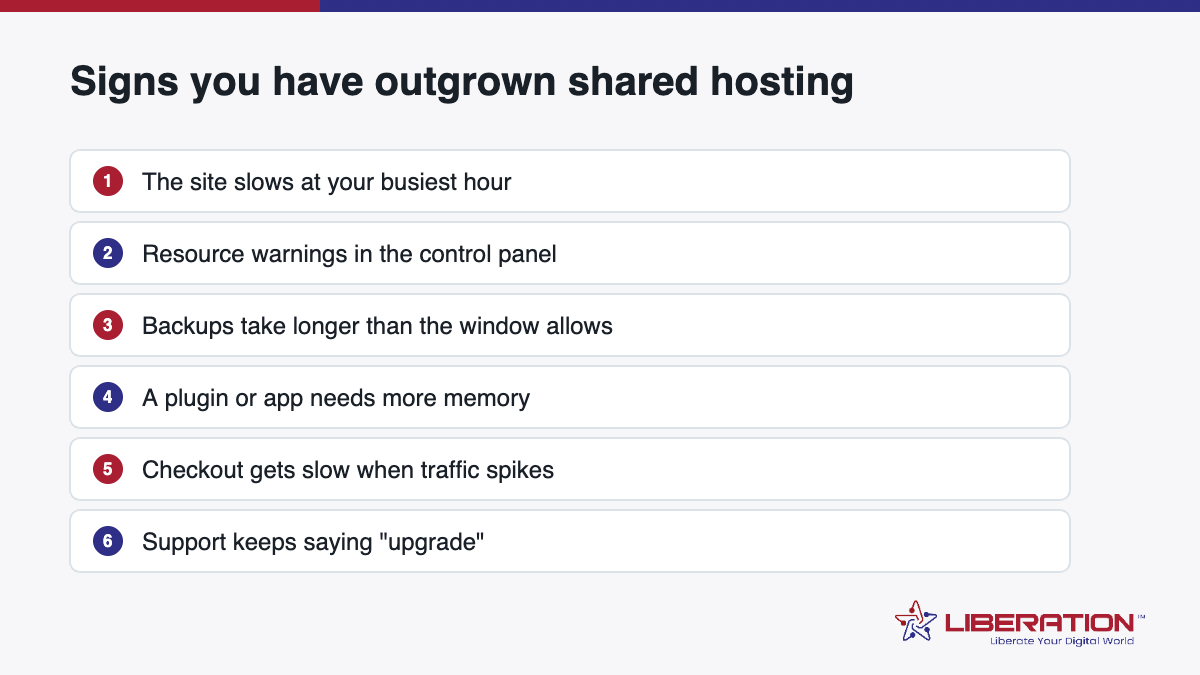
Hosting problems come in four shapes, and each has a different answer.
| What you notice | What it usually is | What actually fixes it |
|---|---|---|
| Site is slow all the time, traffic is modest | Bloated theme, unoptimised images, too many plugins | Not a bigger server. Fix the site first. |
| Admin is slow while the public site is fine | Database size or a heavy plugin | Database cleanup, then more memory if it persists |
| Fine most days, falls over during campaigns | No headroom for peaks | Guaranteed resources – VPS, then Dedicated Cloud |
| One site or app drags down everything else in the account | Shared resource pool | Separation onto dedicated resources |
The first row catches more businesses than the other three combined. Moving a slow, badly built site to a bigger server makes it a slow, badly built site on a bigger bill.
When a private cloud for small business does make sense
- A business application, not just a website. Client portals, booking systems, inventory, anything with a real database behind it. These need memory that shared plans do not promise.
- Spiky traffic. A seasonal business, an email list that all clicks at once, a product launch. Averages look fine; the peak is what breaks.
- Someone is asking who else is on the machine. Enterprise clients, insurers and some regulators do ask. “Dedicated resources on U.S.-owned hardware” is an answer that ends the conversation.
- Downtime now costs more than hosting. Once the site takes orders or bookings, an afternoon offline is more expensive than a year of the difference in plan price.
How to check if you need a private cloud for small business, in fifteen minutes
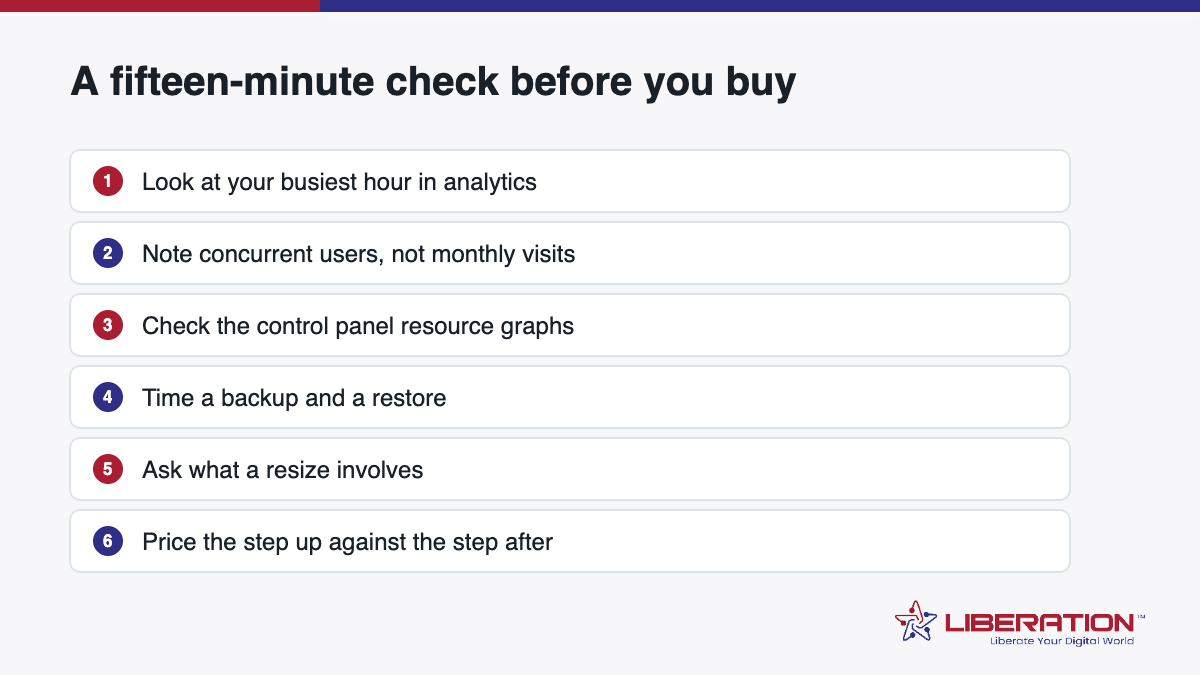
Two outside checks are worth running before you spend anything: measure the site as visitors experience it with PageSpeed Insights, and if you take card payments, read what your processor will expect of the server under PCI DSS.
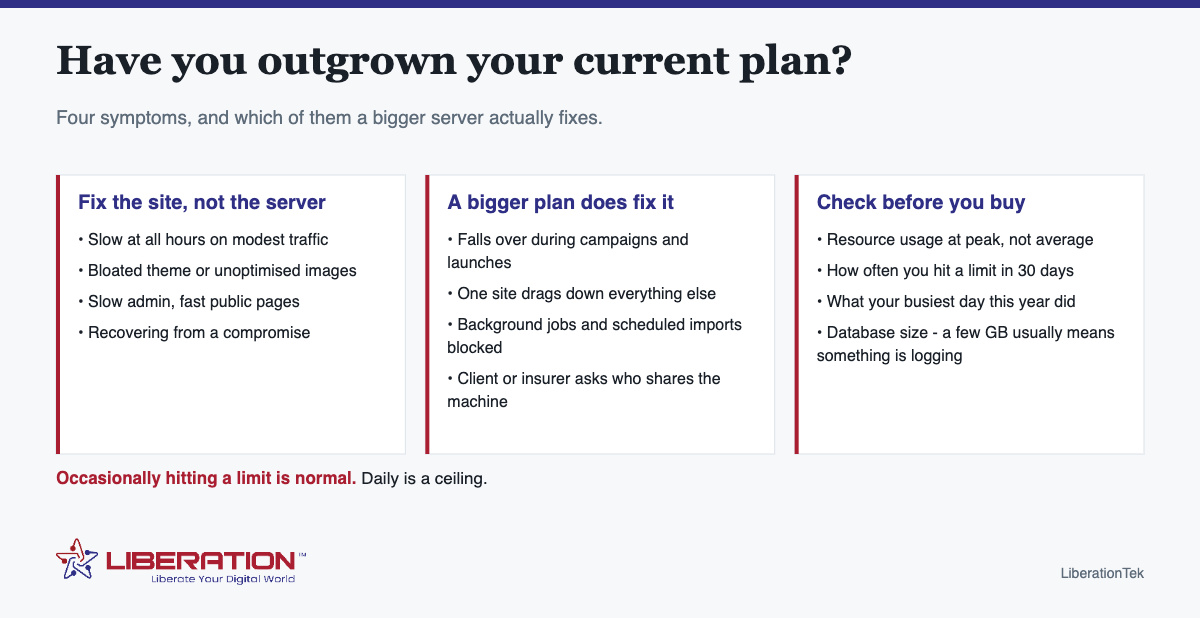
- Open your hosting control panel and find the resource usage graphs. Look at the peak, not the average – averages hide exactly the problem you are investigating.
- Count how often you hit a limit in the last 30 days. Occasionally is normal. Daily is a ceiling.
- Check your database size. A few gigabytes on a small business site usually means something is logging that should not be.
- Note what happened during your busiest day this year. If nothing broke, you have headroom.
If you hit limits daily, or your busiest day did break something, you have evidence. If not, you have a preference – which is fine, but should be priced as one.
What a private cloud for small business actually costs
| Tier | Best for | From |
|---|---|---|
| Shared hosting | Brochure sites, blogs, small business sites – up to 9 sites with cPanel | $7.99/mo |
| VPS | Growing stores and busy WordPress sites needing guaranteed resources, fully managed with cPanel and WHM | See VPS plans |
| Dedicated Cloud | High-traffic sites and business applications needing a private, high-availability server | $65.95/mo |
| Build Your Own | Choosing your own operating system, vCPU, RAM and storage | $16.00/mo |
Note the last row. A lot of businesses who think they need a private cloud actually need one unusual thing – a particular operating system, or more memory relative to cores – and Build Your Own covers that from $16.00 a month without the jump to a full dedicated plan.
Two things worth knowing before ordering a private cloud for small business
You can upgrade later. Plans move up and resources can be added as the site grows, so there is no need to buy two years of headroom today.
The money-back guarantee does not cover Dedicated Cloud. It applies to first-time Shared, Reseller and VPS accounts. That is a genuine reason to have the sizing conversation before ordering rather than working it out afterwards.
The honest recommendation on a private cloud for small business
If you are asking this question for the first time, the answer is almost always a VPS. It gives guaranteed resources, includes cPanel and WHM, comes fully managed, and is covered by the money-back guarantee. Move to Dedicated Cloud when the VPS is genuinely at its ceiling – and by then you will not need an article to tell you.
Want a second opinion on the graphs? Send them over. We would rather tell you that shared hosting is enough than sell you something you do not need.
What it costs to get this wrong in each direction
Both mistakes are real, and they are not symmetrical.
Buying too much costs money and nothing else. You overpay, the site runs comfortably, and you can move down later. It is an annoyance.
Buying too little costs money you never see. The site is slow during exactly the moments you spent money to create – the campaign, the launch, the busy season – and the visitors who leave do not tell you why. That is why the sizing conversation is worth having properly rather than picking the cheapest tier that seems plausible.
The asymmetry is the argument for buying one step above your measured peak, not three.
The middle options between shared hosting and a private cloud for small business
| If the problem is… | The proportionate answer |
|---|---|
| Occasional traffic spikes on an otherwise fine site | Caching and a CDN before any plan change |
| One heavy site among several | Separate that site onto its own plan |
| A workload needing a specific OS or memory shape | Build Your Own, from $16.00/mo |
| Consistent resource ceilings across the board | VPS, fully managed with cPanel and WHM |
| All of the above plus business applications | Dedicated Cloud, from $65.95/mo |
Most businesses land on one of the first three rows. The industry talks mostly about the last two, because that is where the margin is.
What to do with a growing store specifically
E-commerce changes the calculation, because the cost of a slow checkout is measurable and immediate. Three things matter more than raw specification: the database behaving under concurrent carts, the ability to run background jobs without slowing the storefront, and a backup you can restore quickly enough that a bad deployment on a Friday is not a weekend.
A fully managed VPS covers all three for most independent stores. Dedicated Cloud becomes the answer when the catalogue is large, the traffic is genuinely high, or the store is one part of a wider business application rather than the whole thing.
The conversation worth having before you buy
Bring three things and the sizing takes ten minutes: your peak resource usage graph, your busiest day of the last twelve months, and a sentence about what you are planning that might change either. Book a call and we will tell you which tier that points at – including when the answer is that your current plan is fine and the site needs an afternoon of work instead.
If you are still not sure, do this in the next 30 days
Uncertainty here usually means the evidence has not been gathered rather than that the decision is genuinely finely balanced. Four steps settle it.
- Turn on resource monitoring if it is not already recording, and leave it for a month. One month of real data beats any amount of estimating.
- Run a speed test on your slowest page and look at what the report blames. If it names image sizes, scripts or render-blocking resources, the server is not your problem.
- Note the next event in your calendar that will drive traffic – a campaign, a sale, a seasonal peak – and treat that as the test.
- Ask what a slow hour actually costs you. For a brochure site, very little. For a store taking orders, the number is usually larger than the annual difference between two hosting tiers, which settles the argument on its own.
After a month you will have an answer that does not depend on anyone’s opinion, including ours.
Frequently asked questions
Does a small business need a private cloud?
Most do not. Shared hosting suits brochure sites and small business pages, and a VPS covers growing stores and busy WordPress sites. A private cloud earns its cost when one application is starving the others, when traffic is spiky, when software needs real memory, or when a client or regulator asks who else is on the machine.
What is the difference between a VPS and a private cloud for a small business?
Both give guaranteed resources. A VPS provides a smaller allocation and suits growing sites; a Dedicated Cloud plan provides substantially more cores, memory, storage and bandwidth. The practical test is whether your current plan is hitting its ceiling at peak.
How do I know when I need a private cloud for small business?
Look at resource usage at peak rather than on average. Consistent CPU or memory limits, slow admin pages while the public site looks fine, timeouts during campaigns, or a database grown past a few gigabytes are the usual signals.
What does a private cloud cost a small business?
Dedicated Cloud plans start at $65.95 per month with cPanel, free SSL and site security included. Build Your Own starts at $16.00 per month. Shared hosting starts at $7.99 per month and hosts up to nine sites.
Can I upgrade later instead of buying capacity now?
Yes. Plans can be moved up or given more resources as the site grows, so buying headroom you do not need yet is rarely the right call.
Related reading
- Private Cloud Security Solutions: What They Cover and Who Owns What
- Private Cloud Hosting: What You Get That Shared and VPS Don’t
- Sovereign Cloud — Infrastructure you can point at on a map.
- Cloud Computing for Small Business — The wider picture, by use case.