
There is no single answer to the cost to hire a WordPress developer, because the phrase covers everything from a five-page brochure site to a membership platform with payments. What is consistent is what drives the cost – scope, who you hire, and the four things usually missing from the quote. Get those clear and you can compare proposals honestly instead of comparing numbers that describe different projects.
Why hourly rates tell you almost nothing
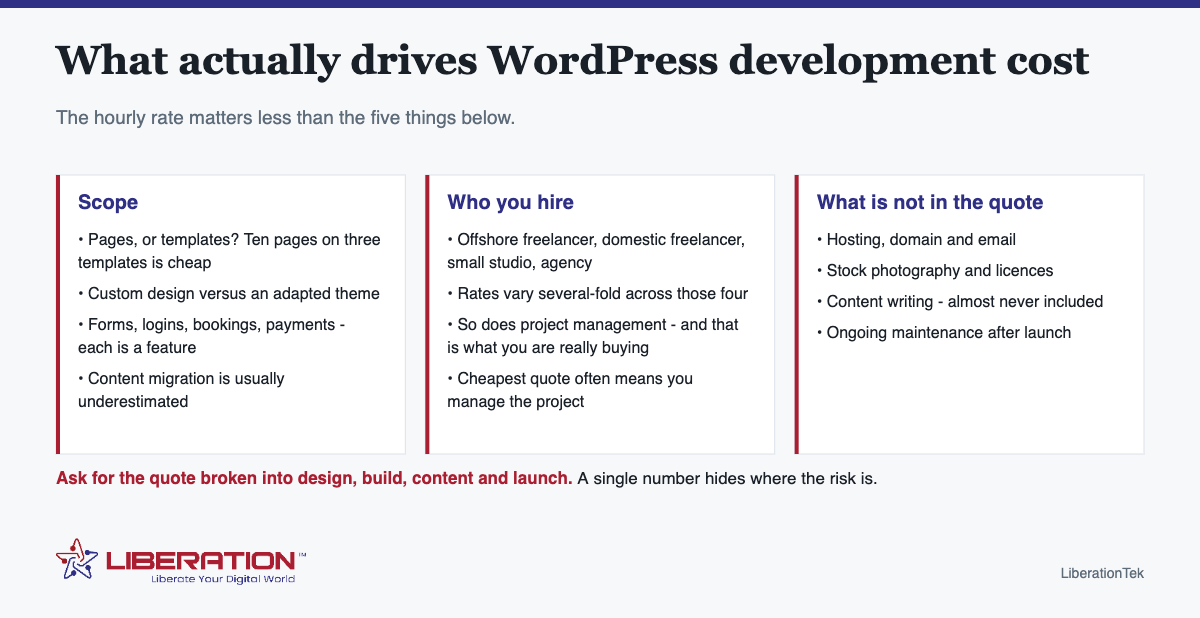
Rates for WordPress work vary several-fold depending on whether you are hiring an offshore freelancer, a domestic freelancer, a small studio or a full agency. Comparing those rates directly is misleading, because what differs is not only skill but how much of the project you end up running.
At the lower end you are typically buying execution: you supply the specification, review the work, chase revisions and test the result. At the higher end you are buying project management, and a large part of the difference in price is someone else carrying that load. Both are legitimate purchases. The mistake is assuming they are the same purchase at different prices.
Scope is the real variable
| What you are asking for | Why it changes the number |
|---|---|
| Pages versus templates | Ten pages on three templates is a small job. Ten bespoke layouts is not. |
| Custom design or adapted theme | Original design is a separate discipline with its own cost. |
| Features | Forms, logins, bookings, calculators and payments are each a feature, not a page. |
| E-commerce | A store is a different project from a website with a shop page. |
| Content migration | Moving 200 existing posts is real work and is routinely underestimated. |
| Integrations | CRM, accounting, booking systems – each one is a small project. |
Write your requirement as a list of features rather than a number of pages, and quotes become comparable immediately.
The four things usually missing from the quote
- Hosting, domain and email. Sometimes bundled, often not, occasionally bundled in a way that leaves the accounts in the designer’s name – see below.
- Stock photography and licenses. Someone has to pay for images, and using unlicensed ones is a problem that surfaces later.
- Content writing. Almost never included, and almost always the reason projects run late. Designers wait on copy; copy waits on someone at your end having a free afternoon.
- Maintenance after launch. WordPress needs updating. Decide before launch whether that is you, them, or a maintenance plan, because “nobody” is the default answer and it ends badly.
The question to ask before any of the others
Whose name are the domain and hosting accounts in?
Bundled hosting is convenient, and it is also how businesses lose control of their own website. If the domain is registered to your designer and the hosting is on their account, then at the end of the relationship – amicable or not – they hold the thing you cannot replace.
The fix costs nothing and should be non-negotiable: the domain registered in your business’s name, on an account you control, and hosting in your name with the logins in your possession. A good developer will agree without hesitation; a reaction to that request tells you something worth knowing early.
How to make quotes comparable
Ask every proposal to break the number into four parts:
- Design – original design, or theme adaptation?
- Build – which features, listed individually
- Content – who writes it, and is migration included?
- Launch – testing, DNS, SSL, and who is responsible if something breaks in week one
Then ask two closing questions: what happens if we want a change in month two, and what does support cost after launch? The answers are usually more revealing than the total.
What you can do without a developer at all
Worth saying plainly, because it is often the right answer for a small business. If the requirement is a brochure site – who you are, what you do, how to reach you – a drag-and-drop website builder at $10.99 a month with hosting and SSL included will do it, and you will be able to update it yourself afterwards without booking anyone’s time.
Hire a developer when you need something a builder cannot do: custom functionality, integrations, an unusual design, or a migration that has to preserve years of content and URLs. That is a genuine project and worth paying for properly.
Where we fit
We do custom web development on a consultation basis rather than a price list, because the honest answer to “how much” is always “what do you need it to do”. We will also tell you when a builder is enough – that conversation costs nothing and saves more people money than it loses us.
On hosting: shared hosting from $7.99 a month covers most brochure sites, and whatever you decide about the build, keep the domain and hosting in your own name.
What a WordPress developer quote should actually contain
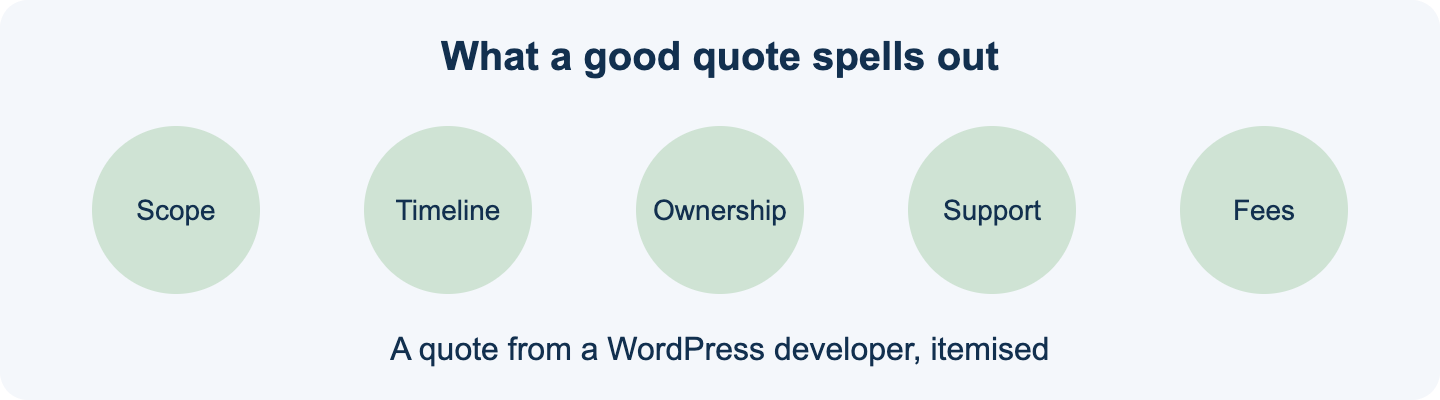
The cost to hire a WordPress developer becomes far easier to judge once the quote is itemised. A quote that is a single number and a sentence is not a quote, it is a hope. Ask for these lines separately, and the comparison between two developers becomes an actual comparison:
| Line item | Why it matters |
|---|---|
| Discovery and planning | Sitemap, page count and functionality agreed before building starts |
| Design | Whether it is a customized theme or original design, and how many revisions are included |
| Build | Page templates, forms, and any custom functionality |
| Content entry | Who types in the text and uploads the images. This is frequently assumed to be you |
| Testing | Browsers, mobile, forms, checkout if you sell |
| Launch | DNS, SSL, redirects from the old site |
| Training | An hour showing you how to edit your own site pays for itself quickly |
| Aftercare | How long fixes are free, and what happens on day 31 |
What you are actually paying for at each price level
The low end
At the cheapest end you are usually buying a premium theme installed with your logo and colors applied, and your content pasted in. There is nothing wrong with this if it is what you need and if it is what you were told you were getting. The problem is when it is sold as custom design. A useful test: ask which theme is being used. A straight answer is fine. Evasion is the signal.
The middle
Here you get a considered structure, a theme customized beyond recognition or a light custom build, content help, and someone who asks what the site is supposed to achieve before designing it. For most small businesses this range is where the value sits, because the thinking is included rather than just the assembly.
The high end
Original design, custom functionality, integrations with systems you already run, and a process with defined stages. Worth it when the site is a significant revenue channel and when specific functionality does not exist off the shelf. Not worth it for a five-page brochure site, whatever the pitch.
The costs that arrive after launch
Almost every unpleasant surprise in this area is a recurring cost that was not mentioned while the project was being sold. Before you sign, get clear on:
- Hosting. What it costs, who it is with, and whose name the account is in.
- Premium plugin licenses. These renew annually. If the site depends on three of them, that is a real yearly cost, and it is yours.
- Maintenance. Updates and backups either happen on a retainer, or you do them, or nobody does them. The third is the most common and the most expensive.
- Change requests. The hourly rate for small edits after launch, and the minimum billing increment.
- The domain renewal. Small, but if it lapses because it was in someone else’s name and their card expired, the cost is your website.
None of these are unreasonable charges. They are only a problem when they appear for the first time after the invoice for the build has been paid.
How to hire a WordPress developer and compare their answers
The easiest way to control the cost of a WordPress developer is to send every candidate the same written brief. When each WordPress developer prices the same scope, the differences between quotes become visible, and you can ask about them directly.
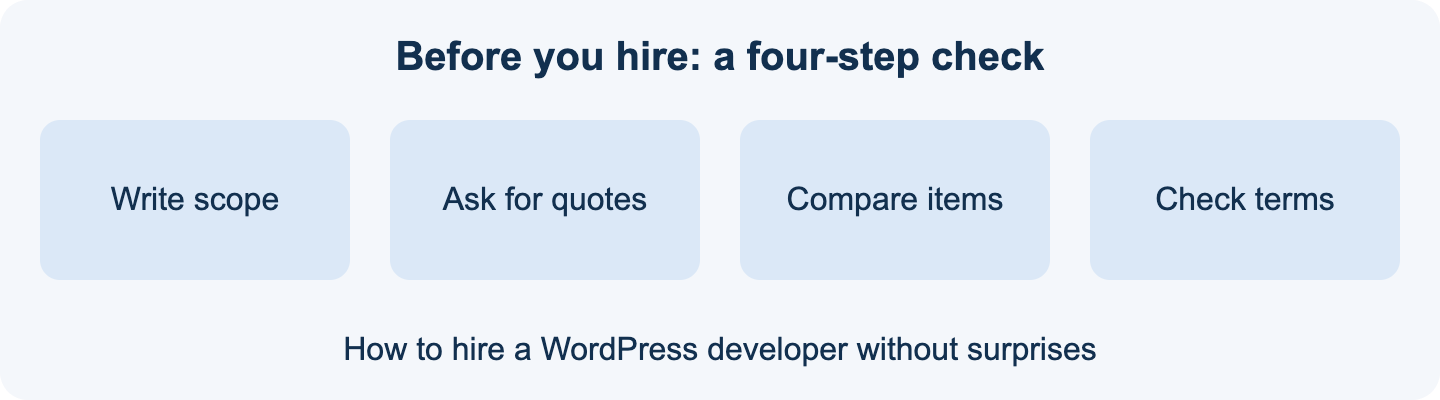
- Write down the pages, features and integrations you need, and what you already have, such as a logo, copy and photos.
- Ask each WordPress developer for an itemised quote instead of a single total.
- Compare line by line and ask why any item appears in one quote but not another.
- Check who owns the finished work, who holds the logins, and what happens if you part ways with the WordPress developer later.
Our guide on building a website yourself or hiring a developer is a useful companion if you are still deciding whether to hire at all.
Red flags to look for in a WordPress developer quote
A good WordPress developer is happy to explain every line of a proposal. Be careful when answers are vague, because vague scope is where extra charges come from later.
- No written scope, only a number.
- No mention of hosting, backups or updates after launch.
- A WordPress developer who will not say who owns the theme, code and content.
- Pressure to decide quickly, without time to compare.
- Pricing that is far below every other quote, with no explanation.
It also helps to know what good practice looks like. WordPress publishes its own developer documentation, which any capable WordPress developer should be comfortable working from, and you can skim it to follow what they tell you. The FTC also offers plain-language cybersecurity guidance for small businesses; ask any WordPress developer how they handle logins, updates and backups. This is general information, not legal advice, and a contract should be reviewed by someone qualified.
If a full custom build is more than you need, our Website Builder may cover it, and you can hand the technical side to our web development team instead of searching for a WordPress developer yourself.
Frequently asked questions
How much does it cost to hire a WordPress developer?
Rates vary several-fold depending on whether you hire an offshore freelancer, a domestic freelancer, a small studio or an agency, so a meaningful answer comes from scope rather than an hourly figure. A brochure site on an adapted theme is a small project; a site with bookings, logins or payments is a different order of work.
What is the average price for a WordPress website?
There is no reliable average, because the same phrase covers a five-page brochure site and a membership platform. What is consistent is the shape of the cost: design, build, content and launch, plus hosting and domain separately.
What is usually not included in a web design quote?
Hosting, domain registration and email; stock photography and licenses; content writing, which is almost never included; and ongoing maintenance after go-live. Ask about all four explicitly before signing.
Is a cheaper developer a false economy?
Sometimes, and the tell is not the rate – it is who manages the project. A lower rate frequently means you supply the specification, chase revisions and test the result. If you have the time, that works; if not, the cheaper quote costs more in your own hours.
Should hosting be included in a web design package?
It can be, but make sure the accounts are in your business’s name and that you hold the logins. Bundled hosting is convenient until the relationship ends, at which point whoever controls the domain and hosting controls your website.
What should be itemised in a WordPress developer quote?
A usable quote separates discovery, design, build, content entry, testing, launch, training and aftercare. Content entry is the line most often assumed to be the client’s job without being said, and aftercare is the line that determines what happens when something breaks in week five. A single number with no breakdown cannot be compared against another quote.
Do I keep the website if I stop working with the developer?
You should, and it depends on whose name the domain and hosting are in. If both are registered to you, the site is yours and you can move it to another developer at any time. If they are in the developer’s name, leaving becomes a negotiation. Settle this before the project starts, not when the relationship has soured.