
AI website builders are good at first drafts: layout, structure, stock imagery, boilerplate copy. They are consistently weak at the things that determine whether a site works — accurate specifics about your business, differentiated copy, conversion design, accessibility, and content Google treats as worth ranking. Use one to skip the blank page, then replace every generated sentence with something true about you. Never publish the output unedited, and check what you can export before you commit.
The demo really is good. You type three sentences about your business, wait a few minutes, and a complete website appears — homepage, services, about, contact, with images, colours and copy already in place. For anyone who has stared at an empty template wondering where to start, it is a genuine relief.
Then you read the copy. It says your team is passionate about delivering exceptional results. It says you combine industry-leading expertise with a customer-first approach. It could belong to any business in any sector in any country.
That gap — between an impressive structure and interchangeable substance — is the whole story of AI website builders, and it determines how to use them well.
What AI website builders are genuinely good at
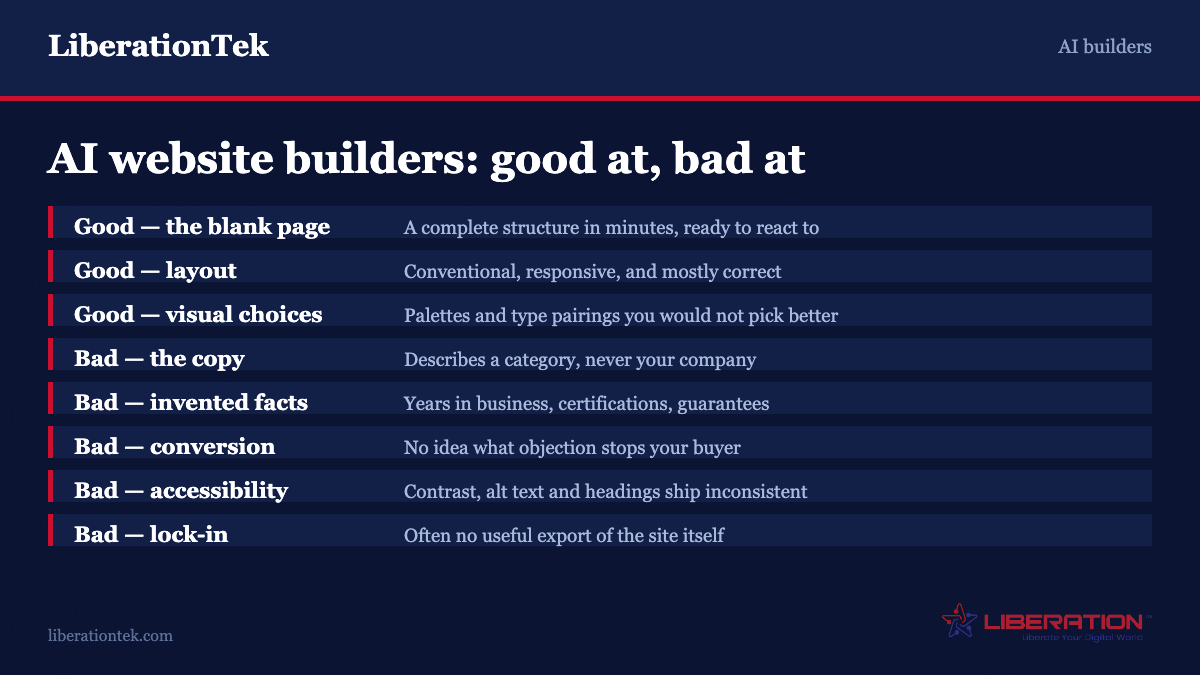
Getting past the blank page. The hardest part of building a site is the first hour. An AI builder produces a complete structure in minutes, and a structure you can react to is worth far more than a template you have to imagine into. Most people edit better than they originate.
Sensible default layout. The generated result is usually a competent modern layout: a clear hero, a services section, some social proof, a call to action, a footer with the right things in it. It is generic, but generic here means conventional, and conventional is mostly correct for a small business site. Visitors have strong expectations about where things go.
Responsive behaviour out of the box. The output works on a phone. This is unglamorous and removes an entire category of problem that used to consume real time.
Coherent visual choices. Colour palettes, type pairings and spacing are typically defensible. If your alternative was choosing these yourself without a design background, the AI version is probably better than what you would have picked.
Stock imagery selection. It picks images matching the sector. Generic, but placed and cropped correctly, which saves an afternoon.
Structural scaffolding for content. The headings it generates — what sections a plumber’s site or an accountant’s site should have — are a reasonable content checklist even if every word beneath them gets replaced.
Taken together that is real value. It is the value of a good first draft, which is not nothing.
Where they fail, consistently
1. The copy says nothing. This is the central failure and everything else is downstream of it. AI-generated business copy is fluent, grammatical and completely interchangeable. It describes a category, not a company. The generated text for a roofing business in Ohio and one in Arizona differs mainly in the place name — not in the fact that one specialises in hail damage insurance claims and the other in reflective coatings for extreme heat.
That matters commercially, not just aesthetically. The specifics are what convince a visitor you are the right choice, and specifics are exactly what the AI does not have. It was never told them.
2. It invents things. Generated copy routinely asserts years in business, team sizes, service areas, certifications and guarantees the model had no basis for. “Serving the community for over 20 years” appears on sites launched by businesses founded last spring. Some of these are merely embarrassing. Claims about licensing, insurance or certification can be a regulatory problem. Read every generated sentence as a factual claim you are personally publishing, because that is what it is.
3. Conversion design is absent. The layout looks right. Whether it moves someone toward contacting you is a different question, and it requires knowing what your customers worry about, what objection stops them, and what proof answers it. An AI builder places a contact button in a conventional spot. It does not know your buyers will not call until they have seen a price range, or that your competitors all hide their pricing and showing yours would win the job.
4. Accessibility is inconsistent. Generated sites frequently ship low-contrast text, images without meaningful alt text, and headings chosen by visual size rather than structure. With federal website accessibility filings running at over three thousand a year, this is not theoretical. Our guide to small business accessibility covers what actually applies and the fixes that matter.
5. SEO is structural at best. The builder will generate title tags and meta descriptions. What it will not do is work out which search terms your customers actually use, or build content that answers a question better than the pages already ranking. Filling in the fields is not the work.
6. The output is often locked in. This gets missed until it matters. Many AI builders produce sites that cannot be exported in any useful form — you can take your text and images, not the site. If you outgrow the platform, or its pricing changes, or it shuts down, you rebuild. Check the export path before you commit, not after.
The Google question
A common worry: will Google penalise a site because AI wrote it?
No, and Google has been explicit. Its published guidance on generative AI content states that using AI is not itself a problem — what matters is whether the result helps anyone. The line it draws is scaled content abuse: using such tools to “generate many pages without adding value for users” may violate that spam policy. The disqualifying characteristics it names are content produced with little effort, little originality and little added value.
So a five-page AI-generated business site is not spam by virtue of how it was made. But read those three phrases again and ask whether unedited generated copy clears them. Little originality, little added value, and a page saying the same thing as ten thousand others is a fair description of the default output.
The practical risk is not a penalty. It is indifference — a site never manually actioned and never ranked, because nothing on it is worth surfacing. That is the more common outcome and it is harder to notice, because nothing appears to have gone wrong.
How to actually use one
Treat the AI as a fast designer with no knowledge of your business.
Generate, then gut the copy. Keep the structure. Replace every sentence — not paraphrase, replace. Where the AI wrote “we pride ourselves on quality workmanship,” write what you actually do: the brand of materials, the length of the warranty, the fact that you photograph every job before and after and send the customer the file.
Fact-check every claim. Years in business, number of staff, service radius, certifications, response times, guarantees. Delete anything you cannot substantiate. This takes twenty minutes and prevents the two worst outcomes — a customer catching you in a false claim, and a regulator doing the same.
Replace the stock photography. Photographs of your actual premises, team and work outperform stock imagery by a wide margin, and phone cameras are entirely adequate. This is the single highest-value hour you can spend on a small business site.
Add what it will not think of. Real pricing or a range. Named testimonials with a first name and a town. A specific service area. Licence numbers where they apply. Your actual hours. A phone number in the header that is a link on mobile.
Do the accessibility pass. Check contrast, write real alt text, verify the heading structure is hierarchical rather than decorative, and tab through your contact form without a mouse.
Do the keyword work separately. Find out what your customers type, then write pages that answer those questions properly. This is where ranking comes from and no builder does it for you.
Test the money path on a phone. Whatever action earns you revenue — a call, a form, a booking, a purchase — complete it yourself on a phone on mobile data. Generated sites frequently have a contact form that looks fine and fails silently.
AI builder, site builder, or WordPress?
Three routes, and the right one depends on what the site has to do.
An AI builder suits a business that needs a presence rather than a channel: a site to look legitimate, show hours and location, and take a phone call. Low content needs, no ecommerce, nobody dedicated to it. The speed genuinely wins here and the weaknesses mostly do not bite.
A hosted site builder suits most small businesses — more control than the AI route, far less maintenance than WordPress, and a template system you can actually shape. If the site needs to grow, collect leads and hold up under scrutiny, this is usually the right trade. Liberation Site Builder sits here, and AI-generated output can be a perfectly good starting point for it.
WordPress suits anything with real content ambitions, an online store, memberships, bookings or custom functionality — and anyone who needs to own and move their site. The cost is maintenance: updates, security, backups and the discipline not to install forty plugins. Our notes on vetting a WordPress plugin cover the discipline part.
The mistake worth avoiding is choosing on build speed alone. Build time is days. Ownership is years.
Questions to ask before you commit
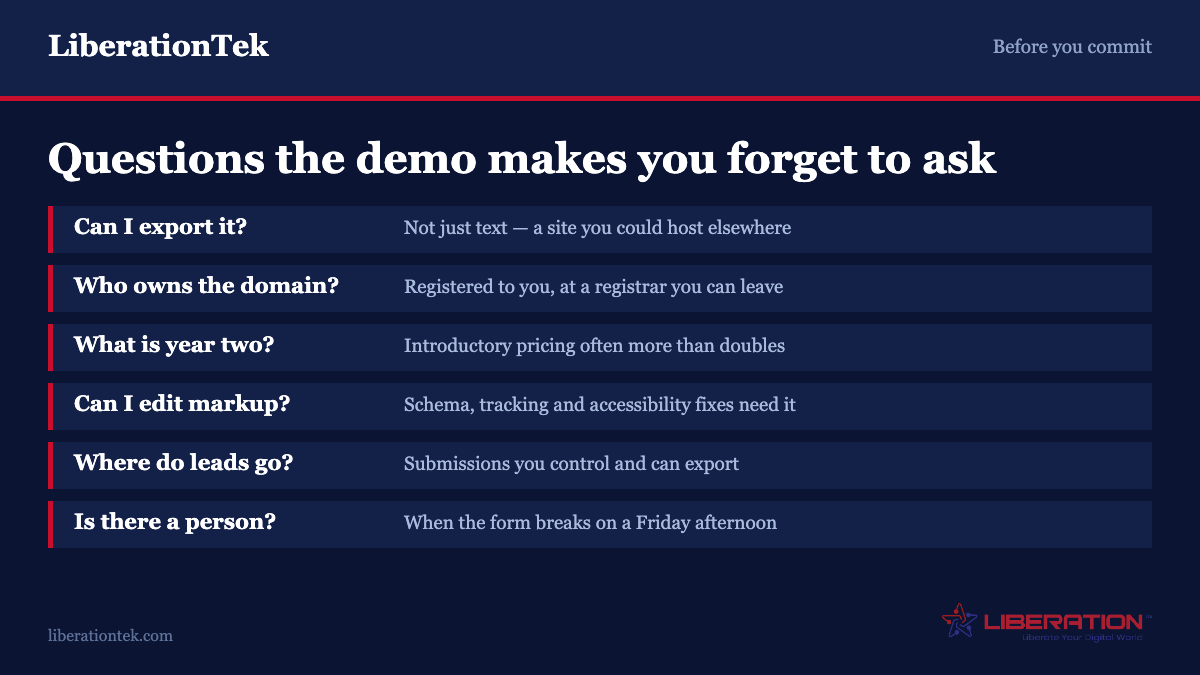
Can I export the site? Not just text and images — something you could host elsewhere. If the honest answer is no, you are renting, and price the platform accordingly.
Who owns the domain? It should be registered to you, in an account you control, with a registrar you can transfer away from. A domain held inside a builder account is a hostage.
What happens to the price after year one? Introductory pricing on site builders often more than doubles at renewal. Ask what you pay in year two, and get it in writing.
Can I edit the actual markup? Some fixes — structured data, accessibility attributes, a tracking script — need access to the HTML. Some builders do not allow it at all.
Where does my form data go? Submissions should arrive somewhere you control and be exportable. Leads trapped in a platform inbox are leads you lose when you leave.
What is the support model? When the contact form breaks on a Friday, is there a person, and how long until they answer?
None of these are about AI. They are the questions that matter about any platform, and the AI demo is designed to make you forget to ask them.
What AI is actually good for on a website
Dismissing the tools entirely would be as wrong as trusting them entirely. There is a narrower set of jobs where generative AI earns its place on a small business site, and they are mostly the ones nobody enjoys.
Drafting the boring pages. Shipping policy, returns, terms of service, an FAQ skeleton. These need to exist, need to be accurate, and nobody is going to rank on them. Generate a draft, correct it against what you actually do, publish. This is a legitimate hour saved.
Writing alt text at scale. If you have two hundred product photos with no alt text, a first pass from an AI that can see the image is far better than the nothing you have now — provided you review it, because it will describe the picture rather than its purpose.
Turning notes into prose. This is the strongest use. You know why customers choose you; you just do not enjoy writing it down. Dictate five minutes of rambling into a transcript, hand that to the AI, and ask it to organise rather than invent. The specifics come from you, the structure comes from the tool, and the output is genuinely yours.
Editing rather than generating. Asking an AI to tighten a paragraph you wrote, flag where you have been vague, or list what a sceptical reader would still want to know is reliable in a way that asking it to write from nothing is not.
The pattern across all four: the tool is useful when you supply the facts and it supplies the form. It fails when you ask it to supply both, because it has no facts to supply.
The honest summary
AI website builders have collapsed the cost of getting a competent-looking site online, and that is a real gain for a business that previously had nothing or had a page untouched since 2016. Something generic and current beats something bespoke and abandoned.
What they have not changed is what makes a website work. That is still knowing who you are talking to, saying something true and specific, making the next step obvious, and being findable. Those remain human work, and the AI cannot do them because it does not know anything about your business that you did not tell it.
Use it for the draft. Do the rest yourself. And if you would rather not manage any of it, we will move an existing site for free and tell you honestly whether it needs rebuilding or just fixing.
Frequently asked questions
Does Google penalise AI-generated website content?
Not for being AI-generated. Google’s published guidance says the method does not matter — what matters is whether the content helps anyone. It draws the line at scaled content abuse: using AI to generate many pages without adding value for users may violate that spam policy, and the disqualifiers it names are little effort, little originality and little added value. A small AI-built business site is not spam by construction, but unedited generated copy struggles to clear that bar, and the usual outcome is not a penalty but being ignored.
Are AI website builders good enough for a small business?
As a starting point, yes. They produce a competent, responsive, conventionally structured site in minutes, which is a real gain over a blank page or an abandoned one. What they cannot supply is anything specific about your business — your actual services, prices, proof and differences — and that is what converts visitors. Generate the structure, then replace the copy with things that are true about you.
What is the biggest problem with AI-generated website copy?
It describes a category rather than a company, so the text generated for two businesses in the same trade differs mainly by place name and gives a visitor no reason to choose you. The second problem is that it invents things — years in business, team sizes, certifications, guarantees the model had no basis for. Treat every generated sentence as a factual claim you are publishing under your own name, because that is exactly what it is.
Can you export a site from an AI website builder?
Often not in any useful form. Many platforms let you take your text and images but not a site you could host elsewhere, which means outgrowing the platform or disliking a price change means rebuilding from scratch. Check the export path before you commit rather than after, and check separately that the domain is registered to you with a registrar you can transfer away from.
Should I use an AI website builder or WordPress?
An AI builder is a reasonable fit if you need a presence rather than a channel — hours, location, legitimacy, a phone call — with low content needs and nobody dedicated to the site. WordPress is right when you need real content, a store, memberships or bookings, or when you need to own and move the site, and the cost is ongoing maintenance. A hosted site builder sits between the two and suits most small businesses. Choose on what you need in year two, not on build speed.
Are AI-generated websites accessible?
Inconsistently, and usually not without work. Generated sites commonly ship low-contrast text, images with missing or meaningless alt text, and headings picked for size rather than structure. With over three thousand federal website accessibility lawsuits filed in 2025, that is worth a deliberate pass: check contrast ratios, write real alt text, confirm the heading hierarchy is logical, and tab through your contact form without touching a mouse.
Sources
Google has published its position on this directly, and it is more permissive and more specific than most commentary about it suggests.
- Guidance on generative AI content — Google Search Central. Why the method of creation is not what is assessed.
- Spam policies for Google web search — Google Search Central. The scaled content abuse policy in full.