
Business email compromise statistics from the FBI show about $3.05 billion in reported losses in 2025 across 24,768 complaints, and about $17.5 billion over the 2019 to 2025 reports. It is the second most costly crime type in the FBI’s latest report. This guide lays out the numbers, what they say about how the scam works, and the controls that interrupt it.
Last reviewed: October 6, 2026. This is general information, not legal or security advice.
Key takeaways
- BEC losses reached $3.05 billion in 2025, the highest in the 2019 to 2025 series.
- Complaints rose to 24,768 in 2025, from 21,442 in 2024.
- Adding the 2019 to 2025 reports gives about $17.5 billion in reported BEC losses.
- Victims aged 60 and older reported about $568 million in BEC losses in 2025.
- The IC3 Recovery Asset Team froze about 58% of the funds in the cases it handled, which shows why speed matters.
BEC losses year by year
The FBI’s 2025 Internet Crime Report lists BEC at $3,046,598,558 in reported losses. Figure 1 compares it with each earlier report. The category was labeled BEC/EAC (email account compromise) in the 2019 to 2021 editions, and the figures are close enough to compare.
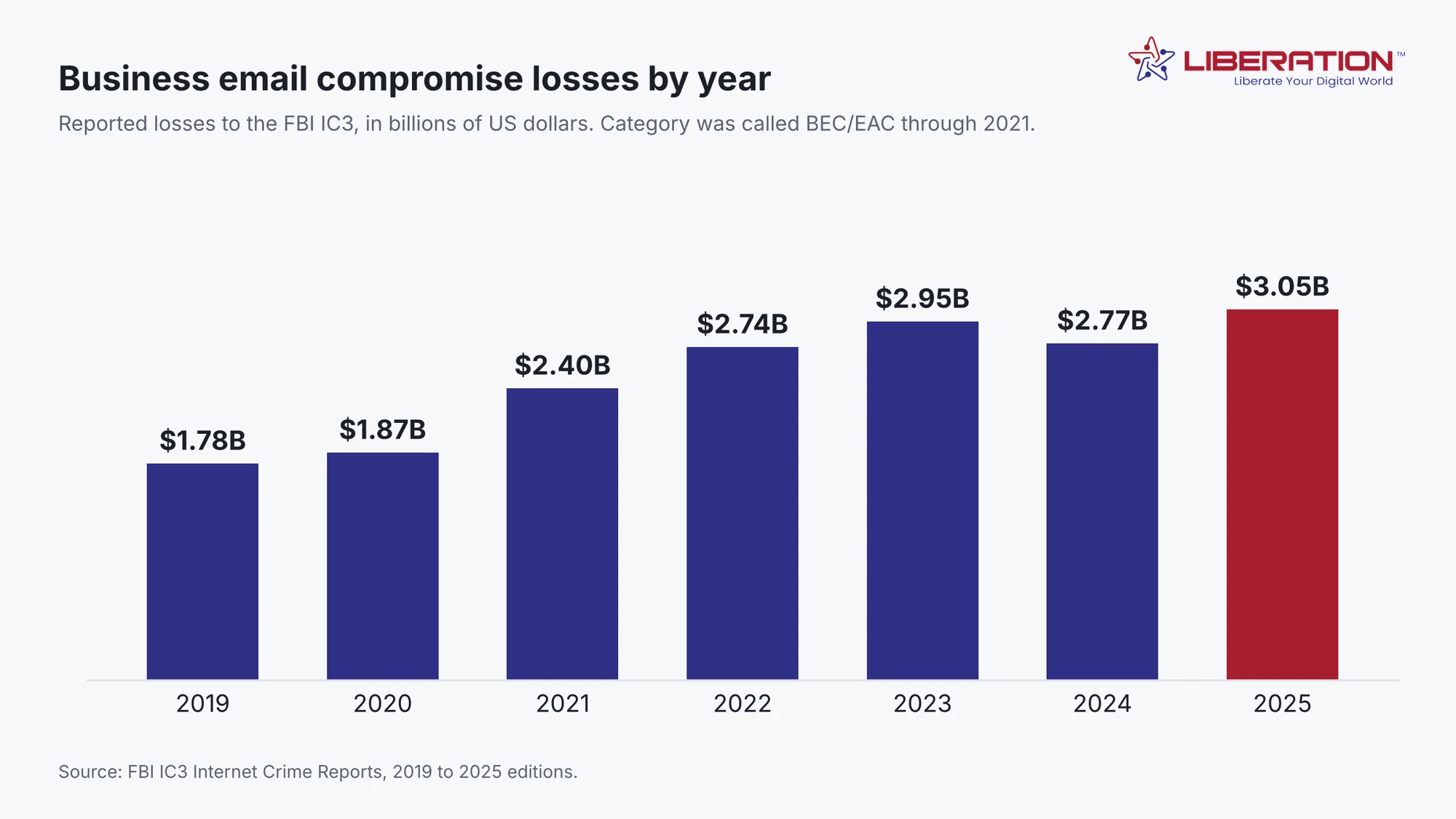
Losses dipped in 2024 and then rose again in 2025, with complaints up about 15% over the year. Complaint counts have stayed in a narrow band of roughly 19,000 to 25,000 a year, so the dollar totals say more about the size of each theft than about how many there are.
How much a single BEC incident costs
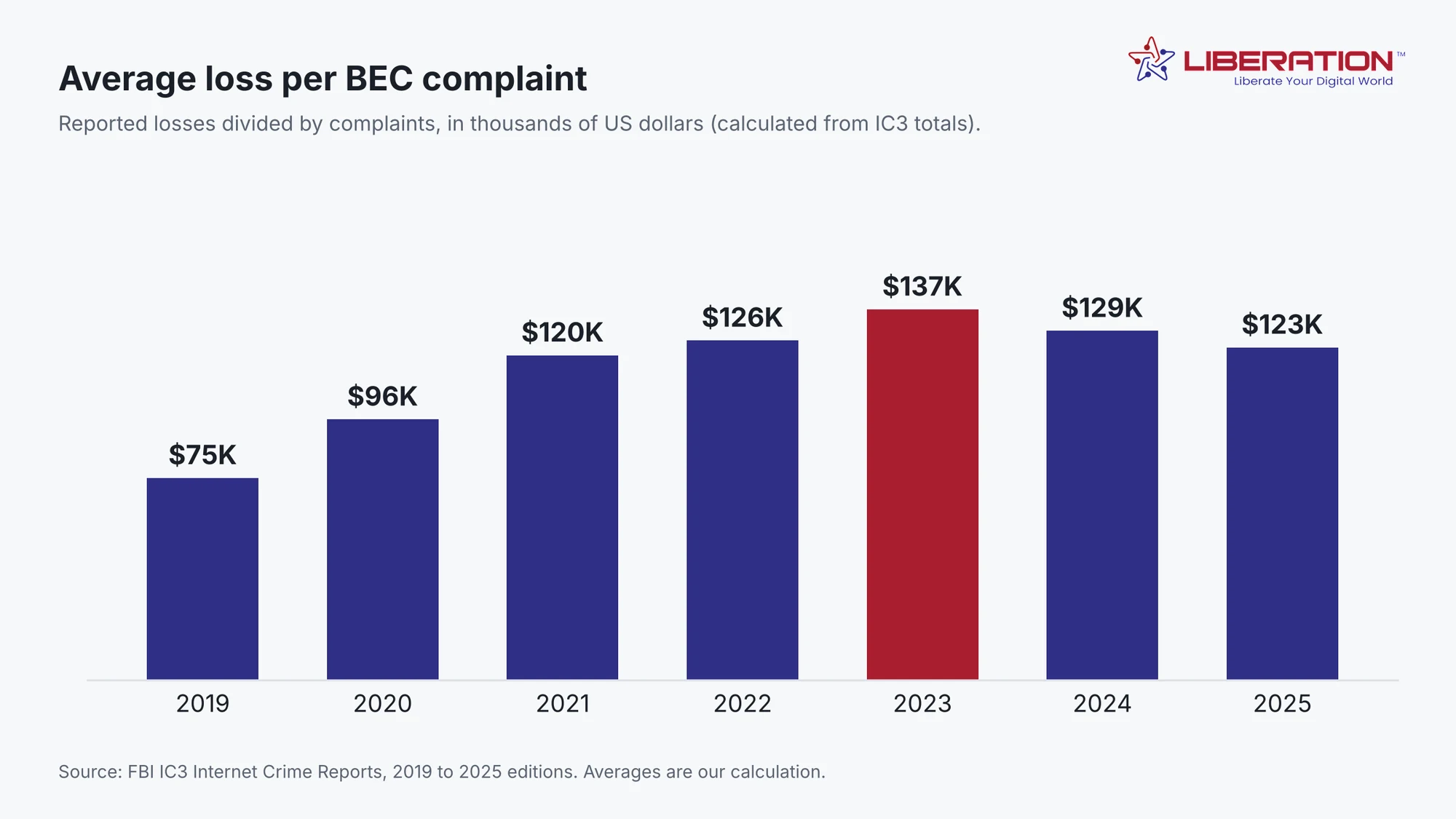
Dividing each year’s losses by its complaints gives a rough average per incident. It reached about $137,000 in 2023 and was about $123,000 in 2025. The average is pulled up by large wire transfers, and many victims lose far less. It still shows the scale a single successful message can reach.
Money does move quickly in these cases. In 2025 the IC3 Recovery Asset Team handled 3,900 incidents, covering about $1.16 billion in attempted theft, and froze about $679 million. Recovery depends on reporting within hours. Waiting a week usually means the funds are gone.
What these numbers mean for a small business
BEC does not need malware or a technical break-in. It needs one person to trust a message. That makes small offices a good target, because payment approvals often rest with one or two people and there is rarely a second check. The IC3 data also shows an age pattern: victims 60 and older reported about $568 million in BEC losses in 2025, so offices that run on long-standing personal relationships are not safe from it.
Businesses also reported more than $30 million in BEC losses involving AI in 2025. Fluent, well-formatted fake emails are now cheap to produce, so spelling mistakes are no longer a useful warning sign.
Four BEC patterns and the control that stops each
| Pattern | Control that interrupts it |
|---|---|
| A vendor invoice with new bank details | Check the change by phone, using a number already on file |
| A rushed wire request from an executive | Require a second approver for transfers above a set amount |
| A reply that comes from a look-alike domain | Flag external senders and register common look-alike domains |
| A real mailbox that has been taken over | Multi-factor authentication and alerts for new forwarding rules |
1. Authenticate your own domain
SPF, DKIM and DMARC records make it harder for anyone to send mail that appears to come from your domain. Our guide to SPF, DKIM and DMARC explains each record and how to roll out a DMARC policy safely.
2. Protect the mailboxes themselves
A taken-over mailbox is harder to spot than a spoofed one, because the message really does come from your vendor or your boss. Multi-factor authentication, sign-in alerts and a review of forwarding rules limit the damage. A managed business email service makes those settings easier to enforce.
3. Make payment changes a two-person job
Any change to bank details, and any wire above a set amount, needs a second approver and a phone call to a known number.
4. Know who to call in the first hour
Write down the bank’s fraud line and the steps for filing a complaint at ic3.gov. The faster a wire is reported, the better the chance of freezing it.
Frequently asked questions about business email compromise
What is business email compromise (BEC)?
It is a scam in which a criminal uses a real or spoofed email account to pose as an executive, vendor or coworker and persuade someone to send money or sensitive data. The FBI tracks it as its own crime category.
How much does business email compromise cost?
The FBI IC3 recorded about $3.05 billion in BEC losses across 24,768 complaints in 2025. Across the 2019 to 2025 reports, the total is about $17.5 billion.
How can a company prevent business email compromise?
Publish SPF, DKIM and DMARC records for your domain, require multi-factor authentication on every mailbox, and confirm any change to payment details by phone using a number you already had on file.
Can stolen money be recovered after a BEC wire?
Sometimes, if you act fast. The IC3 Recovery Asset Team handled 3,900 incidents in 2025 and froze about $679 million of roughly $1.16 billion in attempted theft, a 58% success rate. That figure covers every crime type the team handled, including BEC.
Are criminals using AI for BEC?
IC3 reports that businesses lost more than $30 million to BEC involving AI in 2025. The figure is small next to the total, and it counts only complaints that mentioned AI.
Sources
- FBI IC3, 2025 Internet Crime Report
- FBI IC3, 2024 Internet Crime Report
- FBI press release on the 2025 report