
For many people, your website is the front door of your church before they ever walk through the real one. It is where visitors check service times, members catch up on last Sunday’s sermon and supporters give online. Yet many ministries run on hosting chosen years ago by a volunteer, with no one sure where the backups are. Good church website hosting should be reliable, secure and predictable on a tight budget. This guide explains how to build that stack, and when a managed VPS makes more sense than basic shared hosting for churches and nonprofits.

What Church Website Hosting Needs to Handle
Churches and nonprofits have a different mix of needs than a typical small business. Most sites have to support:
- Online giving and donation pages that are fast, trustworthy and secure
- Sermon audio and video libraries that can use a lot of bandwidth
- Several related sites, such as a school, camp, youth ministry or outreach program
- Email for staff and volunteers that is professional and easy to manage when people come and go
- Predictable costs that fit an annual budget approved months in advance
- Protection for donor and member information
The right nonprofit web hosting covers all of those without requiring a full-time IT person.
Shared Hosting vs. a VPS: When Each Makes Sense
Not every ministry needs a VPS, and we would rather you choose the plan that fits. Our guide to shared hosting explains how it works in detail. In short:
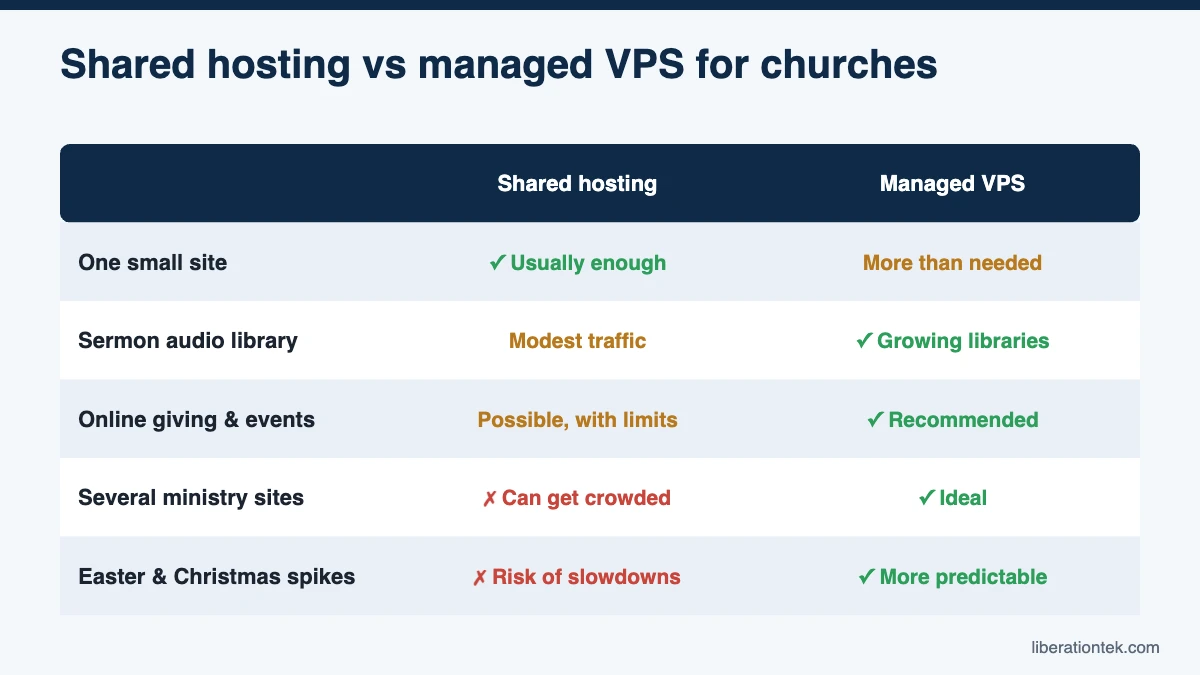
| Situation | Shared hosting | Managed VPS |
|---|---|---|
| One small site with service times and contact info | Usually enough | More than you need |
| Weekly sermon audio library | Can work for modest traffic | Better for growing libraries |
| Online giving, events and registrations | Possible, with limits | Recommended for reserved resources |
| Several ministry, school or campus sites | Can get crowded | Ideal; multiple cPanel accounts on one server |
| Traffic spikes at Easter, Christmas or fundraising campaigns | Risk of slowdowns | Handles spikes more predictably |
A VPS for nonprofits makes sense once the website becomes part of how you operate, not just a digital brochure. With Liberation’s fully managed VPS hosting, the Foundation plan includes 5 cPanel accounts, so a church, its school and its youth ministry can each have their own separate account on one server.
Giving Pages and Donor Data Security
Online giving is often the most important page on a church site, and donors need to trust it. A few principles keep it safe:
- Let a payment processor handle cards. Use a reputable, PCI-compliant giving or payment platform so card numbers never touch your server. The PCI Security Standards Council’s merchant resources explain why a strong security foundation matters.
- Use HTTPS everywhere, not only on the donation form.
- Limit admin access. Give volunteers only the permissions they need and remove accounts when people step away.
- Turn on two-factor authentication for everyone who can edit the site or view donor records.
- Keep software current and remove plugins you no longer use.
On the hosting side, Liberation handles OS and kernel patching, keeps cPanel on its stable release, monitors hardware and uptime 24/7, and provides standard DDoS protection and multi-tiered firewalls. Daily automated backups with 7-day retention are included, and add-ons such as SiteLock security and CodeGuard website backup add malware scanning and longer backup history. CISA’s resources for houses of worship also cover both physical and cyber security planning.
Privacy matters to donors, too. Liberation never tracks, sells or shares customer data, and our article on why data privacy is important explains what that means for the people you serve.
Sermon Audio, Video and Bandwidth
Media is where church website hosting costs can surprise you. Some providers charge egress or overage fees when data leaves the server. Liberation charges no egress or bandwidth overage fees, and every plan includes a generous monthly bandwidth allotment, from 6 TB on Foundation to 32 TB on Scale.
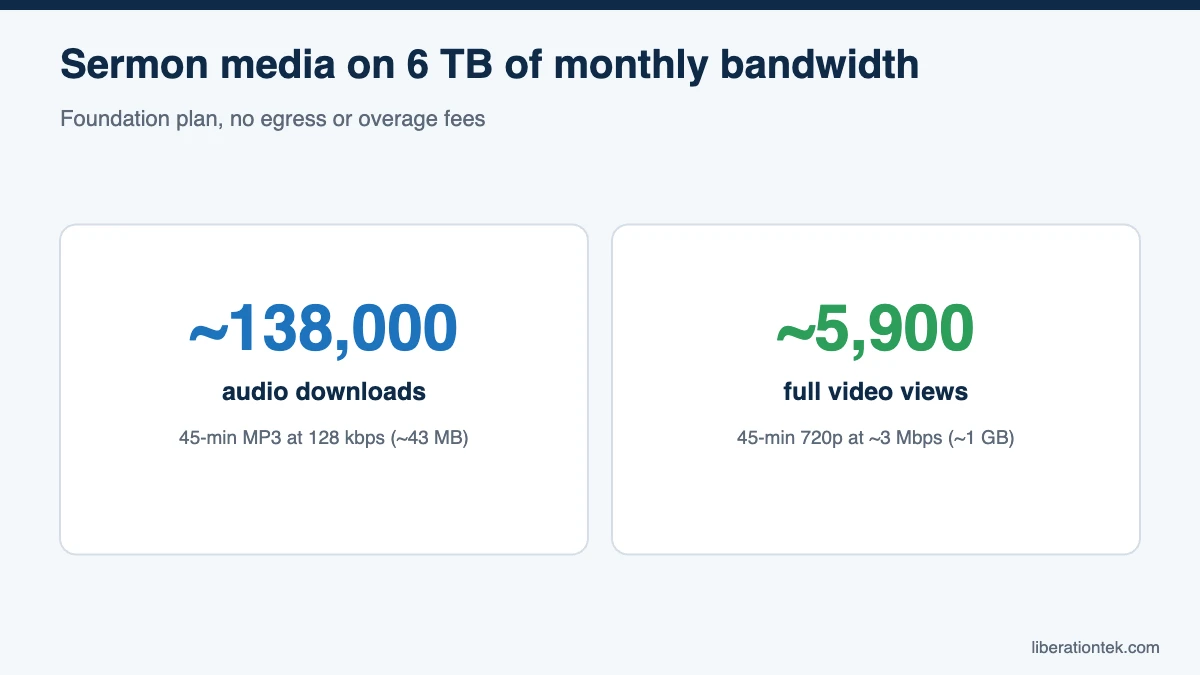
Here is what that means in practice. These figures assume a 45-minute sermon and decimal units (1 TB = 1,000,000 MB):
- Audio: At 128 kbps, a 45-minute MP3 is about 43 MB. 6 TB covers roughly 138,000 full downloads a month.
- Video: At about 3 Mbps (a typical 720p stream), the same sermon is about 1 GB per full view. 6 TB covers roughly 5,900 full views a month.
For most congregations, hosting an audio archive plus recent video on your own site is very achievable. If you stream live services to a large audience, pairing your site with a dedicated streaming platform is still a smart way to handle peak demand.
Volunteer Email and Budget-Friendly Billing
Email that survives volunteer turnover
When the youth pastor leaves or a volunteer rotates off the finance team, shared passwords and personal addresses become a real risk. Role-based addresses such as office@, giving@ and youth@ keep communication with the ministry, not the individual. Liberation Email and Hub for Teams makes those shared addresses easy to hand off, with a private alternative to Google and Microsoft for mail, calendars and files.
Annual billing that fits the budget
Finance committees plan a year at a time, so annual billing simplifies approval and lowers the cost:
| Plan | Billed monthly (12 months) | Billed annually | Yearly savings |
|---|---|---|---|
| Foundation (4 vCPU, 8 GB, 200 GB NVMe, 5 cPanel accounts) | $948 | $708 | $240 |
| Growth (8 vCPU, 16 GB, 350 GB NVMe, 30 cPanel accounts) | $1,548 | $1,188 | $360 |
Every plan includes a cPanel and WHM license, free migration of your existing site, 24/7 U.S.-based human support and a 30-day money-back guarantee.
Sizing Church Website Hosting for a Real Congregation
Churches frequently buy either far too little hosting or considerably too much, because the sizing conversation happens in technical terms rather than in terms of what the congregation actually does. Here is a more useful way to think about it.
Start with the weekly rhythm, not the visitor count. Most church websites are quiet for six days and busy for a few hours. The traffic spike is Sunday morning and the hour before it, when people check service times, look up the address, or find the livestream link. Hosting that handles that hour comfortably handles the rest of the week without effort.
Then add the annual peaks. Christmas and Easter services, a funeral announcement, a building appeal, or a local news mention will produce more traffic in a day than the previous three months combined. Shared hosting frequently copes; what it copes with badly is that spike arriving at the same moment as a sermon upload.
Media is what actually consumes resources. A congregation of two hundred generates very little page traffic and potentially a great deal of media. An hour of sermon video is a large file; fifty-two of them a year is a storage plan. The practical answer for most churches is to host the site properly and put video on a free platform, embedding it rather than serving it. That single decision removes the main reason a church would need expensive church website hosting at all.
Count the mailboxes honestly. Pastor, office, treasurer, and a handful of ministry addresses – plus the aliases that forward to volunteers. Mailbox count drives more of the monthly cost than page views do for a typical church.
Then decide about giving. If online giving runs through a hosted platform, your site links out to it and your hosting requirements barely change. If giving is embedded in your own pages, the security requirements rise and shared hosting becomes a less comfortable choice.
A reasonable default. For a congregation under about three hundred: quality shared hosting or an entry VPS, video embedded rather than self-hosted, giving on a hosted platform, and email on the church domain with a provider that is not the same single point of failure as the website. That configuration serves most churches for years and costs less than many pay today.
Upgrade on symptoms, not on anxiety. Move to a VPS when the site is genuinely slow at peak, when you are running something the shared plan cannot support, or when email volume outgrows the hosting quota. Buying capacity against a hypothetical is how church website hosting budgets get spent on the wrong things.
Frequently Asked Questions
What is the best church website hosting for a small congregation?
For a single, simple site with modest traffic, quality shared hosting is often enough. Once you add online giving, a sermon library, several ministry sites or a members area, a managed VPS gives you reserved resources, stronger isolation and room to grow without a sudden jump in cost.
Can we host sermon audio and video on our own website?
Audio is very manageable. Assuming a 45-minute sermon encoded at 128 kbps (about 43 MB), 6 TB of monthly bandwidth covers well over 100,000 downloads. Full-length video is far larger, roughly 1 GB per 45-minute view at 720p in our example, so many churches host a library of recent video on their site and use a streaming platform for live services.
Is it safe to take donations on a church website?
Yes, when you use a reputable, PCI-compliant payment processor so that card numbers never touch your server. Add HTTPS on every page, keep WordPress and plugins updated, limit admin accounts, turn on two-factor authentication and keep recent backups.
Do nonprofits get discounted VPS pricing?
Liberation’s published pricing is the same for everyone, but annual billing lowers the effective monthly cost. For example, the Foundation plan is $79 per month billed monthly or $59 per month billed annually, which saves $240 a year.
Conclusion: A Reliable Home for Your Ministry Online
Church website hosting does not need to be complicated or expensive. Start with shared hosting if your site is small and simple. When giving, media and multiple ministries become central to how you serve, a managed VPS gives you reserved resources, daily backups and professional security, with predictable annual pricing and no egress fees. Liberation is an independent, 100% USA-owned company running servers it owns in the United States. Explore our managed VPS plans and let our team move your site for free.
Related reading
- Church Website Builder: 5 Simple Pages, One Weekend
- Church Website Hosting: 3 Essential Jobs It Must Do
- Online Giving for Churches: 5 Essential Checks
- Big Tech Alternatives — Replacing the platforms a ministry depends on.
- Building a Business Website — Structure and accessibility decisions that apply to any site.