
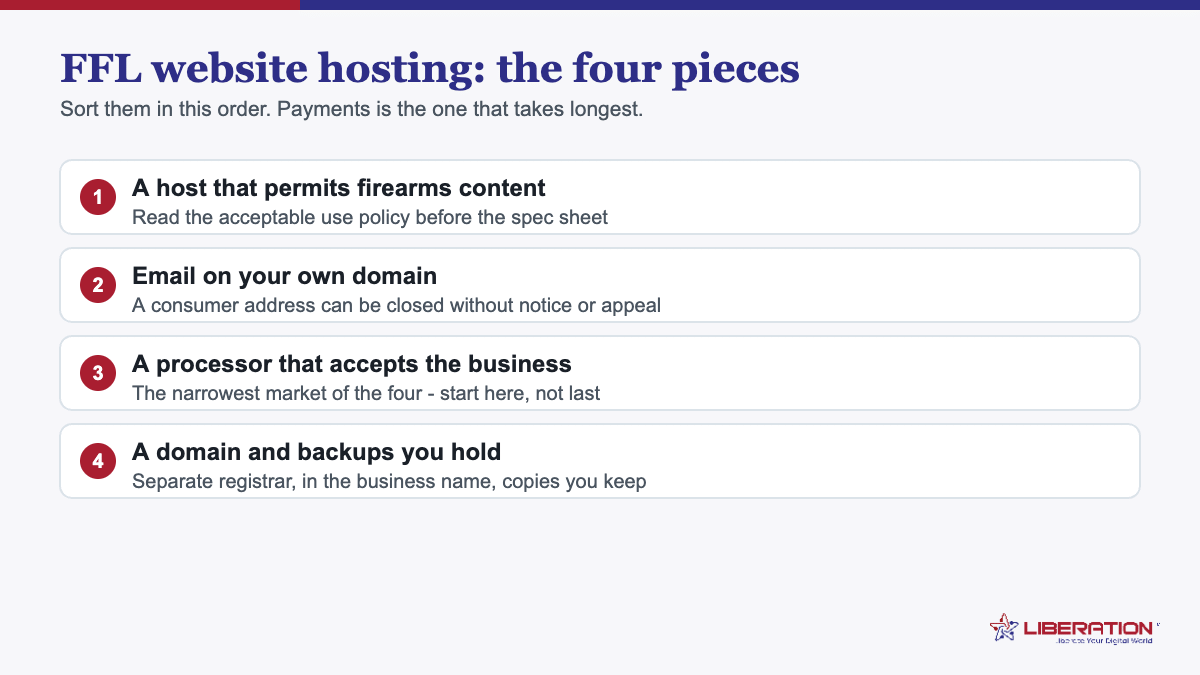
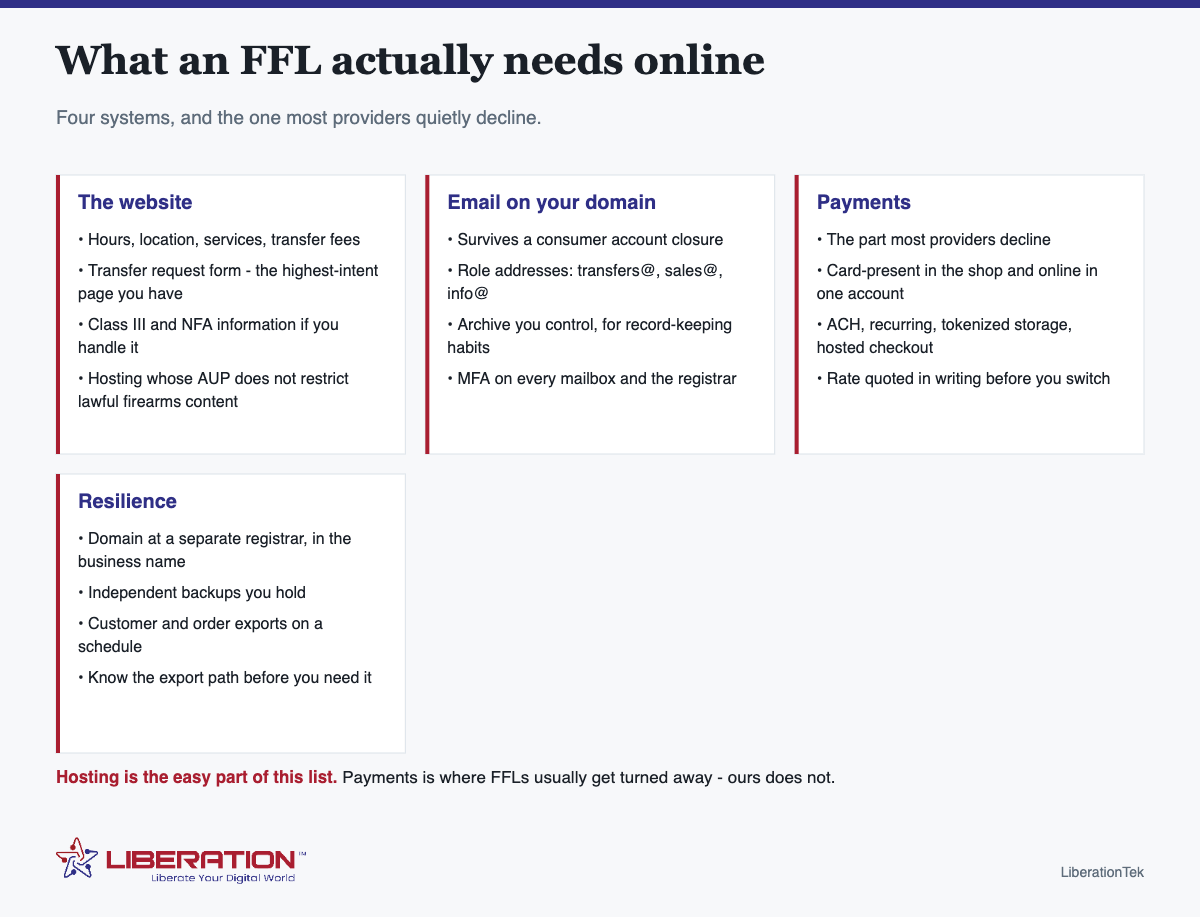
FFL website hosting is one of four things a dealer needs online: a website whose host permits lawful firearms content, email on the business’s own domain, payment processing that will actually accept the business, and an arrangement resilient enough that losing any one provider is an inconvenience rather than a rebuild. The website is the easy part. Payments is where firearms retailers usually get turned away.
FFL website hosting: ordinary requirements, unusual contract
Technically an FFL website is a small business website. Hours, location, services, stock or brands carried, and the pages that actually generate calls. There is nothing exotic in the server requirements.
What differs is the contract. Before signing with any host, read the acceptable use policy rather than the marketing page, and answer four questions: does it name firearms or related content at all; who decides and on what standard; what notice would you get before any action; and is there an appeal to a person. Then ask whether the provider owns its hardware or resells someone else’s – because a reseller can only pass along a decision made above it, which is precisely the exposure you are trying to avoid.
The pages that earn their place on an FFL website
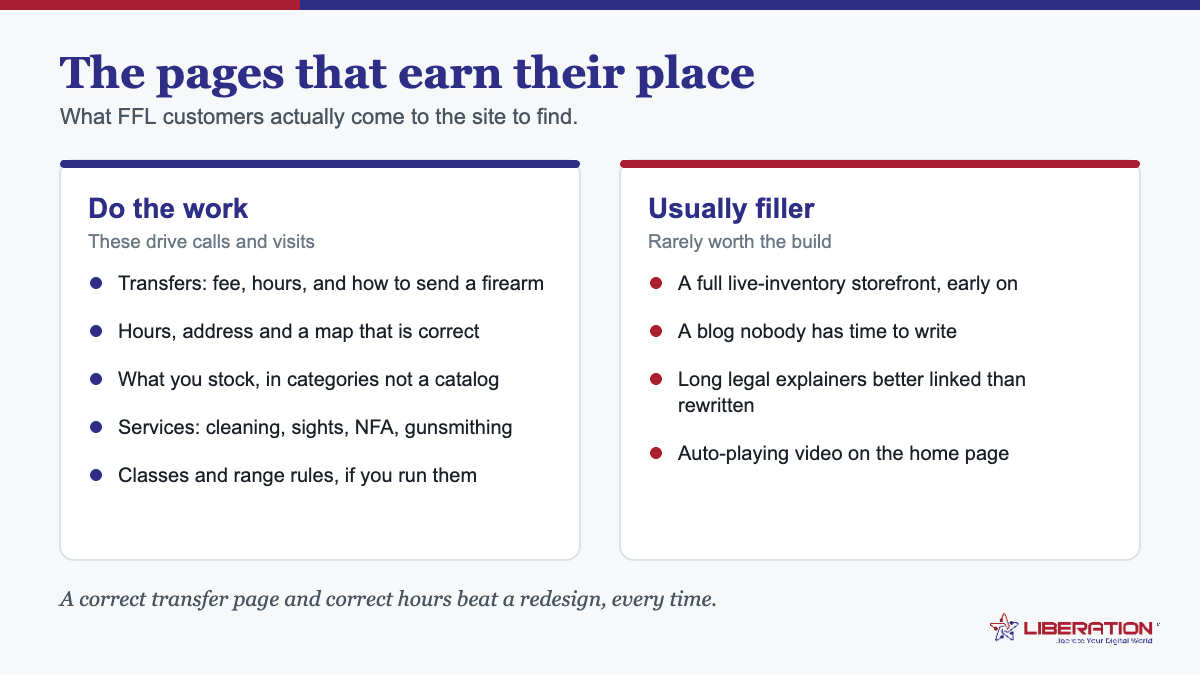
- Transfer fees, stated plainly. This is what people search for and call about. Publishing the number filters the calls you do not want and wins the ones you do.
- A transfer request form. The highest-intent page on most FFL sites. Capture the buyer’s details, the sending dealer, and the item, and you have removed three phone calls.
- Hours and location, above the fold. Range and shop hours differ; say so.
- Class III and NFA information, if you handle it. The process is unfamiliar to most buyers and explaining it well is a genuine differentiator.
- What you will and will not do. Clarity here prevents wasted trips in both directions.
Email: stop running the business on a consumer account
An address at a free consumer provider is a liability for any business and particularly for this one. It can be closed by automated decision, it cannot be handed over when someone leaves, and it is the recovery key to every other account you own.
Mail on your own domain from $1.95 per user per month fixes it: role addresses like transfers@ and sales@ that survive staff changes, an archive you control, and an address tied to a domain you own rather than a platform you do not. Put multi-factor authentication on every mailbox and on the registrar while you are there.
Payments: ask this first, not last
Many mainstream processors decline firearms businesses, and finding that out after you have built everything else is the expensive order to do things in. Ask it first, of every provider you are considering.
Our answer is yes. PayHarmony supports 2A and firearms businesses, and the shape of it suits a dealer: card-present in the shop, online, mobile and phone payments all settling through a single merchant account rather than separate arrangements; a current-generation gateway with a documented API, hosted checkout, tokenized card storage, recurring billing and ACH; no locked contracts; and your rate quoted in writing before you switch.
The line that matters most to this audience is the one about conduct rather than pricing: a partner who will not freeze your funds or close your account without a straight answer. Twenty-five years of merchant services behind it, and a named contact rather than a ticket queue.
Build FFL website hosting so that losing a provider is survivable
| Arrangement | Why |
|---|---|
| Domain at a separate registrar, in the business name | The one thing that is genuinely hard to replace |
| Independent backups you hold yourself | A backup held only by a provider is not insurance against that provider |
| Mail on your own domain, archived locally | Correspondence is the least replaceable record you own |
| Customer and order exports on a schedule | Platform data is the hardest to reconstruct |
| A known export path from every provider | Find out before you need it, not during |
None of this assumes bad faith from anyone in particular. It assumes a business its customers depend on should not be one decision away from starting over, which is ordinary prudence.
What FFL website hosting costs to run
- Shared hosting from $7.99 a month with cPanel and free SSL – enough for a brochure site with a transfer form.
- VPS once you are selling online and need guaranteed resources, with free migration of one site included.
- Mailboxes from $1.95 per user per month.
- Payments quoted against how you actually take money – retail, online or both.
For most dealers the whole stack is under $30 a month plus processing, which is not where the decision should turn. The decision should turn on whether the provider has already decided where it stands.
FFL website hosting questions worth putting in writing
- Do you own your hardware, and which country is it in?
- What does your acceptable use policy say about lawful firearms-related content?
- What notice would we get before any action on the account?
- Does your payment processing accept FFLs, and what would our rate be?
- What can we export, and how quickly?
Ask us those five and you will get written answers – including a straight yes or no on payments rather than an implication.
The transfer page, in detail
For most dealers the transfer business is steady, predictable revenue, and the website either supports it or gets in the way. Four things make the difference.
- Publish the fee. Dealers who hide it get calls asking for it; dealers who publish it get calls asking to book. The fee is not a secret worth keeping.
- List what you will and will not receive. Handguns, long guns, NFA items, anything you decline. Saying so prevents a wasted shipment and an awkward conversation.
- State your FFL delivery process. Buyers and sending dealers both need your license copy; explain how they get it.
- Give the hours for transfers specifically. They are often narrower than shop hours, and mismatched expectations here generate more complaints than pricing does.
Local search for FFL dealers
Most of this business is local, which means the ordinary local-search fundamentals matter more than anything clever. Consistent name, address and phone number wherever they appear; opening hours kept current including holidays; and a page for each service you actually want enquiries about, rather than one page listing everything.
One practical note specific to this industry: some advertising platforms restrict firearms-related promotion, so organic search and word of mouth carry more weight than they would for a comparable retailer. That is an argument for getting the website right rather than treating it as a placeholder behind paid acquisition.
FFL website hosting: what to do this week
- Check who the domain is registered to. If it is a person rather than the business, start the transfer.
- Confirm your host’s acceptable use policy in writing.
- Ask your processor, in writing, whether it accepts FFLs – and what the rate would be.
- Put multi-factor authentication on hosting, email and the registrar.
- Publish your transfer fee.
Four of those five are free and take an afternoon.
One more thing about email
Dealers handle a lot of correspondence that is worth keeping – transfer confirmations, dealer-to-dealer arrangements, customer instructions. Running that through a consumer address means it lives on a platform that can close the account by automated decision, and it cannot be handed to whoever takes over the counter next year. Mail on the business domain solves both, and costs less per month than a box of ammunition.
What to ask before you sign up for FFL website hosting
Every question below can be sent in one email and answered in one reply. A provider that answers all six plainly is usually worth moving to; a provider that answers none of them has told you what you needed to know without meaning to.
“Does your acceptable use policy permit lawful firearms retail content?” Ask for a yes or no and a pointer to the clause. Silence in a policy is not permission – it is discretion held in reserve, exercised by whoever reads the ticket. The strongest answer names firearms explicitly and allows them.
“Do you own the servers, or resell another platform?” This is the question that determines whether the first answer means anything. A reseller can only promise what its upstream supplier permits, and an upstream decision reaches you regardless of what your immediate provider intended. Good FFL website hosting is usually hosting where the company you pay controls the hardware.
“What notice would we get before any action, and is there an appeal?” Thirty days and a named human is a very different proposition from an automated suspension and a support queue. Ask what has actually happened to other customers, not only what the policy theoretically allows.
“Can we export everything, and how?” Full cPanel backups you can download beat a database dump and good luck. The answer tells you how long a move would take if you ever needed one, which is the real measure of how exposed you are.
“Where are the servers and the backups?” Named country at minimum, named facility ideally, and confirmation that backups are held in the same jurisdiction as the live data.
“Do you work with firearms businesses already?” Providers who do will say so and will often know which payment processors onboard FFLs, which saves weeks. Note that payments is a separate industry to hosting – the ATF’s published firearms guides are worth having to hand when a processor’s onboarding team asks precisely what your business does, because a specific answer clears review faster than a vague one.
Keep the replies. If FFL website hosting ever becomes a problem for you, the email where a provider stated its position in writing is a considerably stronger starting point than a memory of a sales call. And if the answers are good, you have just done the hardest part of choosing a host in about twenty minutes.
To put it as plainly as possible: FFL website hosting is ordinary hosting bought with unusual care. The hardware is the same as everyone else’s, the prices should be too, and the only thing you are really selecting for is a company whose terms and ownership mean the question never comes up. Get the four pieces above in place and FFL website hosting stops being something you have to think about at all.
Frequently asked questions
What does an FFL need in a website host?
Hosting whose acceptable use policy does not restrict lawful firearms-related content, from a provider that owns its infrastructure rather than reselling – so an upstream company cannot overrule the arrangement. Technically the requirements are ordinary: reliable hosting with cPanel, free SSL, backups, and email on the business domain.
Can an FFL get payment processing?
Yes, though many mainstream providers decline firearms businesses, which is why it is worth asking before committing to anything else. LiberationTek payment processing, PayHarmony, supports 2A and firearms businesses, with card-present and online payments settling through a single merchant account, recurring billing, ACH and a rate quoted in writing before you switch.
Do gun stores need a special kind of hosting?
Technically no – the server requirements are the same as any small business website. What differs is the contract: whether the acceptable use policy permits lawful firearms content, what notice is given, and whether the provider can honor that commitment.
Should a firearms business keep its domain with its web host?
No. Register the domain with a separate registrar, in the business’s name, on an account the owner controls. The domain is the single hardest thing to replace.
What should be on an FFL website?
Hours and location, the services offered, transfer fees stated plainly, and a transfer request form – usually the highest-intent page on the site. If you handle Class III or NFA items, information on that process answers a lot of phone calls before they happen.
Related reading
- 2A Friendly Web Hosting: 5 Terms to Check Before You Sign
- Gun-Friendly Web Hosting — Hosting for firearms businesses, stated plainly.
- Conservative Web Hosting — Terms that name the risk instead of staying silent.