
Shared hosting is where most websites begin, and for good reason: it is affordable, simple and managed for you. But businesses grow, and at some point the hosting that fit your first website starts holding the business back. The shared hosting vs VPS decision usually is not about specs on a comparison chart. It is about recognizing the warning signs. Below are seven clear signals that it is time to move, plus what actually changes when you do.

Shared Hosting vs VPS: The Quick Difference
On shared hosting, hundreds of websites can live on one server and draw from the same pool of CPU, memory and disk activity. A virtual private server (VPS) carves a physical machine into isolated virtual servers, each with its own guaranteed allocation.
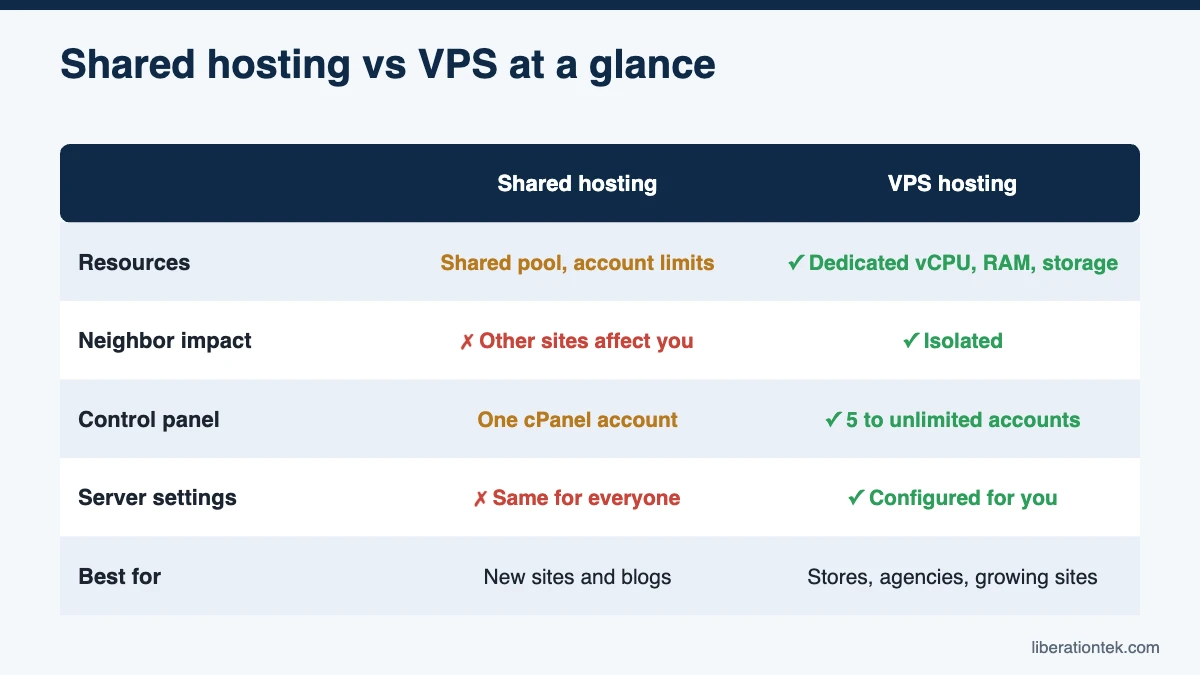
| Shared hosting | VPS hosting | |
|---|---|---|
| Resources | Shared pool with per-account limits | Dedicated vCPU, RAM and storage |
| Neighbor impact | Other sites can affect your performance | Isolated from other customers |
| Control panel | Typically one cPanel account | Multiple cPanel accounts (5 to unlimited on Liberation plans) |
| Server configuration | Set for everyone on the server | Configured for your workload |
| Best for | New sites, blogs, small brochure sites | Growing businesses, stores, agencies, multi-site organizations |
7 Signs It’s Time to Move From Shared Hosting to a VPS
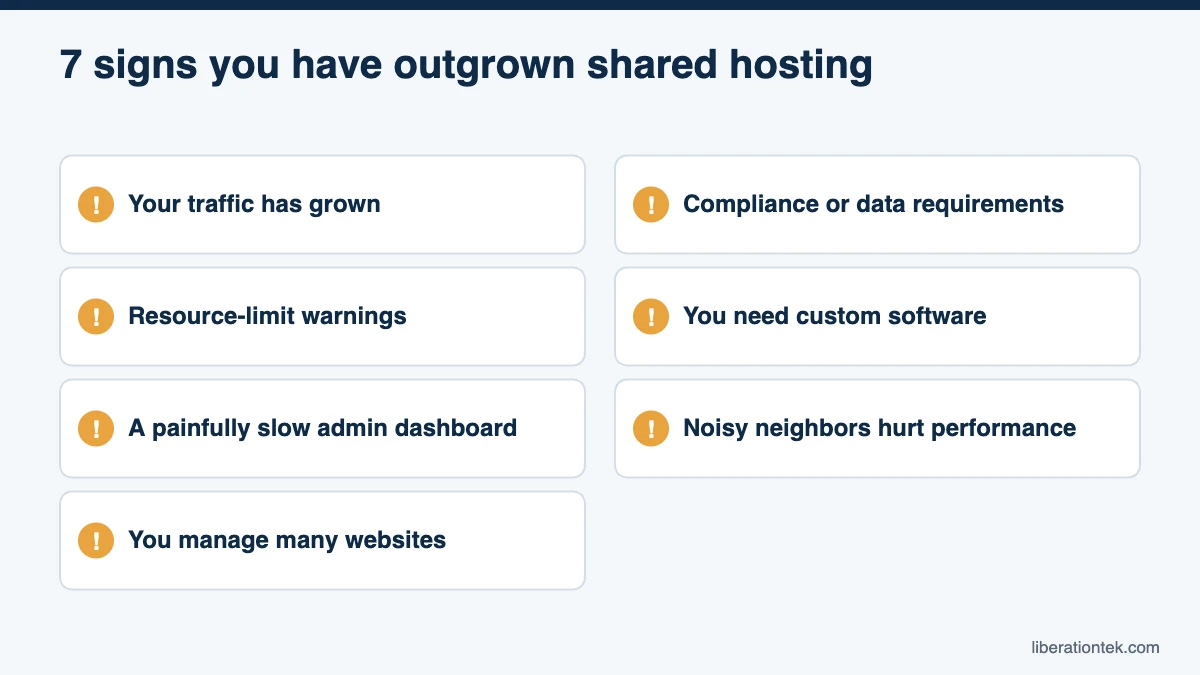
1. Your traffic has grown
Shared plans are sized for modest traffic. If your visitor numbers have climbed steadily, or you run campaigns, sales or events that produce big spikes, your site needs resources that are reserved for you. A slow checkout during your biggest promotion of the year is an expensive way to discover you have outgrown your plan.
2. You are seeing resource-limit warnings
Many shared hosts cap CPU, memory, simultaneous processes and disk I/O per account. When you hit those caps, visitors may see errors such as “508 Resource Limit Is Reached,” or your host may send warning emails. One warning can be a fluke. Repeated warnings mean your site has outgrown the space it has been given.
3. Your admin dashboard is painfully slow
Sometimes the front end looks fine thanks to caching, but logging in to WordPress or WooCommerce feels like wading through mud. Admin pages are rarely cached, so they are one of the first places a lack of CPU and memory shows up. If editing a product or publishing a post takes much longer than it should, that is a strong signal.
4. You are managing many websites
Agencies, franchise owners, churches with several ministries and nonprofits with multiple programs often end up juggling separate shared accounts. A VPS lets you run them all from one server with separate cPanel accounts for each site. Liberation plans include 5 cPanel accounts on Foundation, 30 on Growth, 100 on Commerce and unlimited accounts on Scale, with the cPanel & WHM license included.
5. You have compliance or data-handling requirements
If you process payments, collect donor information or store customer records, you have obligations to protect that data. Payment security, for example, is governed by the standards maintained by the PCI Security Standards Council. An isolated server makes it easier to answer questions about where your data lives and who can reach it. Liberation’s servers are owned and operated by us in the United States, never leased from third-party clouds, and we never track, sell or share customer data. For more on why that matters, see our article on why data privacy is important. Always confirm your specific requirements with your payment processor or compliance advisor.
6. You need custom software or configuration
Shared servers are configured to suit everyone, which means they are optimized for no one in particular. If your application needs specific server-level settings, background jobs or software that your shared host will not allow, a VPS gives you an environment built around your workload. On a managed plan, you can talk through requirements with the support team before you move.
7. Noisy neighbors are hurting performance
If your site slows down at random times even when your own traffic is steady, another customer on the same server may be consuming more than their share. You cannot fix a neighbor’s runaway script, but you can move to a server where your resources are yours alone.
What Changes When You Move to a VPS
For most shared hosting customers, the biggest fear is complexity. With a managed VPS, much of the day-to-day experience stays the same while performance and headroom improve:
- Same control panel. cPanel & WHM is included on every Liberation VPS plan.
- Faster hardware. NVMe SSD storage and high-frequency vCPUs.
- Server upkeep handled. OS and kernel patching, cPanel kept on stable release, 24/7 hardware and uptime monitoring, standard DDoS protection and multi-tiered firewalls.
- Built-in safety net. Daily automated backups with 7-day retention.
- No bandwidth surprises. No egress or bandwidth overage fees.
- A painless move. Free website migration for 1 to 30 sites depending on your plan.
Choosing the Right VPS Plan
Liberation offers four fully managed VPS hosting plans. Prices are shown monthly and as the per-month rate on annual billing.
- Foundation: 4 vCPU, 8 GB RAM, 200 GB NVMe, 6 TB bandwidth, 5 cPanel accounts. $79, or $59 billed annually. A natural first step up from shared hosting.
- Growth: 8 vCPU, 16 GB RAM, 350 GB NVMe, 10 TB bandwidth, 30 cPanel accounts. $129, or $99 billed annually. Well suited to agencies and busy stores.
- Commerce: 12 vCPU, 24 GB RAM, 500 GB NVMe, 15 TB bandwidth, 100 cPanel accounts. $199, or $159 billed annually.
- Scale: 16 vCPU, 32 GB RAM, 750 GB NVMe, 32 TB bandwidth, unlimited cPanel accounts. $289, or $239 billed annually.
Every plan is backed by a 99.9% uptime SLA and a 30-day money-back guarantee.
When Shared Hosting Is Still the Right Call
Not every site needs a VPS. If you run a single brochure site or a small blog, your traffic is steady and you have never seen a resource warning, shared web hosting is still an excellent, economical choice. Upgrade when the signs above appear, not before. Keep an eye on page speed as well; Google explains how loading speed and responsiveness affect the user experience in its Core Web Vitals documentation.
Common Concerns About Moving From Shared Hosting to a VPS
“Isn’t a VPS complicated to manage?”
It can be on an unmanaged plan, where server administration is entirely on you. On a fully managed VPS, the host handles patching, monitoring and backups, and cPanel and WHM are included, so day-to-day site management feels much like shared hosting while the resources are reserved for you.
“Will migrating my site be a hassle?”
Moving a live site does carry some risk if it is done carelessly, which is why Liberation includes free website migration with every VPS plan. Our team copies and tests your site before any DNS change.
“Is a VPS overkill for my business?”
Not if you are already seeing the warning signs above. Plans scale from Foundation to Scale, so you can buy the resources you need now and upgrade later instead of overbuying on day one.
Frequently Asked Questions
What is the main difference between shared hosting vs VPS hosting?
On shared hosting, many customers draw from the same pool of server resources, so one busy site can slow down others. A VPS gives you a dedicated allocation of CPU, memory and storage, which delivers more consistent performance and room to grow.
Will my website be faster on a VPS?
Usually, especially under load. A VPS removes the resource limits and noisy neighbors common on shared servers. Liberation VPS plans run on NVMe SSD storage and high-frequency vCPUs. Your site’s own code, plugins and images still affect speed, so pair the upgrade with basic optimization.
Is moving from shared hosting to a VPS difficult?
It does not have to be. Liberation includes free website migration for 1 to 30 sites depending on your plan, and because every VPS plan includes cPanel & WHM, you keep the same familiar control panel after the move.
Do I need technical skills to run a VPS?
Not with a managed VPS. Liberation handles OS and kernel patching, keeps cPanel on its stable release, and provides 24/7 monitoring, daily backups and 24/7 U.S.-based human support, so you can run a VPS much like you ran shared hosting.
Will moving to a VPS improve my SEO?
It can help indirectly. Page speed and reliability affect user experience, and Google’s Core Web Vitals reward fast, stable pages. A VPS with reserved resources and NVMe storage makes it easier to keep response times low, but content quality, links and on-page optimization still matter most.
How do I know if my slow site is a hosting problem or a website problem?
Both are possible. Oversized images, heavy plugins and poor caching slow a site on any hosting plan. If slowdowns line up with traffic spikes, or your host has warned you about resource limits, the bottleneck is likely hosting capacity rather than your site’s code.
Ready for More Room to Grow?
The shared hosting vs VPS question answers itself once your site starts hitting limits, slowing down or carrying more of your business. If you recognized two or more of the signs above, it is time to plan the move. Liberation’s managed VPS plans give you dedicated resources, cPanel included, daily backups, free migration and 24/7 U.S.-based human support, all on servers we own and operate in the United States. Explore VPS hosting and pick the plan that fits where your business is headed.