
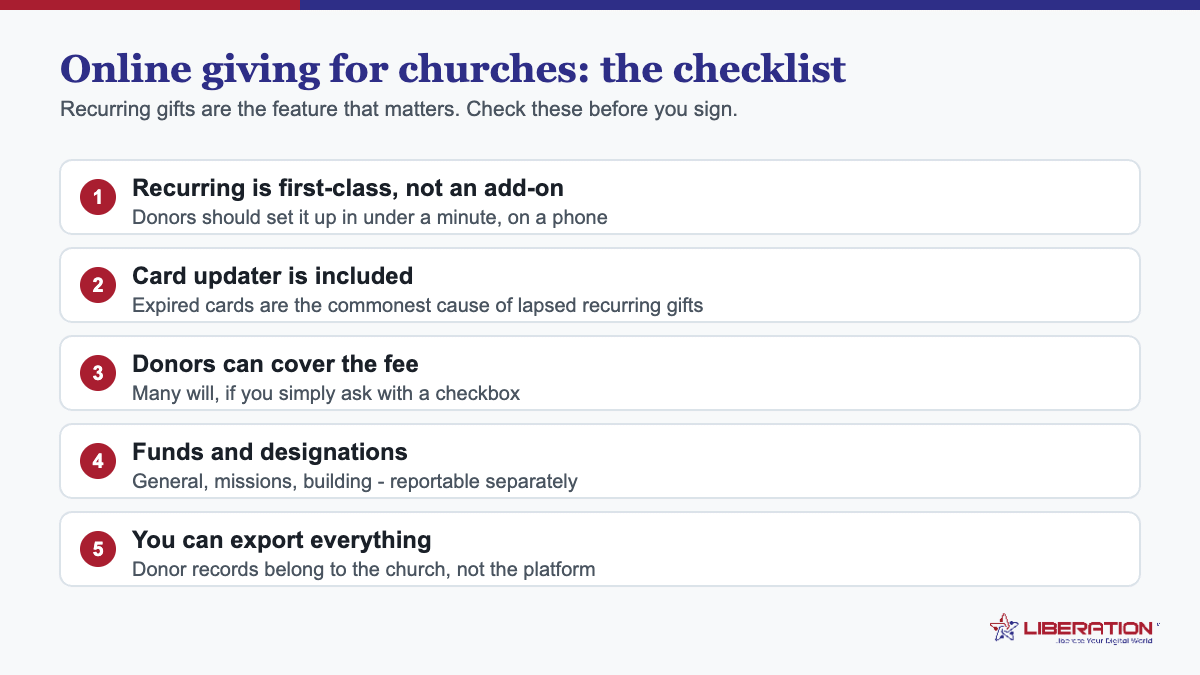
The feature that matters most in online giving for churches is recurring gifts, and it is the one most processor comparisons skim past. One-time giving follows attendance – it dips in summer and at Christmas travel. Recurring giving is what makes a budget predictable. Everything else on the checklist is secondary to whether donors can set up a monthly gift in under a minute and manage it themselves afterwards.
Here is the rest of the checklist, and the questions worth asking before you sign anything.
Why recurring changes the arithmetic of online giving for churches
A congregation relying on the offering plate has income that tracks who is in the building. Weather, holidays and illness all show up directly in the budget. A congregation with a meaningful share of giving on recurring monthly gifts has a floor under it, and can plan staffing and ministry against a number rather than a hope.
Two practical points follow. First, make recurring the easy option on the form rather than a secondary choice. Second, let donors manage their own recurring gift – change the amount, pause it, update a card – without emailing the church office. A donor who has to ask someone to reduce their gift will often cancel it instead.
The online giving for churches checklist
| What to check | Why it matters |
|---|---|
| Recurring giving, donor-managed | Predictable income, and nobody has to phone the office to change a card |
| Fee structure, all three numbers | Percentage, fixed amount per transaction, and any monthly platform fee |
| Bank transfer as well as card | Usually materially cheaper on larger and recurring gifts |
| Designated funds | Building fund, missions, benevolence – separated at the point of giving, not reconciled afterwards |
| Giving statements | Annual statements donors need, without someone assembling them by hand |
| Mobile-first form | Most giving happens on a phone, frequently during or just after a service |
| Integration with the website | A giving page on your own domain looks like you; a redirect to an unfamiliar brand loses people |
| Data export | Donor and transaction history you can take with you if you change provider |
| Optional fee coverage | Let donors choose to cover fees – optional and unticked by default |
The questions that reveal the most
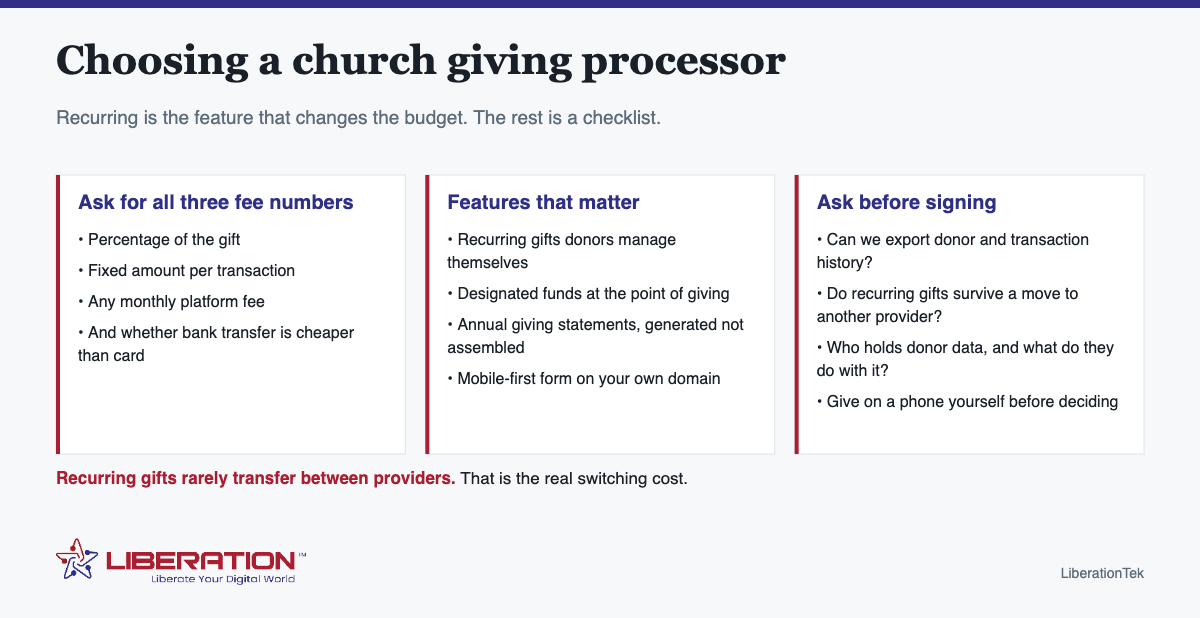
- “What are all the fees, including monthly?” A low percentage with a platform fee attached can cost a small congregation more than a higher rate with none.
- “Can we export donor history if we leave?” Ask before signing. The answer after signing is whatever it is.
- “Do recurring gifts survive a move to another provider?” Usually not – donors must re-establish them, and a meaningful share never do. This is the real switching cost, and it is why the choice deserves care up front.
- “Who holds the donor data, and what do they do with it?” A donor list is sensitive in a way a customer list is not.
- “What does a donor see?” Give on a phone yourself before deciding. If it takes more than a minute, that is your answer.
Things churches regret after choosing online giving
- A giving page that looks like somebody else’s website. Trust is the whole transaction. A form on your own domain, in your own design, converts better than a redirect to an unfamiliar brand.
- Fees discovered in month three. Get all three numbers in writing before starting.
- No designated funds. Retrofitting fund designation means reconciling gifts by hand, every month, forever.
- Nobody owns it. Someone has to reconcile giving, produce statements and chase failed cards. Decide who before launch, not after the first failed payment.
- Statements assembled manually. A platform that cannot produce annual statements creates a January job nobody wants.
How we handle online giving for churches
Our payment processing supports one-time and recurring payments, integrated into the church website rather than bolted on as an external link – which matters because the giving page should look like your church, not like a payment company. On the church solutions side it sits alongside a contribution system that integrates with your site, memberships, and self-hosted analytics so you are not handing congregational browsing data to an advertising platform.
Fees and setup depend on the size of the congregation and how you want funds designated, so it is a conversation rather than a price list. Tell us roughly how many giving units you have and what you want separated, and you will get straight numbers.
What the fee structure does at different gift sizes
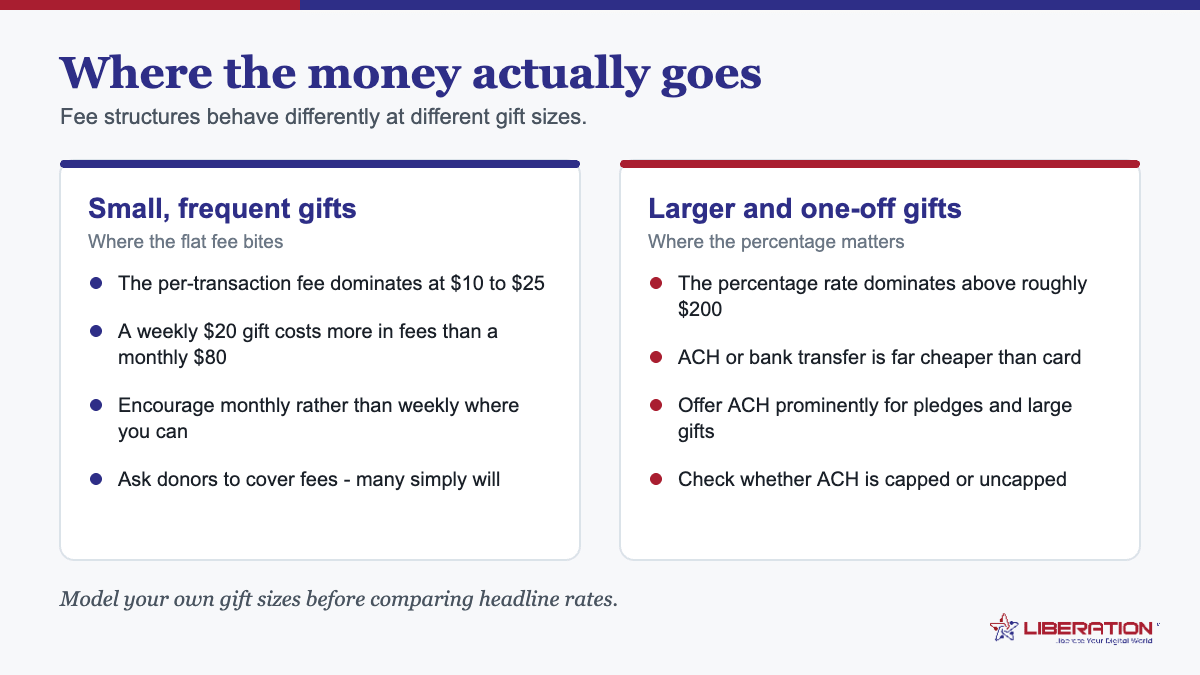
Percentage-plus-fixed pricing behaves differently depending on what people actually give, which is why comparing headline percentages alone is misleading.
- Small, frequent gifts are hit hardest by the fixed per-transaction amount. A congregation with many small weekly gifts pays proportionally more than one with fewer monthly gifts of the same total.
- Large gifts are dominated by the percentage, which is where bank transfer usually saves real money – often materially cheaper than card on a four-figure gift.
- Monthly platform fees hurt small congregations most, because they are the same number regardless of volume.
Before comparing providers, work out your own giving profile: roughly how many gifts a month, and the typical size. Then ask each provider what that profile would actually cost. A provider who cannot answer that question has told you something useful.
Encouraging recurring online giving without pressure
Recurring giving works when it is easy and honest, and backfires when it feels like a subscription trap. Four things help:
- Make it the default option on the form, with one-time clearly available beside it.
- Let donors change or pause it themselves. A donor who must email the office to reduce a gift will often cancel instead.
- Say what it funds. Designated funds make recurring giving concrete rather than abstract.
- Acknowledge it once, properly, and then leave people alone. Monthly thank-you emails read as marketing.
The operational side of online giving for churches nobody plans
| Job | How often | Who usually ends up doing it |
|---|---|---|
| Reconciling giving against the bank | Monthly | Treasurer |
| Chasing failed or expired cards | Monthly | Nobody, until income drops |
| Producing annual giving statements | January | Whoever is least able to say no |
| Answering “did my gift go through?” | Ongoing | Church office |
| Keeping donor records current | Ongoing | Often nobody |
Failed cards are the quiet one. Recurring gifts fail when cards expire or are reissued, and unless somebody notices, a congregation can lose a meaningful slice of monthly income without a single person deciding to stop giving. Ask any provider how failed payments are surfaced and whether donors are prompted automatically.
Donor data deserves more care than customer data
A giving record says something about a person that a purchase history does not. Three practical rules: keep the list of people who can see it short, know where it is stored and who else has access, and confirm you can delete a record on request. If a provider cannot tell you where donor data sits or who processes it, that is a reason to keep looking.
Our payment processing supports one-time and recurring gifts integrated into your own site, and the church solutions stack includes self-hosted analytics so congregational browsing data is not handed to an advertising platform. Tell us your giving profile and you will get real numbers rather than a rate card.
Launching online giving for churches well
The technology is the easy half. Getting a congregation to actually use it takes a little planning.
- Explain what it funds before asking anyone to use it. Designated funds make giving concrete – people give to a roof, a mission trip or a benevolence fund more readily than to a general account.
- Demonstrate it once, from the front, on a phone. Thirty seconds showing how short the form is removes most of the hesitation.
- Give the office a script for the two questions that will come: “did my gift go through?” and “how do I change the amount?”
- Do not retire the physical offering. Recurring giving works alongside it; replacing it alienates the people who give most consistently.
- Review after three months. Look at what proportion of giving is now recurring and how many gifts failed on expired cards – the second number is the one nobody checks.
The compliance and record-keeping side of online giving for churches
Choosing a processor is the visible decision. The part that causes trouble later is record-keeping, because a church has obligations to its donors that a normal business does not.
Contribution statements are not optional. Donors claiming a deduction need a written acknowledgement from the church, and for any single gift of $250 or more the IRS requires a contemporaneous written acknowledgement containing specific language. The IRS sets this out in its substantiation and disclosure requirements, and it is worth reading once so the statements your platform generates can be checked against it rather than assumed correct.
Ask whether statements are built in. Some giving platforms produce year-end statements automatically, some produce a report you then have to turn into statements, and some do neither. For a small church without a bookkeeper, that difference is several evenings in January. It belongs in the comparison alongside the fee table.
Designated gifts need to stay designated. If a donor gives to the building fund, that gift is restricted, and your records need to show it was received and used accordingly. A platform that cannot report by fund pushes that reconciliation onto a spreadsheet, which is where errors enter.
Quid pro quo disclosures catch churches out. If a donor receives something of value in return – a banquet ticket, an auction item – the acknowledgement has to state the value of what they received. Event ticketing handled through the same platform as online giving for churches makes this much easier to get right.
Keep the donor list yours. Names, addresses, giving history and email addresses are the congregation’s relationship, not the vendor’s asset. Confirm you can export the full record at any time, and actually export it once a quarter. A platform that makes this awkward is telling you something about how it views that data.
Decide who sees what. Giving records are sensitive within a congregation as well as outside it. Most churches limit visibility to the treasurer and one other person, and a platform with proper role-based permissions makes that policy enforceable rather than aspirational.
Handled at the outset, none of this is burdensome. Handled in January, with a spreadsheet and a deadline, it is the part of online giving for churches that people remember unhappily.
Getting a congregation to actually use online giving
A well-chosen platform that nobody uses has solved nothing. The adoption side is mostly communication, and a handful of practical choices make more difference than the software comparison does.
Ask once, clearly, from the front. Most congregations have never been told plainly that online giving for churches exists at their church, how it works, or that it is secure. One clear explanation from the platform, repeated occasionally without apology, does more than any number of bulletin inserts.
Make the path two taps long. A short, memorable URL, a QR code in the bulletin, and a visible button on the homepage. Every additional step loses people, and the phone is where this actually happens – if your giving page is awkward on a phone, it is awkward, because that is where almost all of it will be done.
Frame recurring as faithfulness, not convenience. Churches that present regular giving as a commitment rather than a time-saver see meaningfully higher take-up. It is also simply more accurate, and it avoids the transactional tone that makes some congregations uncomfortable.
Do not remove the plate. Online giving for churches works best alongside the existing habit rather than replacing it. Older members in particular value the physical act, and forcing a change creates resistance that outlasts any efficiency gained.
Show what it funds. Giving rises when people can see the result. A short note once a quarter on what the general fund actually paid for does more for recurring giving than any feature on the platform.
Watch for lapses and follow up gently. A recurring gift that stops is usually an expired card rather than a decision. A card updater catches most of these automatically; for the rest, a quiet, kind message from the treasurer recovers a surprising number.
Give it a year. Adoption of online giving for churches typically builds slowly and then settles, with the largest single jump coming whenever the church next cannot meet in person. Set it up properly now rather than during the next disruption, and it is simply there when it is needed.
What it costs a small church to start
For a congregation weighing this up, the realistic numbers matter more than the feature list.
Setup should be free or close to it. Be wary of a meaningful setup fee for online giving for churches – the market does not support one, and a provider charging it is usually bundling something you have not agreed to yet. Monthly platform fees exist and can be reasonable, but check what they buy beyond the processing you are already paying for.
Processing is the real cost. Card giving typically lands in the region of a percentage plus a fixed amount per gift; ACH is usually considerably cheaper and sometimes capped. Run your own last twelve months of gifts through both structures rather than comparing headline rates, because the mix of gift sizes in your congregation decides which is cheaper for you specifically.
Fee coverage changes the picture. When donors are offered the option to cover processing fees, a substantial share of them do. That single checkbox often has more effect on net receipts than switching provider would.
Budget staff time, not just money. Someone has to reconcile gifts against the accounts, handle a donor whose card failed, and produce statements. An hour a week is a fair estimate for a small church, less if the platform produces statements automatically.
Start narrow. Launch with general fund giving only, get one full month of reconciliation done, then add funds and events. Churches that launch online giving for churches with six designations and an events module tend to spend the first quarter fixing reports instead of receiving gifts.
Frequently asked questions
What should a church look for in an online giving processor?
Recurring giving that donors can set up and manage themselves, fees stated as a clear percentage plus a fixed amount per transaction, funds designated to specific ministries, giving statements for tax purposes, a mobile-friendly form, and the ability to export donor records if you ever change provider.
Can donors set up recurring giving?
Yes. LiberationTek payment processing supports both one-time and recurring payments, integrated with the church website. Recurring giving is what makes congregational income predictable.
How much does online giving cost a church?
Every processor charges a percentage of the gift plus a fixed amount per transaction, and some add a monthly platform fee. Ask for all three numbers, and ask whether the rate differs between card and bank transfer – bank transfer is usually cheaper on larger recurring gifts.
Should churches let donors cover the processing fee?
Many churches offer it as an optional checkbox and a good share of donors tick it. Keep it optional and unticked by default – a pre-ticked box reads as a surcharge and undermines trust.
What happens to donor records if a church changes giving platform?
That depends on the provider, which is why it is worth asking before signing up. Confirm you can export the full donor and transaction history in a usable format, and that recurring gifts can be re-established without asking every donor to set them up again.
Related reading
- Christian Web Hosting: 3 Essential Questions to Ask
- Big Tech Alternatives — Replacing the platforms a ministry depends on.
- Building a Business Website — Structure and accessibility decisions that apply to any site.