
Web accessibility statistics from the WebAIM Million 2026 show that 95.9% of the top one million home pages have detectable WCAG 2 failures, with an average of 56.1 errors per page. The picture got slightly worse this year. This guide covers the six failures behind most errors, the trend over time, and a short fix list for a small business site.
Last reviewed: October 6, 2026. This is general information, not legal advice.
Key takeaways
- 95.9% of home pages had at least one detectable WCAG 2 failure, up from 94.8% in 2025.
- The average page had 56.1 detected errors, up 10.1% from 51 in 2025.
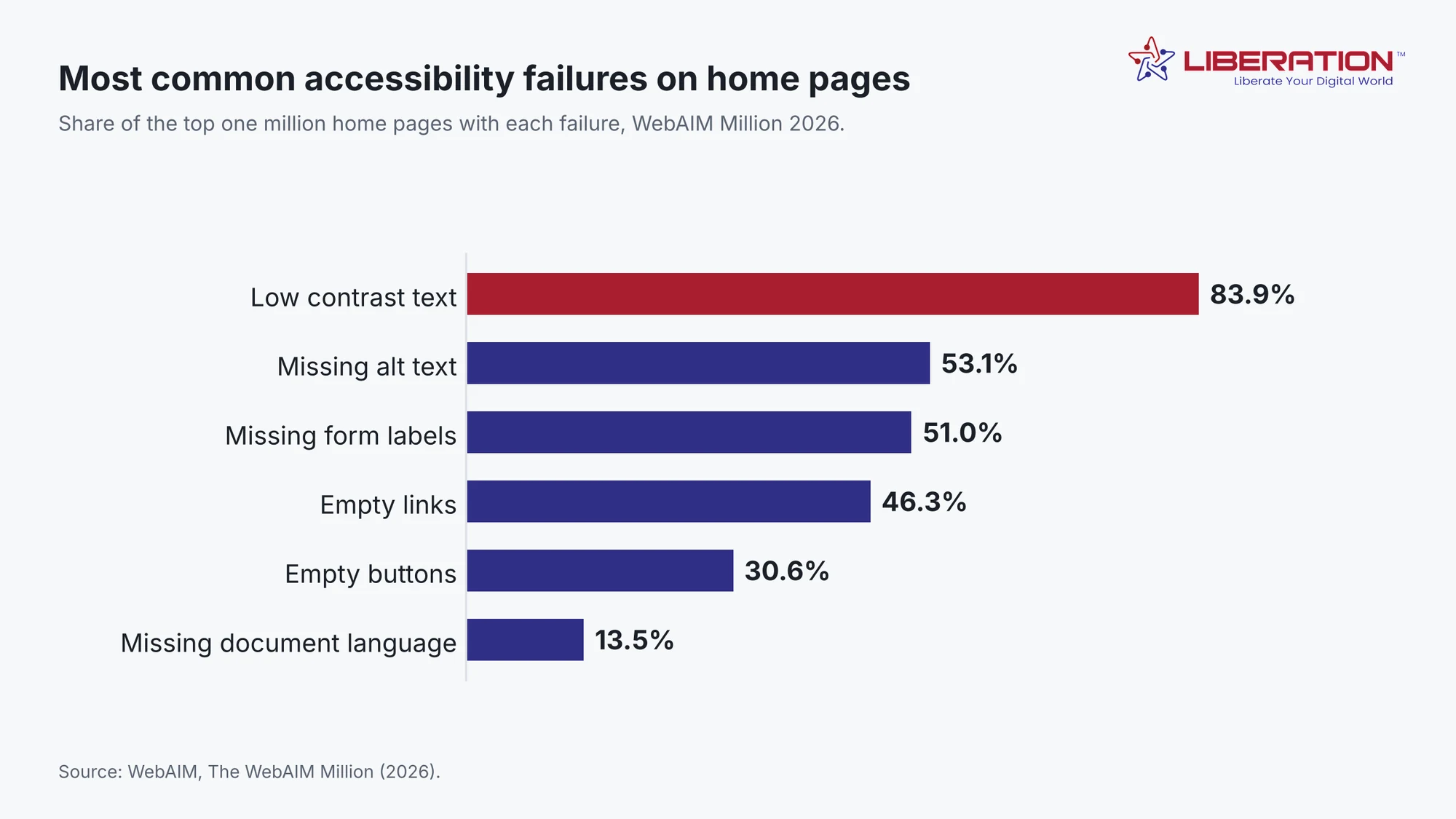
- Low contrast text appeared on 83.9% of pages, the most common failure.
- Six failure types account for 96% of all detected errors.
- Pages using ARIA averaged 59.1 errors, against 42 on pages without it.
The six failures behind most errors
The WebAIM Million runs an automated check on the home pages of the top one million sites each year. Figure 1 shows the six most common failures in the 2026 edition. All of them are easy to fix once someone finds them.
Automated tools find only a share of real barriers, so a page with no detected errors can still be hard to use. The figures are best read as a floor.
The trend since 2021
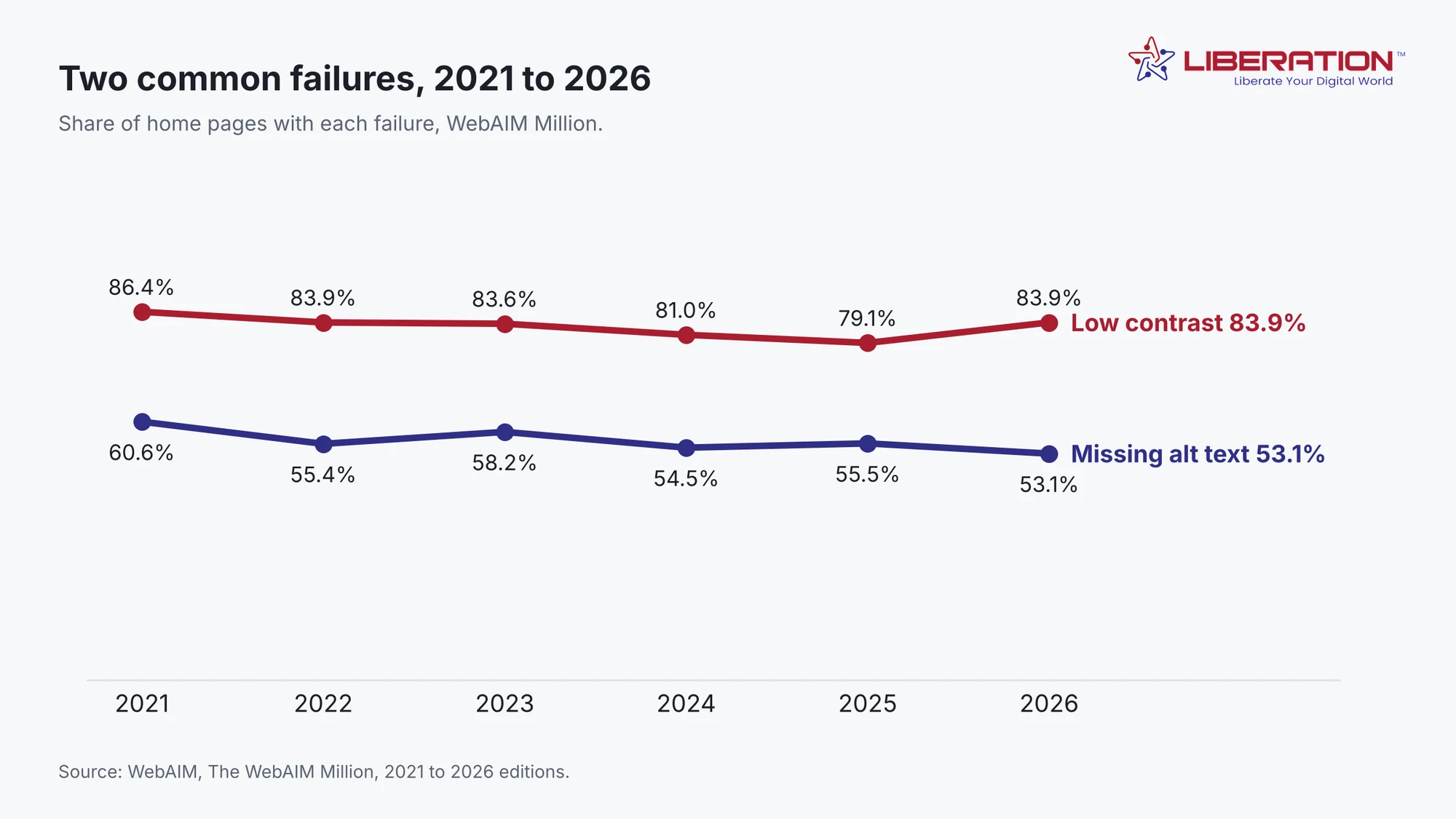
Errors per page were about 50 from 2021 to 2023, 56.8 in 2024, 51 in 2025 and 56.1 in 2026. Figure 2 follows two of the six failures. Missing alt text has slowly declined. Low contrast fell for several years and then jumped from 79.1% to 83.9% in 2026.
Pages are also getting heavier. The average page had 1,437 elements in 2026, up from 1,257 a year earlier, which gives errors more places to occur.
What a small business should fix first
Many small business sites are built on templates and page builders, and some common failures come from the theme, so a one-time review of the template can pay off across every page. WebAIM’s platform comparison shows how much it varies. WordPress sites averaged 52.8 errors per page, against 33.3 for Wix and 33.0 for Squarespace. The table pairs each failure with its standard fix.
| Failure | Standard fix |
|---|---|
| Low contrast text | Check text against the WCAG ratios, 4.5:1 for body text and 3:1 for large text |
| Missing alt text | Describe informative images in the alt attribute and leave decorative ones empty |
| Missing form labels | Attach a visible label to every field |
| Empty links and buttons | Give each one visible text or an accessible name that says what it does |
| Missing document language | Set the lang attribute on the html element |
Three steps to improve a site
1. Test the template
Run a free checker such as WAVE on your home page and two inner pages. Fixes to the header, footer and menu apply everywhere.
2. Fix content as you publish
Add alt text when you upload an image, and write link text that makes sense out of context. That habit prevents most of the content errors.
3. Know your deadlines
Government sites have new federal deadlines. See our guide to ADA Title II website compliance. If you want help with the build itself, our web development team can review a template and fix the issues.
Frequently asked questions about web accessibility statistics
What percentage of websites are not accessible?
The WebAIM Million 2026 found detectable WCAG 2 failures on 95.9% of the top one million home pages, up from 94.8% in 2025. Automated checks catch only some problems, so the true share with barriers is likely higher.
What are the most common accessibility errors?
Low contrast text (83.9% of pages), missing image alt text (53.1%), missing form input labels (51.0%), empty links (46.3%), empty buttons (30.6%) and a missing document language (13.5%). Together these six categories made up 96% of all detected errors.
How many accessibility errors does a typical home page have?
The average was 56.1 detected errors per page in 2026, up 10.1% from 51 in 2025. That reverses part of the improvement of the previous years.
Does ARIA make pages more accessible?
Not automatically. 82.7% of pages used ARIA in 2026, and those pages averaged 59.1 detected errors against 42 for pages without it. WebAIM presents this as an association. Used carelessly, ARIA can add problems.
Which website platforms had fewer errors?
Among the platforms WebAIM lists, Adobe Experience Manager averaged 29.9 errors per page, Squarespace 33.0, Wix 33.3 and WordPress 52.8. How a site is built and maintained matters as much as the platform.