
Who should own your domain and hosting has one sensible answer: you do. Buy both in your business’s name, on your own card, then give your designer access. This is not about distrust. It is that whoever holds those two accounts controls whether your website and email keep working, and that should be you rather than a supplier relationship that might end.
Why designers offer to handle it
Usually for genuinely good reasons. It is faster, it avoids walking a non-technical client through a registrar’s checkout, it keeps everything in one place they can manage, and it means they are not blocked waiting for a password. Many designers bundle hosting as a service and manage it properly for years.
The problem is not motive. It is what happens at the end – and every supplier relationship ends eventually, through a move, a retirement, a disagreement or a business closing. At that moment, whoever owns the accounts holds the leverage, and you will discover which arrangement you made.
What actually goes wrong
| Situation | Consequence |
|---|---|
| Designer stops responding | Nobody can renew the domain or fix the site. It expires quietly. |
| Designer retires or closes | Accounts sit in a business that no longer exists, which is hard to unpick. |
| You want to move on | Transfer depends on their cooperation and their timeline. |
| A billing dispute | Your website and email are the leverage, whichever side is right. |
| Email is on the same domain | Losing the domain loses every business address at once. |
That last row is the one people do not see coming. The domain is not just the website – it is every email address, and email is the recovery route for every other account your business owns.
The arrangement that works for both sides
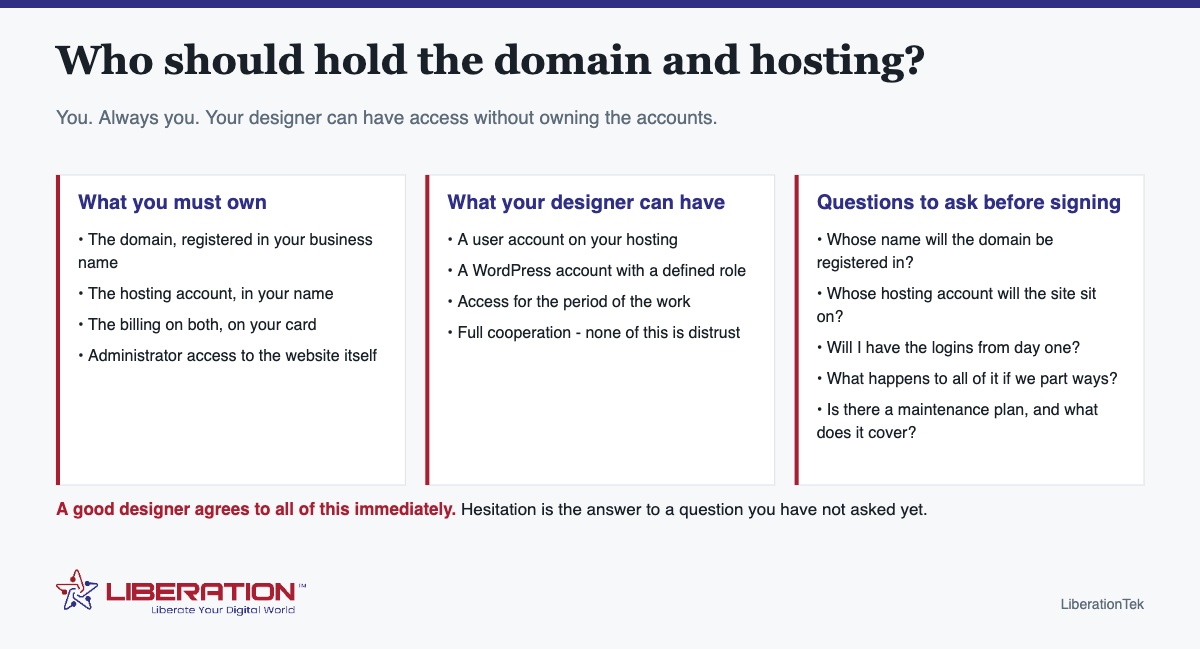
You own the accounts. Your designer gets access. Everyone gets what they actually need.
- Domain registered in your business’s name, at a registrar, on your card.
- Hosting in your name, on your card, with your contact email.
- Designer access as a user on the hosting account and their own WordPress account with a defined role.
- Billing alerts to an address you monitor, so a renewal cannot lapse silently.
This costs nothing extra and removes the entire category of problem. A good designer will agree without discussion, because it protects them too – they are no longer holding something that could become a dispute.
Five questions to ask before signing
- Whose name will the domain be registered in?
- Whose hosting account will the site sit on?
- Will I have the logins from day one?
- What happens to the domain, the hosting and the site files if we part ways?
- Is there a maintenance plan, what does it cover, and what does it cost?
The fifth is the one that prevents the most common ordinary failure: a site built well, then never updated, because nobody agreed whose job that was.
If it is already in their name
Ask for it to be transferred. Most designers will do it willingly – many never intended to hold it permanently and simply set it up that way to get moving.
Do it now, while the relationship is good. Domains transfer between registrars using an authorization code, and hosting can be migrated in an afternoon. Both become considerably harder the moment there is a disagreement, which is precisely when people think to ask.
If you get resistance, ask why. There may be a reasonable explanation – a bulk registrar account, a reseller arrangement. There may not be.
What “managed by your designer” should mean
There is a perfectly good version of this arrangement. Your designer manages the hosting, handles updates and monitors the site – on accounts that are in your name, with logins you hold. You are buying their time and attention rather than their control.
Many web designers run this way deliberately through reseller hosting, which lets them provide hosting under their own brand while their clients retain proper ownership. If your designer works that way, ask how the accounts are structured and whether you could take the hosting over directly if you ever needed to.
Doing it yourself takes ten minutes
Registering a domain and opening a hosting account is a checkout, not a technical task. Shared hosting starts at $7.99 a month with cPanel and free SSL, and handles most small business sites. Add mailboxes from $1.95 per user per month and your email is on a domain you control too.
Then hand your designer access and let them get on with the work they are good at.
What you should own, and what can reasonably sit with someone else
The question of who should own your domain and hosting is not all-or-nothing. Some things must be in your name. Others are fine delegated, provided you can reach them.
| Asset | Whose name | Why |
|---|---|---|
| Domain name | Always yours | It is your business identity. Everything else can be rebuilt; this cannot be taken back easily |
| Hosting account | Yours, ideally | Controls the site files and often the email. Delegation is workable if you hold the login |
| WordPress admin | Yours, plus theirs | Separate accounts, both administrators |
| Email accounts | Always yours | Losing mail access is worse than losing a website |
| DNS management | Either, if you can reach it | This is what points the domain at the site and the mail |
| Premium plugin licenses | Yours where possible | They renew on whoever’s card bought them, and stop working when that ends |
| Analytics and Search Console | Yours, with them added | Historical data does not transfer if the account is theirs |
The pattern is simple: anything that represents your identity or holds your data should be in your name, with the designer added to it. The reverse arrangement, where everything is theirs and you are added, is where the trouble starts.
The conversation to have, and how to have it
Designers are not villains here. Most offer to handle the domain and hosting because it genuinely is easier for them and because clients often ask them to. The problem is structural rather than moral: an arrangement set up for convenience becomes a dependency the moment either side wants to end it.
It helps to frame the ask as being about your own continuity rather than their trustworthiness. Something like: “I want the domain and hosting in the business name for continuity, and I will add you as a user with full access.” Almost no professional will object to that, because it does not restrict them in any way. A designer who does object is describing their business model, and it is one that depends on you not being able to leave.
Warning signs worth noticing early
- You have never seen a hosting bill. If hosting is bundled into a monthly fee with no visibility, you do not know what you are paying for or with whom.
- You do not know who your registrar is. This is the most important single fact about your domain and you should be able to answer it.
- Login requests get deflected. “I will handle that for you” in response to a direct ask for access is an answer about control, not service.
- Your email runs through a system you cannot see. Losing website access is disruptive. Losing mail access can stop the business.
- There is no written agreement about what happens if you part ways. The time to agree this is at the start, when everyone is being reasonable.
How to check what you actually own, in ten minutes
- Look up your domain in a public WHOIS lookup. Privacy protection may mask the details, but the registrar will be named. That tells you where the domain lives.
- Try to log in to that registrar with a password reset to your own email address. If the reset email does not come to you, the account is not in your name.
- Do the same for the hosting account.
- Check your WordPress user list and confirm you are an Administrator.
- Check who owns the Google Analytics and Search Console properties.
Nothing here is confrontational, and it is all information you are entitled to. If everything checks out, you have five minutes of reassurance. If it does not, you have found out at a calm moment rather than during a dispute, which is the entire point of checking.
Frequently asked questions
Should I buy my own domain and hosting, or let my web designer handle it?
Buy them yourself, in your business’s name, on your own card – then give your designer access. Convenience is the argument for letting them handle it, and control is the argument against. If the relationship ends, whoever owns the accounts controls whether your website keeps working.
What happens if my web designer owns my domain?
You are dependent on their cooperation to move, renew or change anything. Most designers behave well, but the ones who do not leave businesses without a website and without the email addresses attached to that domain.
What questions should I ask my web designer about hosting?
Whose name the domain will be registered in, whose hosting account the site will sit on, whether you will have the logins from day one, what happens if you part ways, and what any maintenance plan actually covers.
Is it rude to ask a designer for the logins?
No. It is ordinary business practice, the same as holding the keys to premises someone works in. A professional will expect the question and answer it without friction.
What if my designer has already registered everything in their name?
Ask them to transfer it – most will. Domains move between registrars with an authorization code, and hosting can be migrated. Do it while the relationship is good rather than waiting until there is a disagreement.
How do I find out who owns my domain name?
Run a public WHOIS lookup on your domain. Privacy protection may hide the contact details, but it will always name the registrar. Then attempt a password reset at that registrar using your own email address. If the reset email arrives with you, the account is reachable by you. If it does not, the domain is registered to someone else.
Should my web designer host my email?
Generally no, or at least not in a way you cannot reach. Losing website access is disruptive; losing email access can halt the business, and mail cannot be rebuilt the way a website can. Keep email on an account in your own name, with the designer given access if they need it. LiberationTek Email starts at $1.95 per user per month on a separate account you control.