
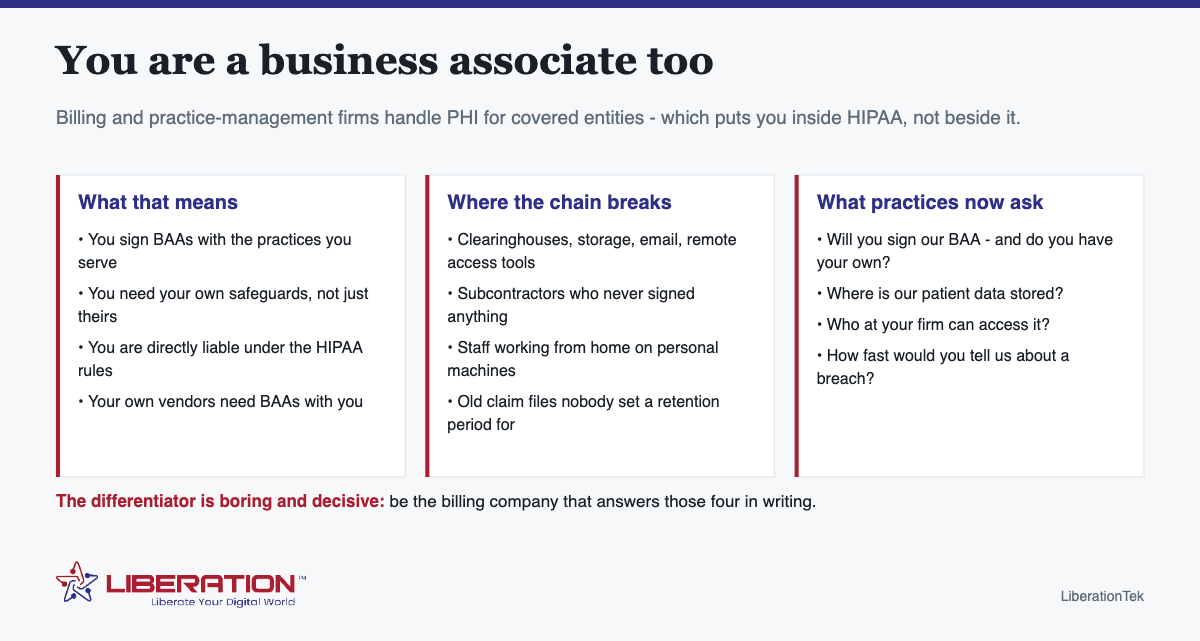
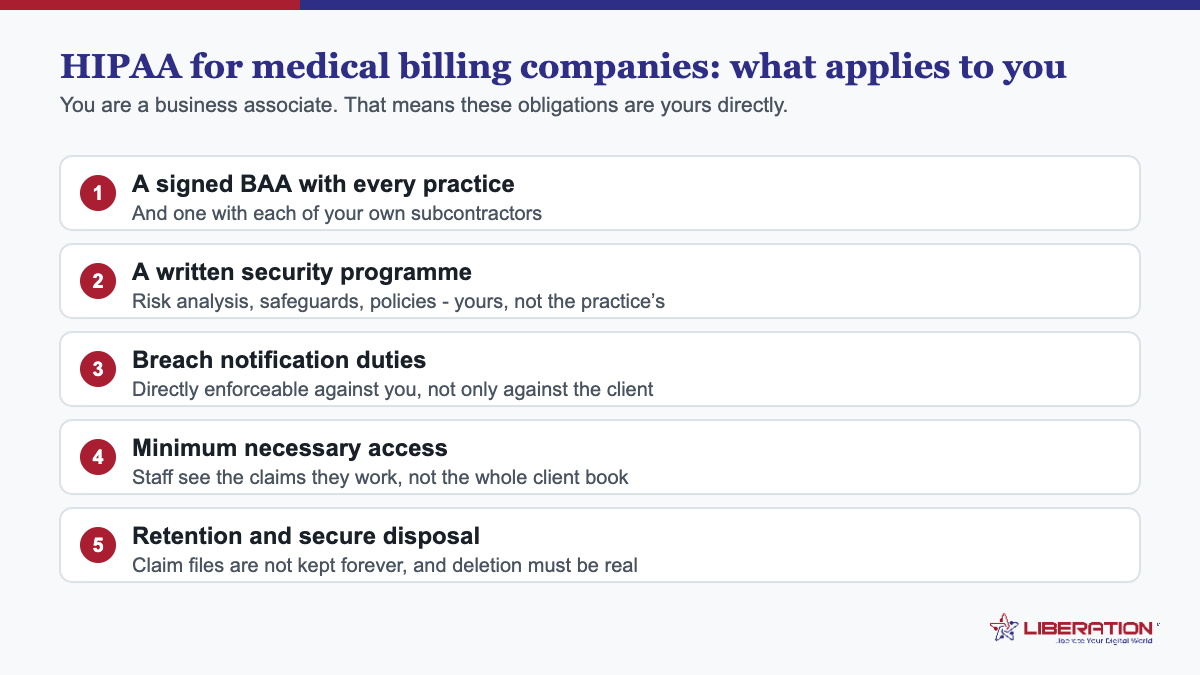
HIPAA for medical billing companies is direct, not reflected: billing and practice-management firms are business associates, which means the rules apply to you directly rather than by reflection off your clients. You sign BAAs with the practices you serve, you need your own safeguards, you are liable for them, and every subcontractor you pass patient data to needs a BAA with you. The chain has to reach the end.
HIPAA for medical billing companies: associate, not bystander
The distinction matters because it changes who is answerable. A covered entity – the practice – is obviously inside HIPAA. A business associate handling protected health information on that practice’s behalf is inside it too, with its own obligations and its own direct liability.
For a billing company that means three things in practice. You will be asked to sign the practice’s BAA. You are expected to maintain safeguards of your own rather than relying on theirs. And where you hand data onward – to a clearinghouse, a storage provider, an email service, a remote access tool – you need an agreement with that subcontractor, because your obligations travel with the data.
Where the chain usually breaks
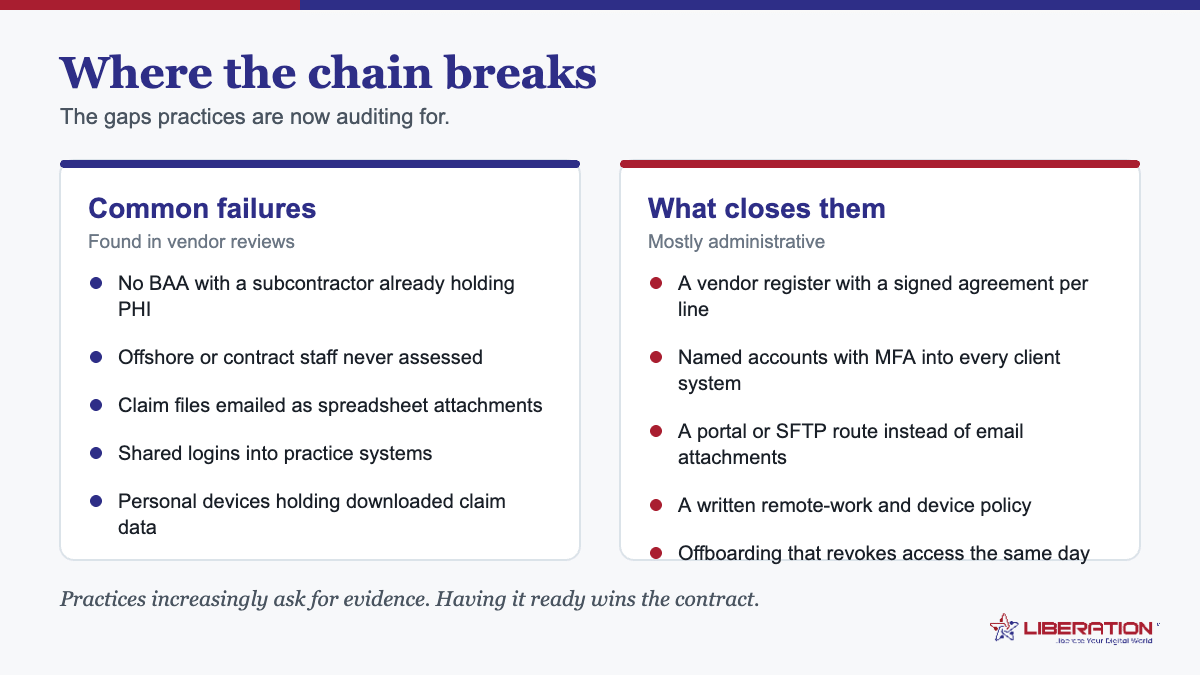
| Gap | Why it happens | The fix |
|---|---|---|
| Subcontractors without agreements | Tools get adopted by whoever needed them, not by procurement | Inventory every vendor touching PHI; get a BAA from each |
| Home working on personal machines | Billing is remote-friendly work | Managed devices, or remote access that keeps data off the endpoint |
| PHI living in email | It is the path of least resistance for practices sending you files | Give clients an upload link; stop accepting attachments |
| No retention period on claim files | Nobody deletes anything, and search makes hoarding costless | Decide a period, write it down, and actually dispose |
| Access never removed | Staff turnover, contractors, seasonal help | Review access twice a year and remove on the day someone leaves |
None of these are sophisticated failures. They accumulate because no single person owns them, which is exactly what naming a responsible individual is supposed to fix.
The four HIPAA questions practices now ask billing companies
Due diligence on billing vendors has tightened considerably, and the questions are consistent:
- Will you sign our BAA, and do you maintain your own security program?
- Where is our patient data physically stored, and who owns that infrastructure?
- Who at your firm can access it, and is that access logged?
- How quickly would you notify us of a breach, and by what route?
Here is the commercial point, which is more interesting than the compliance one. Most billing companies answer these badly – vaguely, slowly, or by escalating to someone who will call back. Being the firm that answers all four in writing, immediately, is a differentiator in a market where practices are nervous and switching costs are lower than they look.
What to put in place for HIPAA for medical billing companies
- A vendor inventory. Every system touching PHI, what it does, whether a BAA is in place, where the signed copy lives, and when you last reviewed it. Five or six rows for most firms, and the single most useful document you can have.
- Email on your own domain with multi-factor authentication on every mailbox, and a rule that PHI does not travel as an attachment in either direction.
- A secure intake path for practices sending you files, because they will use whatever you make easiest.
- Access control and logging you can actually retrieve when a client asks.
- A retention period for claim files, with disposal that happens on a schedule rather than in principle.
- An incident plan that names who decides, who tells the client, and within what timeframe.
What a vendor can and cannot do for HIPAA for medical billing companies
Plainly: there is no HIPAA certification, for hosts or for billing companies, and any provider claiming to make you compliant is describing something that does not exist. What a provider can do is sign a BAA, carry specific technical safeguards, and answer your subcontractor questions in writing so your own documentation is real.
We sign a Business Associate Agreement. Hosting runs on hardware we own and operate in the United States, with encryption in transit and at rest, free SSL, and multi-factor authentication configured in cPanel. Liberation Email from $1.95 per user per month keeps mail on your own domain with nothing scanned for advertising or passed to a data broker, and Hub For Teams from $7.49 per user adds secure file sharing – which is the practical answer to practices sending you claim files by email.
For firms handling volume across many clients, Dedicated Cloud from $65.95 a month gives you resources no other customer shares, which is a materially easier thing to describe in a client questionnaire than shared hosting.
See how we work with healthcare, or ask us the four questions above and file the answers with your program.
Turning HIPAA compliance into a sales asset
Most billing companies treat security questionnaires as an obstacle. The firms winning accounts treat them as the pitch, because a practice choosing a biller is choosing who to trust with the thing that would end their week if it leaked.
Three things make that concrete. Have the vendor inventory ready before anyone asks. Have your BAA – your own, not just a signed copy of theirs – available on request. And answer the four questions in a paragraph rather than escalating them. Speed of answer signals competence more reliably than the answer itself.
Remote staff, which is most of this industry
Billing work is done remotely more than almost any other healthcare-adjacent function, and that is where the practical exposure sits. Three decisions cover most of it:
- Where does data live during work? Keeping it off the endpoint entirely – accessed rather than downloaded – avoids most of the hard questions about personal machines.
- What happens on the day someone leaves? Access removed the same day, not at the end of the month, and a written record that it was done.
- What are staff allowed to use? A short list of approved tools beats a long policy nobody reads, and it prevents the quiet adoption of whatever is convenient.
Retention under HIPAA for medical billing companies
Billing generates volume, and volume with no retention period becomes liability that grows every month. Decide a period per record type, write it down, and dispose on schedule – from the billing system, from storage, from email and from backups. Data you no longer need cannot earn you anything and can still be breached.
What a practice is really buying from a billing company
Worth naming the commercial reality: a practice choosing a billing company is choosing who to trust with the thing that would end their week if it leaked. Collection rates and turnaround matter, but they are compared against other bidders who also claim them. A firm that can answer security questions immediately, in writing, is differentiating on something its competitors usually cannot.
That is an unusual position for a compliance obligation to be in – it is normally pure cost. Treating it as sales material rather than paperwork is the single most useful reframe available to a billing company this year.
A short quarterly routine for HIPAA for medical billing companies
- Review the vendor inventory – anything new adopted since last quarter?
- Check access: anyone left, anyone changed role, any contractor finished?
- Restore one backup to confirm it works.
- Dispose of anything past its retention period.
- Confirm every BAA is still current and the signed copies are findable.
An hour, four times a year. It is also, not coincidentally, exactly what you would want to be able to show if anyone ever asked.
What enforcement against a business associate actually looks like
There is a persistent belief in this industry that HIPAA is really the practice’s problem and that a billing firm is one step removed. That stopped being true in 2013, and it is worth understanding what changed, because it shapes how much of this is discretionary.
Business associates are directly liable. Since the HIPAA Omnibus Rule, the Security Rule applies to business associates in its own right. A billing company can be investigated and penalised directly, without the practice being the subject of the action. The practice’s contract with you is a separate matter from your obligations under the regulation itself.
The commonest finding is the absence of a risk analysis. Not a breach, not a sophisticated attack – simply no documented assessment of where PHI sits and what could go wrong. HHS publishes its enforcement outcomes and guidance through the Office for Civil Rights enforcement pages, and the pattern is consistent enough to be instructive. For HIPAA for medical billing companies, the written risk analysis is the single highest-value document to produce.
Subcontractors inherit everything. If you use an offshore coding team, a clearinghouse, a cloud storage provider or a contract coder, each is your business associate and needs an agreement with you. The obligations flow all the way down the chain, and the firm in the middle is responsible for the links it created.
Breach notification runs on a clock. You must notify the covered entity without unreasonable delay. Practices increasingly write specific timelines into their agreements – often considerably shorter than the regulation’s outer limit – and being unable to meet a contractual deadline is a commercial problem before it is ever a regulatory one.
Documentation is the defence. In practice the question asked is not “were you perfect” but “can you show what you did and when”. Dated policies, a training log, a vendor register and a record of decisions are worth more than any single technical control.
Which is why this is worth doing properly. HIPAA for medical billing companies is not an abstract compliance exercise; it is the difference between a vendor review that goes smoothly and one that ends a client relationship. Practices are asking harder questions every year, and the firms that answer them with documents rather than assurances are the ones keeping the contracts.
Remote and offshore staff: the hardest part of HIPAA for medical billing companies
Medical billing is one of the most distributed industries there is. Coders work from home, some teams are offshore, and staff turnover is high. That is not a compliance failure in itself – but it is where most of the genuine difficulty sits, and it deserves its own answer rather than a general policy.
Home working is permitted; unmanaged devices are the problem. Nothing prohibits a coder working from a spare room. What matters is whether the device is encrypted, whether the session times out, whether household members can see the screen, and whether claim data is being downloaded locally at all. The strongest answer is usually to stop data landing on the device: remote desktop or a browser-based system, with downloads disabled.
Write the remote-work rules down specifically. Not “work securely” but the actual expectations: no printing at home, no personal cloud sync folders, screen locked when away, no working in public spaces, a stated position on household members in the room. Staff follow specific rules and ignore vague ones.
Offshore teams need the same agreements and more documentation. HIPAA does not prohibit sending PHI overseas, but practices increasingly ask directly, and some will decline. You need a business associate agreement with the offshore entity, and you should be able to say which country the data is in and who has access. Firms that answer this cleanly win work from those that hedge.
Onboarding and offboarding are the controls that actually work. Turnover means access changes constantly. One named account per person into every client system, granted on day one and revoked on the last day, is worth more than any policy document. Shared logins exist precisely because offboarding was never designed – and they make it impossible to say who did what.
Train for the specific risks of this work. Not generic security awareness, but the things that actually happen in billing: a claim spreadsheet forwarded to a personal address to work on at the weekend, a client’s portal password shared with a colleague covering absence, a screenshot pasted into a chat to ask a question. Name those scenarios in training and they stop happening.
Then document that you did all this. HIPAA for medical billing companies is judged on evidence, and a distributed workforce with a written policy, named accounts and a training log is a far stronger position than an office-based team with none of those things.
A 30-day starting plan for HIPAA for medical billing companies
If your firm has clients but no documentation, the gap can be closed faster than most owners expect. Thirty days of small tasks produces something you could hand to a practice tomorrow.
Week one: the register. List every client practice and whether a signed BAA exists. List every system and subcontractor that touches claim data, and whether an agreement exists with each. This register is the backbone of HIPAA for medical billing companies, and most firms find two or three gaps in the first hour.
Week two: access. Remove shared logins, give every person a named account into every client system, enable multi-factor authentication everywhere it exists, and write down who has access to what. Then check the list against your current payroll – departed staff with live access is the finding nobody wants to explain.
Week three: the written programme. A risk analysis naming where PHI sits and what could go wrong, the safeguards you actually have, a remote-work policy, and an incident response plan with real names and numbers. Four to six pages. Accurate beats comprehensive.
Week four: training and evidence. Walk the team through the new rules with the specific scenarios from their actual work, get a dated sign-off sheet, and file it with everything else. Then write a one-page summary of your security posture that sales can send to prospects.
Then keep it alive quarterly. Check the access list, chase any missing agreements, note anything that changed. Fifteen minutes.
That last document is the part firms underrate. Practices are being asked by their own auditors and insurers about vendor oversight, and a billing company that can answer with a current, dated summary is making its client’s job easier. HIPAA for medical billing companies looks like a burden from the inside and like a differentiator from the client’s side of the table.
The summary worth keeping: HIPAA for medical billing companies is not your client’s obligation passed along to you by contract. It is a duty you hold in your own right, enforceable directly, covering every subcontractor you bring into the chain. Firms that treat HIPAA for medical billing companies as their own programme rather than as their clients’ paperwork find the vendor reviews straightforward and, increasingly, find it wins them the work.
Frequently asked questions
Are medical billing companies covered by HIPAA?
Yes, as business associates. A billing company handles protected health information on behalf of covered entities, which places it directly within the HIPAA rules. That means signing business associate agreements with the practices it serves, maintaining its own safeguards, and being directly liable for them.
Does a medical billing company need its own BAAs with its vendors?
Yes. A business associate that passes protected health information to a subcontractor – cloud storage, a clearinghouse, an email provider, a remote access tool – needs a business associate agreement with that subcontractor. The chain has to reach every party that touches the data.
What do medical practices ask billing companies about security?
Increasingly four things: will you sign our BAA and do you maintain your own program, where is our patient data stored, who at your firm can access it, and how quickly would you notify us of a breach. Answering those in writing is a commercial advantage.
Where do billing companies usually fall short?
Subcontractors without agreements, staff working from home on personal machines, patient data sitting in email indefinitely, and old claim files with no retention or disposal routine.
Does hosting make a billing company HIPAA compliant?
No. Hosting and email can carry specific technical safeguards and a provider can sign a business associate agreement, but the firm still has to run its own program, train staff, manage subcontractors and document its decisions. There is no HIPAA certification.
Related reading
- HIPAA Hosting for Dental Practices: 3 Essential Fixes
- HIPAA Hosting for Small Practices: 5 Essential Basics
- HIPAA Compliant Email: 5 Essential Requirements
- HIPAA Compliant Email With a Signed BAA — What a BAA-backed mailbox actually includes.
- HIPAA Compliant Hosting for Healthcare — Where the rest of a practice’s data lives.