
Cloud server hosting runs your website, email or application on virtual servers that draw on a pool of physical machines, so you are not tied to one box. For a small business, church, nonprofit or campaign, the practical question is less about the technology and more about who owns the servers, where your data sits and who answers the phone. At LiberationTek, we own and operate our servers in the United States, and our plans start at $14.99 per month for Shared Cloud Hosting.
TL;DR
- A cloud server is a virtual server you reach over the internet. The provider handles the hardware, and you handle your site, data and logins.
- Pick the tier by workload: shared cloud for a brochure site, managed WordPress for a site you update often or sell from, Private Cloud for sensitive data or heavy traffic.
- Before you buy, check who owns the servers, where your data is stored, how backups work, whether support is a real person and what the total monthly cost is.
- LiberationTek plans include direct U.S. based support, free migration and a 30-day money-back guarantee.
Table of Contents
- What cloud server hosting actually is
- How cloud hosting differs from shared, VPS and dedicated
- Why who owns the servers matters
- What managed cloud servers cover, and what stays with you
- Match the hosting tier to your organization
- What to check before you choose a provider
- How the cost adds up
- Moving to LiberationTek
- FAQ
- Sources
What cloud server hosting actually is
A traditional server is one physical computer sitting in one rack. A cloud server is a virtual server: software divides physical machines into separate, isolated virtual ones. TechTarget describes a cloud server as a virtual server running in a cloud computing environment and reached remotely over a network. It works by virtualizing physical servers, often with software called a hypervisor, and it is provisioned and managed through software interfaces.
Cloud hosting is the service built on that idea. You outsource computing and storage to a provider, and the provider handles setup, infrastructure, security and maintenance. Because the work is spread across many virtual machines that balance demand, you get better availability and easier recovery than most small organizations could build in their own server closet.
Three parts make it work:
- Virtualization, which keeps each customer’s virtual server separate on shared hardware.
- A network of physical servers in a data center.
- Management software, which assigns resources, watches server health and helps protect data.
For you, that means your site does not go down because one drive failed, and you can move to a bigger plan without rebuilding anything.
How cloud hosting differs from shared, VPS and dedicated
These terms overlap, which is why shopping for hosting gets confusing. Here is the plain version.
| Type | How it works | Good fit |
|---|---|---|
| Shared hosting | Many sites share one server’s resources | Small brochure sites, church or club sites, low traffic |
| VPS (virtual private server) | One physical server split into a few private slices with set resources | Growing sites that need guaranteed resources |
| Cloud hosting | Resources come from a connected group of servers, so capacity can move | Sites with uneven traffic, steady growth, higher uptime needs |
| Dedicated server | You rent a whole physical machine | Heavy workloads and strict control needs |
The lines blur because providers build their products differently. Some shared plans run on cloud infrastructure, and some VPS plans are really cloud servers under another name. The label matters less than three questions: what resources are set aside for you, who manages the server, and who owns the hardware.
At LiberationTek, the range looks like this:
- Shared Cloud Hosting with cPanel, in three plans: Starter at $14.99 per month, Ramping Up at $19.99 per month and Growth at $29.95 per month.
- Managed WordPress Hosting: WP Starter at $35 per month, WP Growth at $69 per month and Commerce at $129 per month.
- Private Cloud Hosting: Sentinel at $179 per month, Steward at $299 per month, Sovereign at $479 per month and Citadel at $679 per month.
- Dedicated Cloud, built to order under Build Your Own, with no published price.
If you are weighing the VPS route specifically, our guide on managed versus unmanaged VPS walks through the differences.
Why who owns the servers matters
Many “cloud” products are resold capacity from a few giant providers. That is fine for some uses, but it adds a layer between you and your data. LiberationTek runs on servers we own in the United States, not capacity resold from Big Tech. We do not track or share customer data, and there are no ads.
This matters most for organizations whose records are sensitive or whose supporters are privacy conscious: healthcare practices, law firms, ministries, political campaigns, Second Amendment businesses and local government. If the people who rely on you ask where their information lives, you can answer in one sentence: on servers owned and run by a U.S. company.
For a deeper look at this approach, read our guide to privacy-first cloud hosting.
What managed cloud servers cover, and what stays with you
“Managed” means the provider runs the routine administration. That usually includes the physical hardware, the network, the virtualization layer, updates to the server software and monitoring. Our overview of managed cloud hosting explains what this looks like for a small team.
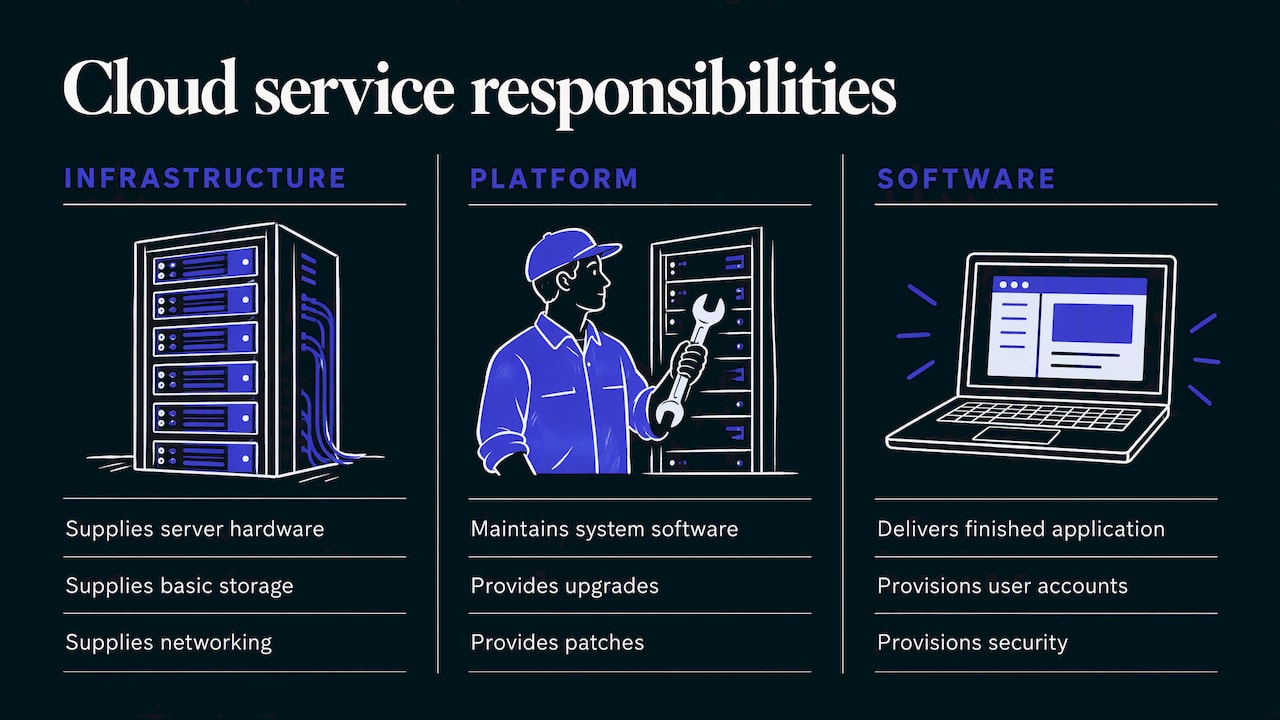
No provider takes over everything, though. The Nonprofit Technology Network’s 2020 cloud summary breaks responsibilities down by model. Infrastructure providers supply server hardware with basic storage and networking. Platform providers also maintain system software, including upgrades and patches. Software providers deliver the finished application and also provision user accounts and security.
In every model, you still own the basics: who has a login, how strong the passwords are, what goes into your site and who can publish. A simple rule keeps this manageable. Give admin access only to people who need it, give each person a unique login, and turn on two-factor authentication for administrators. For a broader look at how a business’s own habits affect its exposure, see this piece on website security and customer trust.
The benefit of a managed plan is that you are not hiring someone to patch servers at night. A small office rarely has a full-time systems administrator, and a good managed plan puts that work with the provider while you keep running your organization.
Match the hosting tier to your organization
A church, club or small business with a simple site
If your site is mostly pages, a sermon archive or a contact form, shared cloud hosting is the sensible start. Starter is $14.99 per month, and Growth at $29.95 per month adds room as you add content. Mailboxes use the same disk allowance as your site, so if you plan to host many email accounts, think about moving mail onto Liberation Email, which starts at $1.95 per user per month on Mail Starter. Liberation Email is private, ad-free and offers end-to-end encryption.
Our page on shared cloud hosting for business helps you decide whether you are ready to move.
A nonprofit or business that runs on WordPress
WordPress sites need regular updates, backups and security attention. Managed WordPress hosting takes that routine off your plate. WP Starter at $35 per month suits a single organization site, WP Growth at $69 per month suits a busier one, and Commerce at $129 per month is built for online stores. Churches and nonprofits receive a 15% discount.
When you compare WordPress hosts, look for these:
- Controlled updates for WordPress itself, plus a clear approach to plugin updates
- Daily backups that you can restore easily, stored away from the server they protect
- An SSL certificate, so visitors see the lock in their browser
- Restricted admin access with unique logins and two-factor authentication
Our guide to cloud hosting for small business covers how these plans fit different budgets.
A practice, firm, campaign or agency with sensitive data or heavy traffic
When you handle client files, patient records or donor lists, or a campaign launch will send a surge of visitors, a Private Cloud gives you dedicated resources and more control. Our four tiers run from Sentinel at $179 per month to Citadel at $679 per month. Private Cloud includes unmetered monthly data transfer with no egress fees. Egress fees are what some providers charge when data leaves their network, so they can turn a quiet bill into a surprise one.
To see how we think about protection at this level, read about private cloud security controls and where private cloud services can be hosted. If you want a deeper comparison of why organizations step up, see five reasons businesses move to private cloud hosting.
If you resell hosting to clients, our notes on reseller hosting security cover the safeguards that protect your customers’ sites.
An ecommerce store
Online stores need steady speed during sales and careful handling of customer data. The Commerce plan is our managed WordPress option for WooCommerce stores. As your volume grows, a Private Cloud tier gives you room to move up without changing providers.
What to check before you choose a provider
Use this checklist with any provider, including us.
- Who owns the servers. Ask whether the provider runs its own hardware or resells someone else’s.
- Where your data is stored. Know the country, and know which laws apply to it. Healthcare practices in particular should confirm what they need for regulated data.
- Backups and recovery. Find out how often backups run, where they are stored and how fast you can restore.
- Support. Learn whether support is included or charged separately, which channels it uses and whether a real person answers.
- Total monthly cost. Count storage, data transfer, support and add-ons, not just the headline price. The NTEN summary also notes that pay-for-what-you-use pricing may not deliver the savings people expect.
- Migration. Moving a site and email is the part most owners dread. Ask who does it and what it costs.
- Exit terms. Look at the refund policy and contract length before you commit.
On our side: every LiberationTek plan comes with direct U.S. based support, free migration from another provider and a 30-day money-back guarantee. Pricing is published per plan, so you can add it up before you talk to anyone.
How the cost adds up
Cloud pricing from large public providers is often built from many small meters: compute, storage, data transfer, backups, security tools and support. That model is flexible, but it makes a monthly bill hard to predict, which is a real problem for a ministry or campaign working from a set budget.
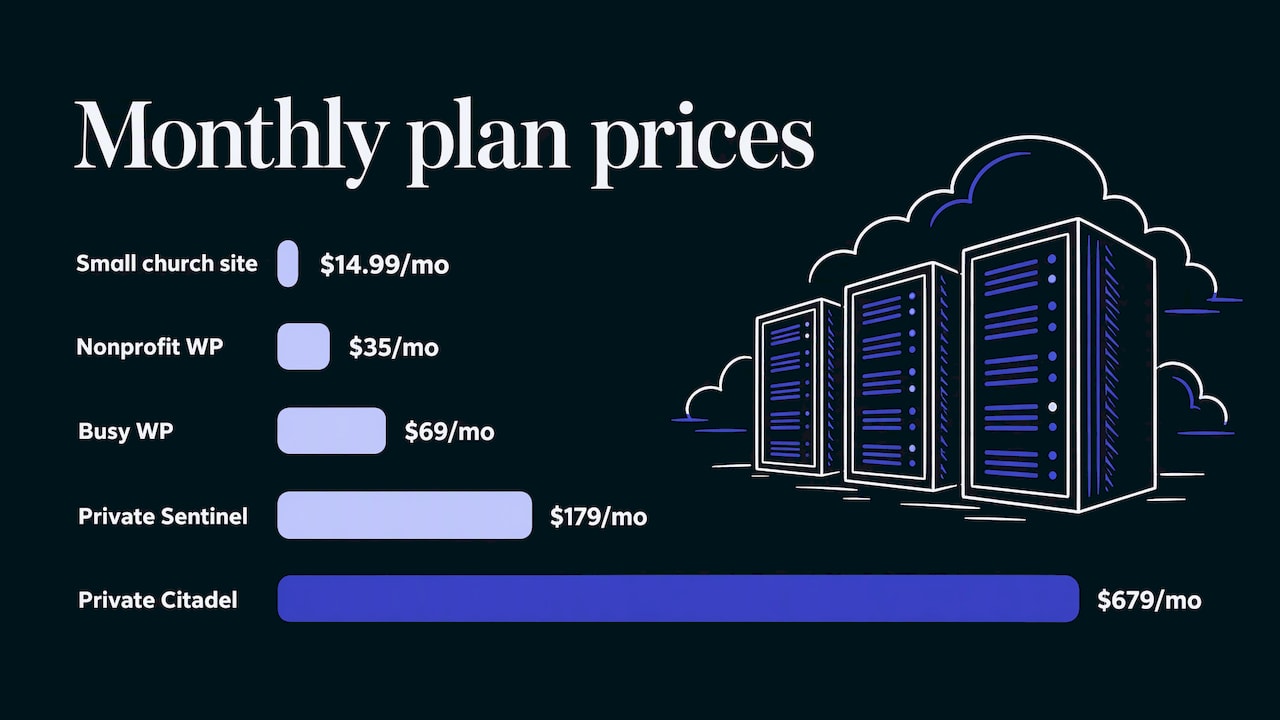
Our approach is to publish a flat monthly price per plan. Here is how a few common setups compare:
| Setup | Plan | Monthly price |
|---|---|---|
| Small church site | Shared Cloud Hosting, Starter | $14.99 |
| Nonprofit WordPress site | WP Starter | $35 |
| Busy WordPress site | WP Growth | $69 |
| Online store | Commerce | $129 |
| Practice or firm with sensitive data | Private Cloud, Sentinel | $179 |
| Large or high-traffic organization | Private Cloud, Citadel | $679 |
Email is priced separately per user: $1.95 on Mail Starter, $4.95 on Mail+ and $7.95 on Mail Pro. If your team also needs files, chat, video and projects in one workspace, Hub for Teams starts at $7.49 per user per month on Teams Starter.
Moving to LiberationTek
If you are leaving a Big Tech cloud, a budget host or an agency-managed server, the move does not need to be a project of its own. We migrate your site and email from your current provider at no charge, and you have 30 days to decide if it is right for you.
To get started, choose a managed WordPress plan or compare Private Cloud tiers. If you are not sure which fits, talk to our U.S. based support team, and they will point you to the right plan for your site, your traffic and your budget.
FAQ
What is cloud hosting in simple terms?
Cloud hosting runs your website or application on virtual servers that draw on a group of connected physical machines. The provider manages the hardware, network and security of the platform. You manage what you put on it, including your content and your logins.
Is cloud server hosting good for small businesses?
Yes. You do not buy or maintain hardware, and you can move to a larger plan as your needs grow. Small businesses, churches and nonprofits often start with shared cloud or managed WordPress hosting and move to Private Cloud when they handle more sensitive data or heavier traffic.
How much does cloud hosting cost for a business?
With LiberationTek, plans run from $14.99 per month for Shared Cloud Hosting Starter to $679 per month for Private Cloud Citadel, with managed WordPress at $35, $69 and $129 per month between them. Your right plan depends on traffic, data sensitivity and how much hands-on management you want.
What is the difference between cloud hosting and a VPS?
A VPS is a private slice of a single physical server, while cloud hosting pulls resources from a connected group of servers. In practice, the more useful comparison is what resources are reserved for you and who manages the server. Our Private Cloud plans are managed for you.
Do I still need to protect my own site on managed hosting?
Yes. The provider secures the platform, but you decide who gets admin access and which plugins you install. Use unique logins and two-factor authentication for every administrator.
Sources
- What is a cloud server? | TechTarget
- cloud hosting | TechTarget
- Cloud Computing for Nonprofits Executive Summary | NTEN