
Email marketing costs less than most people expect at the platform level and more than expected everywhere else. Major services have free tiers covering a few hundred to a couple of thousand contacts. Pricing then scales with list size rather than results, so an unengaged list costs the same as a good one. The real cost is usually writing the emails.
How much does email marketing cost is a question usually answered with a pricing table, which is the easy part and the least useful answer. What determines whether email marketing is expensive for your business is mostly how your list is priced and who writes the content, and neither of those appears on a comparison page. Both are worth settling before you pick a platform, because the platform choice follows from them rather than the other way round.
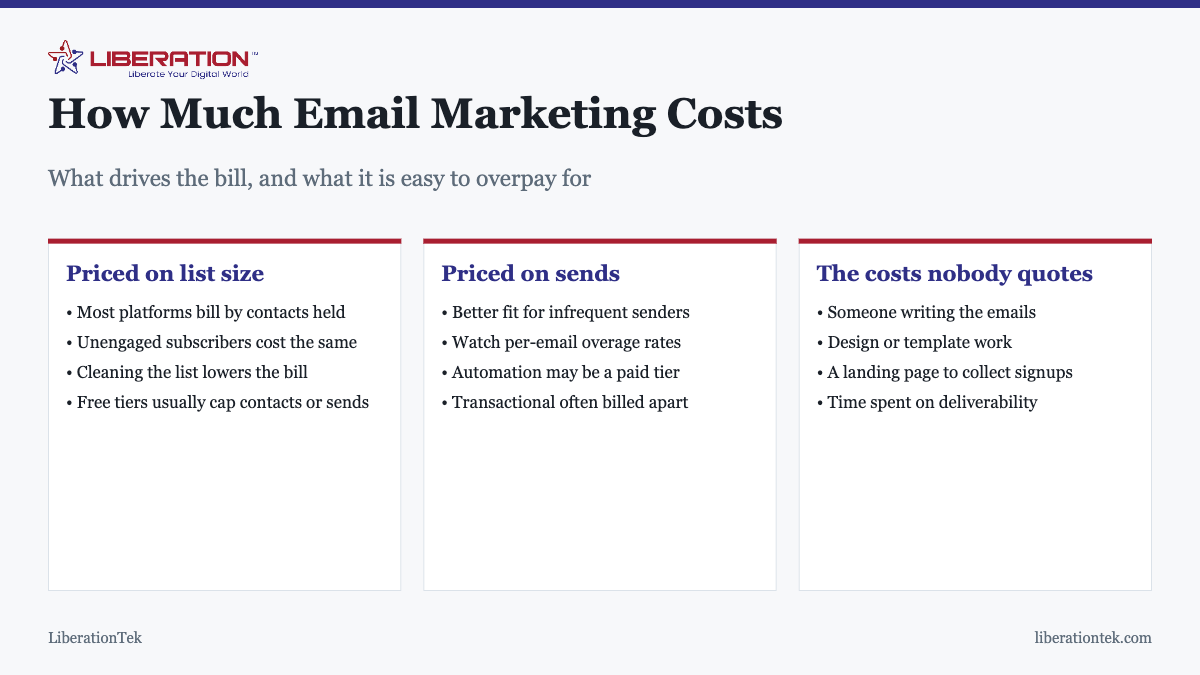
How the pricing models work
Nearly every platform uses one of two models, and which one suits you depends on how often you send rather than on how large you are.
| Priced by contacts | Priced by sends | |
|---|---|---|
| You pay for | Every address stored | Every email delivered |
| Suits | Frequent senders | Occasional senders |
| Punishes | Large unengaged lists | High-frequency sending |
| Cost of inactive subscribers | Full price | Nothing, if you exclude them |
| Watch out for | Tier thresholds | Overage rates per email |
If you send a monthly newsletter to a large list, per-send pricing is usually cheaper. If you send frequently to a modest list, per-contact pricing usually wins. Most businesses are on whichever model their platform happens to use rather than the one that fits, which is worth checking once.
The threshold problem
Contact-based pricing steps up at fixed points. Crossing a threshold by a few contacts moves you to the next tier for the whole billing period, so a list at 2,050 contacts can cost meaningfully more than one at 1,950 while performing identically.
Check also whether your platform counts unsubscribed and bounced addresses towards the total. Some do, which means you can be paying to store people who have explicitly asked not to hear from you.
The costs that never appear in a quote
- Writing. The largest real cost, whether it is your own time or a freelancer’s. Email programs stall on content far more often than on tooling.
- Design or templates. A one-off cost if you want something beyond the built-in templates, though the built-in ones are generally fine.
- A signup path. A landing page or form on your website, plus whatever incentive persuades people to join.
- Deliverability work. Setting up authentication properly so your mail arrives at all. One-off, and skipping it makes everything else pointless.
- List maintenance. Periodically removing people who have not engaged. Takes minutes and directly lowers the bill.
Where the money is actually wasted
Three patterns account for most overspending, and none of them are about choosing the wrong platform:
Paying to store people who will never buy. Contacts who have not opened anything in a year cost full price, drag down your engagement metrics, and gradually harm deliverability for everyone else on the list. Removing them is the single highest-return piece of housekeeping available.
Buying a bigger tier for features you do not use. Advanced segmentation and multi-step automation are worth paying for when you are using them. Many businesses upgrade in anticipation and never do.
Treating list size as the goal. A purchased or scraped list costs money, produces complaints, and can damage your sending reputation badly enough to affect ordinary business email. A smaller list of people who asked to hear from you outperforms it on every measure that matters, including cost.
What you should not do
Sending bulk marketing from your normal business mailbox is tempting and a false economy. There is no unsubscribe handling, no bounce management, and a real risk of your domain being flagged for sending bulk mail from an account not configured for it.
The expensive part is not the failed campaign. It is that damaging your domain’s sending reputation affects your invoices, quotes and order confirmations too. Keep marketing mail on a platform built for it, and keep your business mail clean.
A realistic first-year budget
For a small business starting from nothing, the honest shape of the first year looks like this:
- Months one to three: nothing on software. Use a free tier. Your list is small enough that paying for it would be paying for capacity you do not have. Spend the time instead on authentication and on a signup form that actually appears somewhere people see it.
- Months four to nine: still probably free, or a low entry tier. Most free tiers cover a few hundred to a couple of thousand contacts, and most small businesses take longer than they expect to reach that. If you cross it, the first paid tier is usually modest.
- Months ten to twelve: the first real decision. By now you know your sending frequency and roughly how fast the list grows, which is exactly what you need to choose between contact-based and send-based pricing. Make that choice on evidence rather than at signup.
What should be budgeted from day one is the writing. A program that sends nothing costs nothing and returns nothing, and the most common reason a business abandons email marketing is not expense but that nobody had time to write the second email.
The other thing worth budgeting early is patience. Email marketing compounds: a list built slowly from people who genuinely opted in performs better in year two than year one, and better again in year three. Most of the spending mistakes in this area come from trying to shortcut that with purchased contacts or a larger tier than the list warrants.
Getting the foundations right first
Before spending anything on a platform, make sure mail from your domain actually arrives. Correct SPF, DKIM and DMARC records matter more to results than any feature on a pricing page, and they are free to publish. The detail is in what SPF, DKIM and DMARC are, and the diagnostic sequence is in why emails go to spam.
For the business email underneath it all, LiberationTek Email starts at $1.95 per user per month with no long-term contract. If you would rather hand the campaign work over, our marketing team runs email campaigns alongside SEO, PPC and social.
How to estimate your email marketing cost before you sign up
Your email marketing cost has three parts: the platform fee, the time spent writing and designing, and the extras around delivery. Add all three and the real email marketing cost is usually well above the headline price.
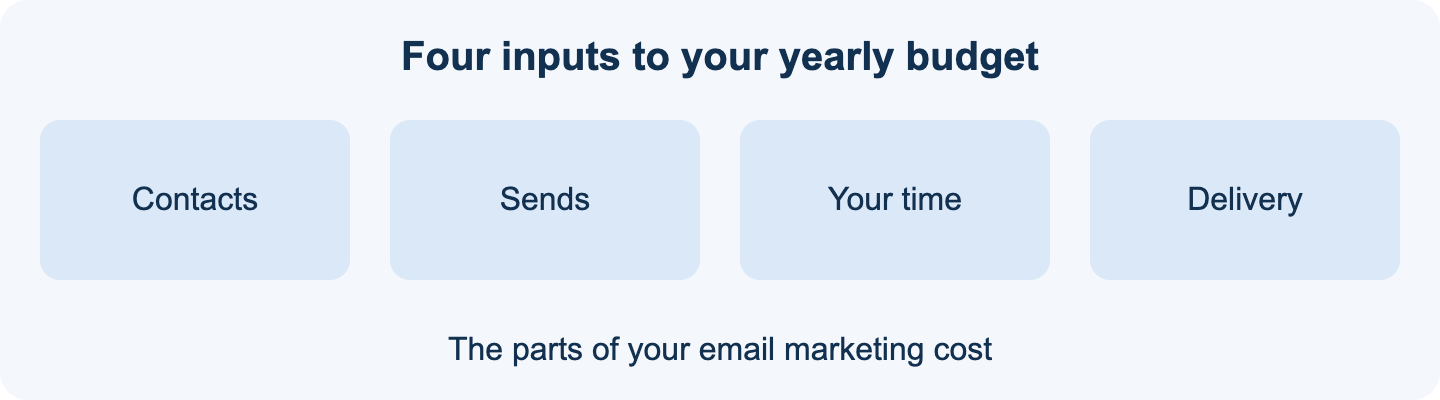
- Count your contacts today and the number you expect in twelve months, because most platforms price by list size.
- Decide how many emails you will send each month, since some plans also limit sends.
- Estimate the hours you or your team will spend per campaign and put a value on them. This is often the largest email marketing cost of all.
- Add delivery setup. Our guide to SPF, DKIM and DMARC explains the records that keep your messages out of the spam folder.
Write the result as a yearly figure. A monthly email marketing cost looks small, but the yearly total is what you actually budget for.
Ways to keep your email marketing cost under control
You can lower your email marketing cost without sending less. Clean the list first, because an unengaged list costs the same to hold as a good one. Remove contacts who have not opened anything in a long time, and the email marketing cost drops with the list.
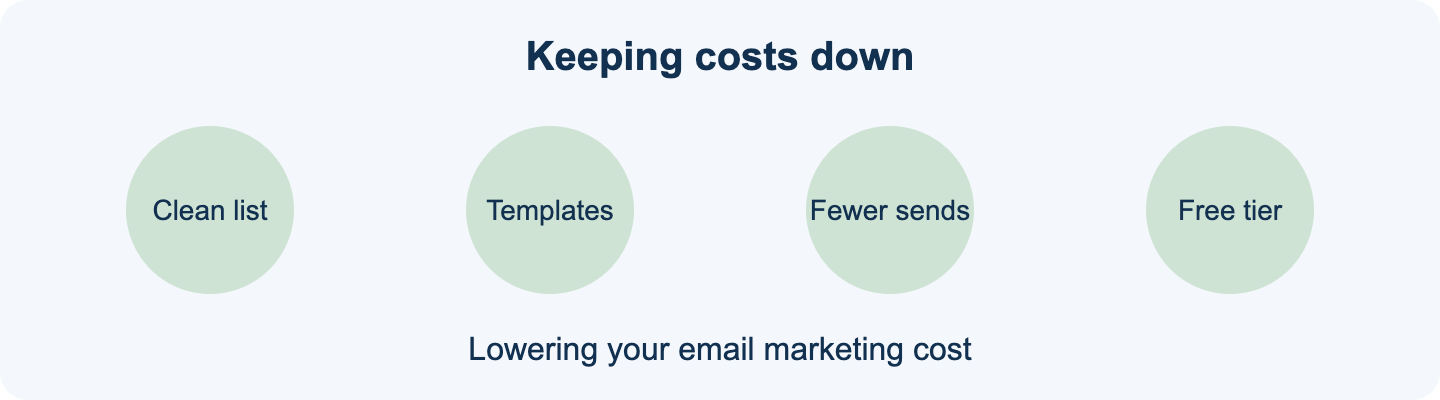
- Start on a free tier and move up only when you hit its limit.
- Reuse templates so each campaign takes less time to build.
- Send fewer, better emails to people who asked for them.
- Check the rules before you send. The FTC explains your obligations in its CAN-SPAM Act compliance guide for business, and a mistake there can raise your email marketing cost far above any platform fee. This is general information, not legal advice.
If you are weighing a hosted tool against running your own, our marketing services page and why emails go to spam are useful next reads. Whatever you pick, review your email marketing cost every quarter and compare it against the orders and enquiries it brings in. A low email marketing cost means little if nobody reads the messages, and a higher email marketing cost can be fair when the results justify it.
A simple yearly email marketing cost worksheet
Put numbers beside each line and the email marketing cost stops being a guess. List the platform fee for the plan you expect to need, the hours per campaign multiplied by the number of campaigns, any design or copy help you buy in, and the cost of your sending domain and mailbox setup. The sum is your yearly email marketing cost. Divide it by the number of enquiries or sales the emails bring in, and you have a cost per result you can compare month to month.
Do this once at the start and again after six months. A rising email marketing cost with flat results means the list or the content needs attention before you pay for a bigger plan. A falling email marketing cost with steady results means the process is working. Keep the worksheet somewhere shared so anyone on the team can update it.
Frequently asked questions
How much does email marketing cost for a small business?
Most small businesses spend very little on the platform itself, because the major services have free tiers covering a few hundred to a couple of thousand contacts. Costs rise with list size rather than with results, so a list full of people who never open anything costs exactly as much as an engaged one. The larger real cost is usually someone writing the emails.
Why does email marketing pricing go up so fast?
Because most platforms bill by the number of contacts stored rather than emails sent, and pricing tiers step up at fixed thresholds. Crossing a threshold by a handful of contacts moves you to the next tier for the whole month. This is why list hygiene has a direct and immediate effect on the bill.
Is there a free email marketing option?
Yes. Most major platforms have a free tier, typically capped on contacts or monthly sends, which is enough for a small business starting out. The constraints are usually on automation and support rather than on basic sending. Starting free and upgrading when a limit genuinely binds is the sensible path.
Can I just send marketing emails from my normal email account?
For a handful of recipients, yes. Beyond that it causes problems: no unsubscribe handling, no bounce management, and a high risk of your domain being flagged for sending bulk mail from an account not set up for it. It can also damage the deliverability of your ordinary business email, which is a much more expensive problem.
What hidden costs should I check before choosing a platform?
Check whether pricing counts unsubscribed and bounced contacts, what happens when you exceed a tier mid-month, whether automation and segmentation are on your tier or a higher one, whether transactional email is billed separately, and whether you can export your list and templates if you leave.
Does a bigger list mean better results?
Not usually. A smaller list of people who asked to hear from you outperforms a large one assembled from purchased or scraped addresses, and the large list costs more, damages your sender reputation, and raises your complaint rate. Removing people who have not engaged in a year typically improves both results and cost.
What is the biggest cost in email marketing?
For most small businesses it is the time to write emails worth reading, not the software. Platform costs are modest and predictable; producing something customers actually want to open is the part that stalls programs. Budgeting for the writing, whether your own time or someone else’s, is the more realistic way to think about the cost.