
When you evaluate reseller hosting terms of service, read five things before anything else: why the host can suspend or terminate you, how much notice you get, who they contact, what happens to your data, and whether they can raise prices or approach your clients. Those clauses decide whether your client book stays safe when something goes wrong. Most of the rest of the agreement matters less.
Key takeaways
- Most hosting agreements give the host broad discretion to suspend accounts, often without notice. That is normal, but you should know the limits before you sign.
- As a reseller, you are usually responsible for everything your clients host, so the acceptable use policy applies to their sites as much as yours.
- The clauses that protect business continuity are notice periods, reseller-first contact, data export, non-solicitation and renewal pricing.
- Have an attorney review both the host’s terms and your own client agreements. This article is a checklist, not legal advice.

Why Reseller Hosting Terms of Service Matter More Than Plan Specs
Plan specs tell you how fast client sites will load. The terms tell you whether they stay online. When you resell hosting, one decision by your upstream provider can affect 30 or 100 client websites at once, plus your reputation and recurring revenue.
Most suspensions are routine and fair: an unpaid invoice, a hacked WordPress site sending spam, a runaway script. Reading the agreement is not about assuming the worst. It is about knowing how the host handles those moments so you can plan for them.
If you are new to the model, our guide on how white-label hosting works covers the basics of reselling under your own brand.
The 10 Clauses That Matter Most
Not every section deserves equal attention. Focus on these first.
1. Termination and hosting account suspension rights
Nearly every host reserves the right to suspend or terminate service. The question is how broad that right is. Many agreements let the host act if your conduct may cause it harm or liability, and leave that judgment to the host. For example, HostGator’s Terms of Service (as of September 2026) lists conduct that may harm the company among its grounds for termination, “as determined by HostGator in its sole discretion.”
That language is common and lets hosts respond quickly to real abuse. The business risk is that open-ended discretion can also cover situations you would consider unfair. Look for specific grounds (non-payment, unlawful use, security threats) rather than open-ended ones.
2. Notice periods
Does the host promise notice before acting, or can it suspend immediately? Immediate action makes sense for an active attack. For a content complaint or billing dispute, a notice window gives you time to respond, fix the problem, or move the site.
3. Who gets contacted: you or your client
If a host emails your end client directly, your client may learn who your upstream provider is, or feel you lost control of their site. A reseller-first policy means the host talks to you and you handle your own client relationship.
4. Reseller hosting acceptable use policy scope
Your review of any reseller hosting acceptable use policy should ask one question: is the standard “unlawful,” or does it extend to content the host finds “objectionable,” “offensive,” or harmful to its reputation? Lawful-use standards are clear and predictable. Subjective standards are harder to plan around, especially if you serve churches, advocacy groups, campaigns, or any client with firm views.
5. Data export on termination
Some agreements say data is deleted when service ends. HostGator’s terms, for example, state that user content and websites will be deleted upon termination for any reason. Find out whether you can download full backups if your account ends, how long you have, and whether access is restored for that purpose.
Keeping your own off-server backups is good practice no matter what the agreement says. WHM’s Backup Configuration supports remote destinations, and a service like CodeGuard automated website backups adds a second copy outside the server.
6. Client solicitation and non-compete
Can the host market directly to your clients, or take them on if they call in? Your client list is the asset you are building. A clear non-solicitation commitment protects it.
7. Renewal price increases
Many hosts offer an introductory rate and renew at a higher regular rate. That is fine if disclosed, but it can wipe out your margin if you priced client plans around the promo. Look for what the renewal price will be and whether increases are capped.
8. Liability for client content
Reseller agreements usually make you responsible for everything under your account. HostGator’s terms, for instance, hold resellers responsible for all content in the reseller account and for their clients’ actions. Expect this anywhere, and pass that responsibility down in your client contracts.
9. Indemnification
Indemnification means you agree to cover the host’s costs if a third party brings a claim tied to your use of the service, and often your clients’ use. It is standard, but the scope varies, and it can carry real financial exposure. Have an attorney read it.
10. Changes to the terms
Most agreements let the host revise its terms by posting a new version online. Check how changes are announced and whether you can leave without penalty.
Reseller Hosting Terms of Service: Red Flags vs. Green Flags
No agreement is perfect, and one red flag is not a reason to walk away. Weigh the overall picture.
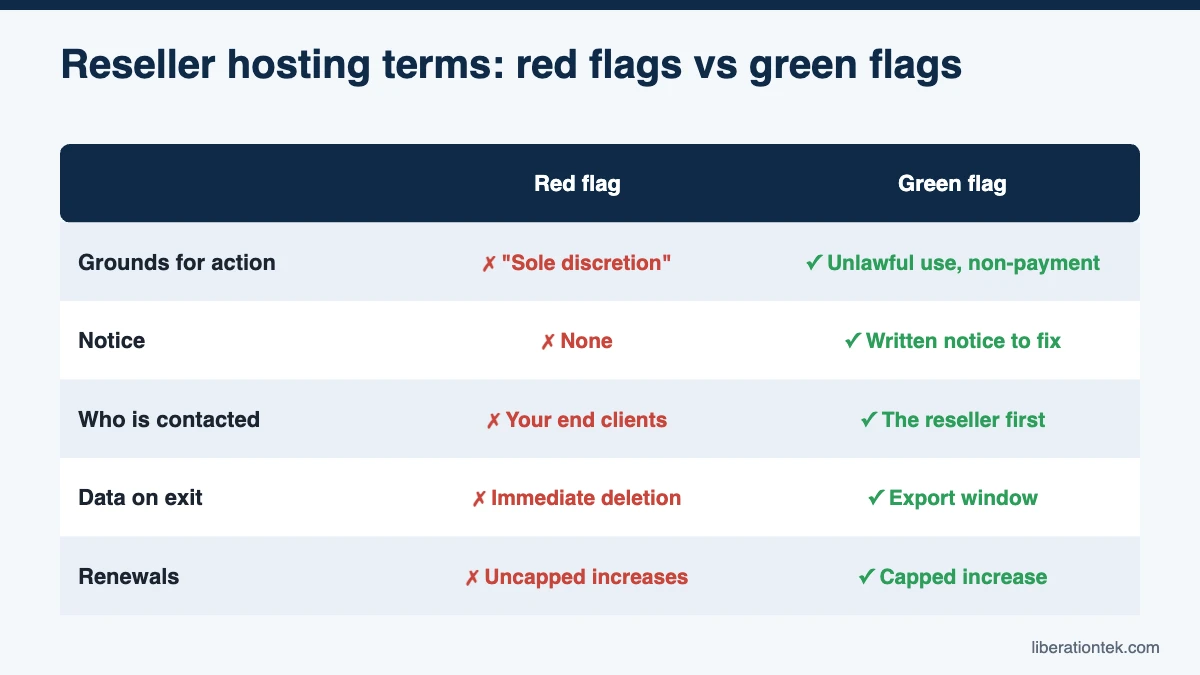
| Clause | Red flag | Green flag |
|---|---|---|
| Grounds for action | Open-ended “any reason” or “sole discretion” language that reaches lawful content | Specific grounds such as unlawful use and non-payment |
| Notice | No notice in any situation | Written notice with time to fix, plus narrow exceptions for emergencies |
| Contact | Host may contact end clients directly | Host contacts the reseller first |
| AUP scope | “Objectionable” or reputational standards | Lawful-use standard tied to actual law |
| Data on exit | Immediate deletion, no export window | Clear path to download full backups |
| Your clients | Silence on solicitation | Written promise not to market to or bill your clients |
| Renewals | Low promo rate, uncapped renewal | Renews at signup price or a stated cap |
| Emergency actions | Whole reseller account suspended for one bad site | Narrowest action, such as isolating one site |
Questions to Ask a Host Before You Move Your Clients
Send these to sales in writing and keep the answers.
- On what specific grounds can you suspend or terminate a reseller account or a single client site?
- How much written notice do I get before action, and what are the exceptions?
- In an emergency, do you suspend the whole reseller account or only the affected site?
- Will you ever contact my end clients directly? What happens if they contact you?
- Is your acceptable use policy based on lawful use, or on broader content standards?
- If my account ends, how do I export full cPanel backups, and how long do I have?
- What will my plan cost at renewal, and is any increase capped?
Some independent hosts publish commitments that answer several of these up front. Patmos’s Hosting Bill of Rights, for example, includes data export when you leave and a promise not to cancel customers for ideological reasons (as of September 2026). Published commitments like these make comparison easier.
How Liberation’s Client Protection Promise Answers Each Question
Liberation’s Client Protection Promise puts client protection in writing for every reseller. Here is how it maps to the clauses above, including the exceptions.
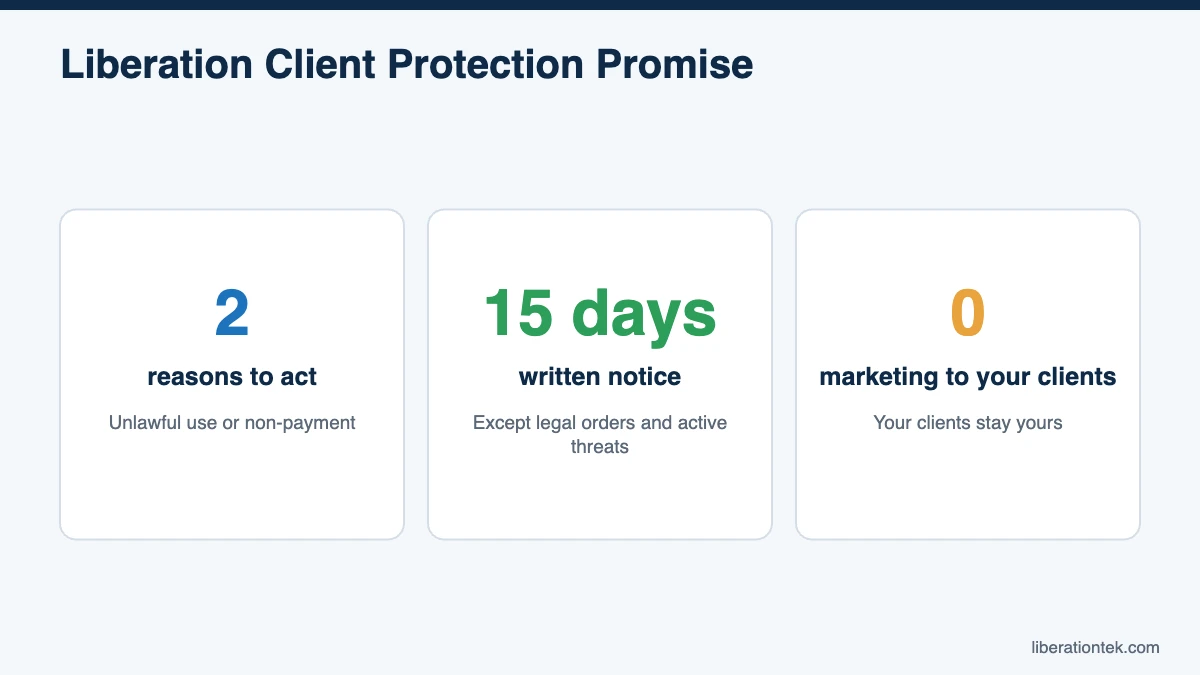
| Clause | Liberation’s answer |
|---|---|
| Grounds for action | Only two: unlawful use under U.S. law, or non-payment. Never over lawful content, viewpoints, or political or religious beliefs. |
| Notice | 15 days’ written notice before action, with a chance to fix the issue. |
| Exceptions | A law, court order or law-enforcement request, an active security threat (malware, a compromised account, an attack), or resource abuse affecting other customers can require faster action. Liberation then takes only the narrowest step, such as isolating one site, and notifies you as soon as legally permitted. |
| Who we contact | You, the reseller. Not your end client. |
| Your clients | They belong to you. Liberation never markets to, solicits or bills them. If one contacts Liberation directly, you are notified and get first right to do the work. |
| Renewals | Plans renew at your signup price. Any increase is capped at 5%, with notice before renewal. |
| Data access (plan feature) | Every plan is your own private VPS with root/SSH access and WHM, so you can create full cPanel backups of your client accounts whenever you need them. |
Some things the promise does not change. You are still responsible for your clients’ use of the service, and indemnification and other standard legal terms still apply, so read Liberation’s agreement as you would any other. If you have questions, ask the Liberation team directly before you sign up.
Protection is one part of the value. Every plan also includes Imunify360 on each client account, free migrations from other cPanel hosts up to your account limit, 24/7 U.S.-based human support, and servers Liberation owns and operates in the United States. See the white-label reseller hosting plans, or read why it matters in choosing a values-based technology provider.
Protect Your Clients With Your Own Agreement, Too
Your host’s terms are half the picture. The other half is your agreement with clients. A solid one usually covers acceptable use (mirroring your host’s AUP), payment terms, what happens on non-payment, who owns the domain and content, backup responsibilities, and how you handle a hosting account suspension if a client’s site is hacked or abused.
Have an attorney licensed in your state draft or review your client agreements. Legal review is cheap insurance for a business built on recurring revenue. When you are weighing providers side by side, our comparison of American reseller hosting providers puts these policies next to features and pricing.
Frequently Asked Questions
What should I look for first in reseller hosting terms of service?
Start with the grounds for suspension or termination, the notice period, and who the host contacts when there is a problem. Then check data export on termination, client non-solicitation, and renewal pricing. Those clauses decide whether your clients’ sites stay online and whether your client relationships stay yours. Everything else is secondary for business continuity.
Is “sole discretion” language in a hosting agreement a dealbreaker?
Not by itself. Broad discretion clauses are common and help hosts respond quickly to real abuse like malware or spam. The concern is when discretion reaches lawful content with no notice. Weigh the whole agreement: specific grounds for action, notice windows, reseller-first contact and narrow emergency actions all reduce the risk that broad language creates.
Am I responsible for my clients’ content as a reseller?
Usually yes. Reseller agreements typically make you responsible for all content and activity under your account, including your clients’ sites. That is why your own client agreement should require lawful use and let you act if a client’s site is hacked or abused. Have an attorney review that agreement so responsibility flows down to your clients.
What does Liberation’s Client Protection Promise cover?
Liberation acts on a reseller account or client site only for unlawful use under U.S. law or non-payment, never over lawful content or beliefs. You get 15 days’ written notice with a chance to fix, except for legal orders, active security threats or resource abuse, where only the narrowest action is taken. Liberation contacts you, not your clients, and never solicits them.
Choose Reseller Hosting Terms of Service You Can Plan Around
Good reseller hosting terms of service are predictable. They name specific grounds for action, give you notice, talk to you instead of your clients, let you take your data, and do not surprise you at renewal. Read those clauses first, ask the host the questions above in writing, and have an attorney review your own client contracts. When you are ready for a host whose promise answers those questions plainly, compare Liberation’s private VPS reseller plans and start with a 30-day money-back guarantee.
Related reading
- What Is Reseller Hosting? A Plain Guide for Web Designers
- VPS Reseller Hosting vs Shared Reseller Hosting for Agencies
- How to Start a Web Hosting Business in 2026: 10 Steps
- WordPress Hosting — What you are reselling, and how it is priced.
- SSL Certificates — Auto-installed and auto-renewed on client sites.