
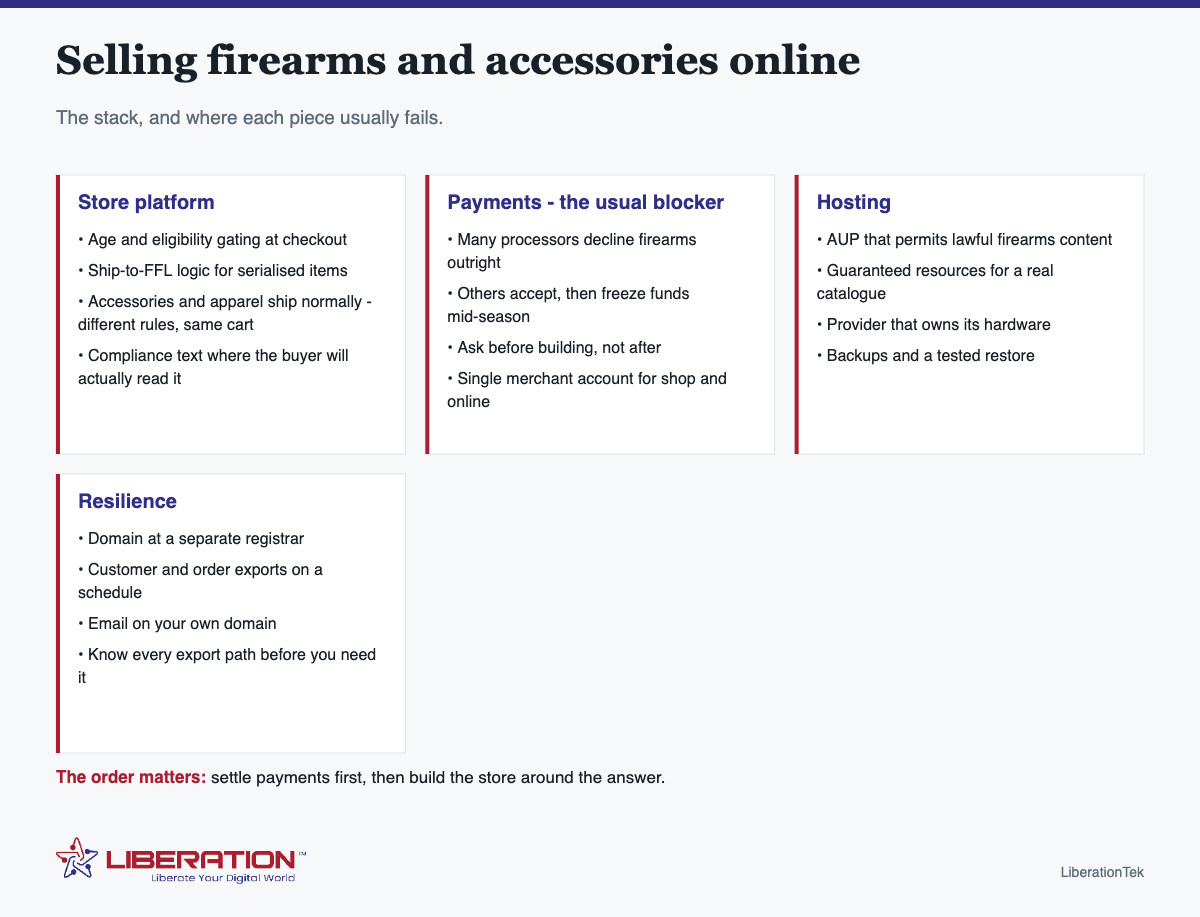
Firearms ecommerce hosting is the straightforward part. Build a store in the wrong order and you will discover the expensive problem last. Payments is the piece most providers decline, so settle it first and build the store around the answer – not the other way round. The hosting, the catalogue and the shipping logic are all solvable; a store that is live but cannot take money is not a store.
Settle payments first
Many mainstream processors classify firearms as high risk as a matter of policy, regardless of the individual merchant. Some decline outright, which is at least clear. The version that does real damage is a processor that accepts the account and then freezes funds months later, typically during your busiest weeks.
So ask the question before you build, and get the answer in writing. Ours is yes – PayHarmony supports 2A and firearms businesses, and the structure fits a dealer who sells both ways:
- One merchant account for card-present, online, mobile and phone payments, rather than separate arrangements that reconcile separately.
- A current-generation gateway with a documented API, hosted checkout, tokenized card storage, recurring billing and ACH processing.
- Integration with the store we build for you, and with most major carts and accounting packages.
- No locked contracts, and your rate quoted in writing before you switch.
- A partner who will not freeze your funds or close your account without a straight answer, backed by twenty-five years of merchant services and a named contact.
The firearms ecommerce catalogue problem nobody warns you about
A firearms store is really two stores sharing a cart. Serialised items are sold online and transferred through a licensed dealer at the buyer’s end. Accessories, optics, parts, ammunition where permitted, and apparel follow ordinary retail fulfillment.
That means one catalogue with two fulfillment paths, and the cart has to route each item correctly without making the buyer think about it. Three things make the difference:
- Item-level rules, not store-level. Whether something needs a dealer transfer is a property of the product, so it has to drive checkout behavior per line.
- Dealer selection in the flow, not in a follow-up email. Asking the buyer to nominate a receiving dealer after payment is where orders stall.
- Say what happens next, on the product page. Buyers unfamiliar with the process abandon carts out of uncertainty more often than out of price.
None of this is exotic development work, but it is more than a default store template does, which is why firearms e-commerce usually needs a store built for it rather than a generic one bent into shape.
Firearms ecommerce hosting for a real catalogue
A brochure site with a transfer form runs comfortably on shared hosting from $7.99 a month. A store with a catalogue, concurrent carts and seasonal peaks wants guaranteed resources – a VPS, fully managed, with cPanel and WHM included and free migration of one site.
The contract question applies here too: an acceptable use policy that permits lawful firearms content, from a provider that owns its hardware rather than reselling, so no upstream company can overrule the arrangement. We own and operate our servers in the United States.
Build it to survive losing any one piece
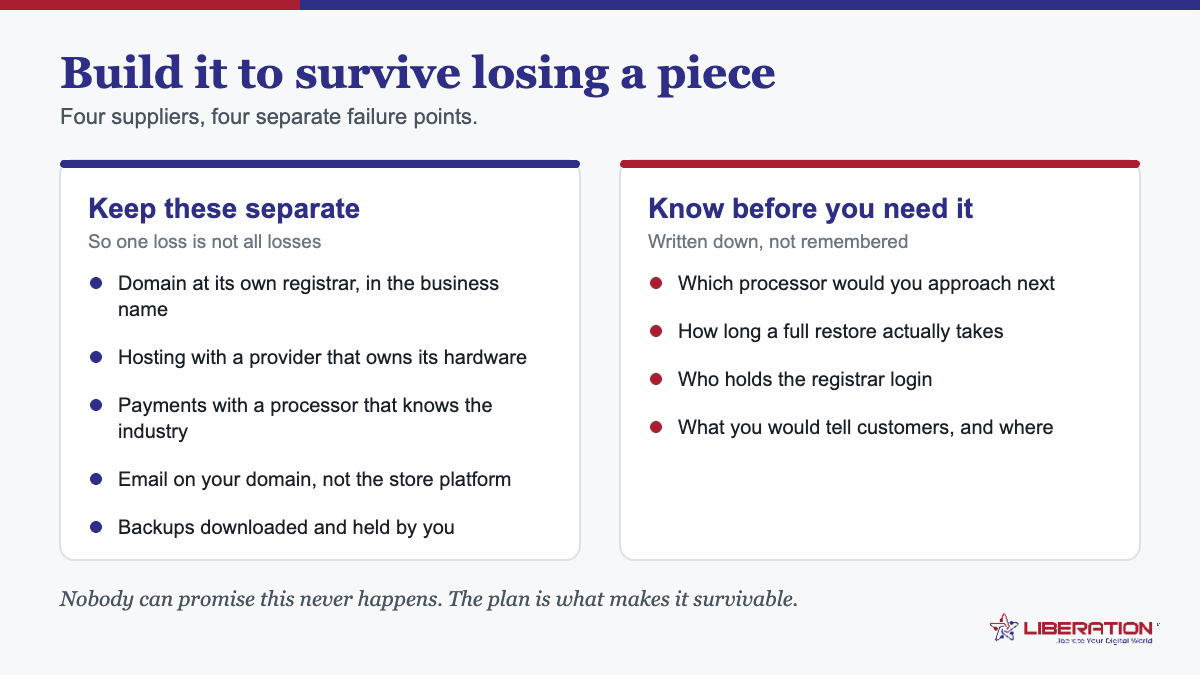
| Risk | The arrangement that defuses it |
|---|---|
| Processor declines or freezes | Settle it in writing first; know what your fallback would be |
| Host terminates | Provider that owns its infrastructure; independent backups |
| Domain held hostage | Separate registrar, in the business’s name |
| Platform locks your data | Customer and order exports on a schedule |
| Email account closed | Mail on your own domain with a local archive |
A sensible firearms ecommerce hosting build order
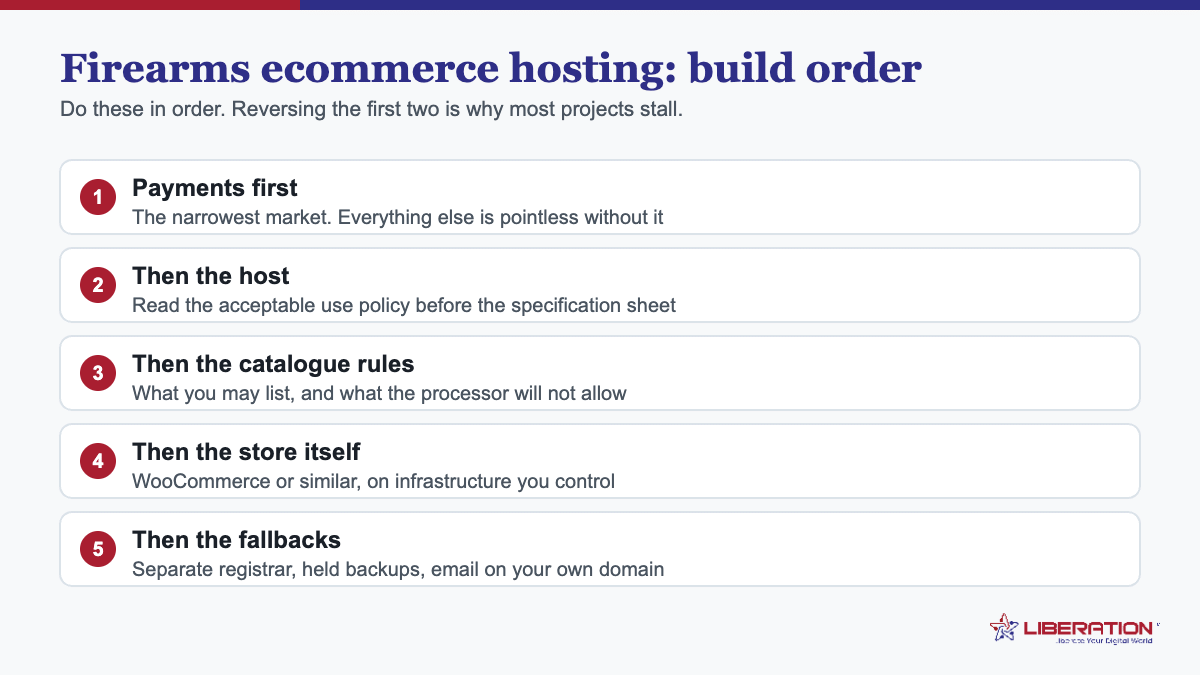
- Get the payment answer in writing, with an indicative rate.
- Register the domain separately, in the business’s name.
- Choose hosting on the contract questions, then the specifications.
- Build the catalogue rules – which items transfer through a dealer, which ship direct.
- Wire the gateway and test a real transaction end to end, including a refund.
- Set up email on the domain with role addresses and multi-factor authentication.
- Turn on exports for customers and orders before launch, not after.
Done in that order, nothing later in the list can invalidate anything earlier – which is the whole point.
Where we fit in firearms ecommerce hosting
Hosting, email, payments and the store itself from one provider that has already decided where it stands on this industry: payment processing that accepts 2A and firearms businesses, hosting on US-owned hardware we operate, mail on your own domain from $1.95 per user, and e-commerce development for the catalogue rules a default template will not handle.
Tell us how you sell – retail, online, or both – and you will get a straight answer on payments and a quote in writing before anything changes.
What the catalogue rules look like in practice
Getting the two fulfillment paths right is mostly a data problem rather than a design one. Each product carries a flag for how it ships, and the cart reads that flag rather than relying on the category it sits in.
| Item type | Fulfillment | What the cart must do |
|---|---|---|
| Serialised firearm | Ships to a licensed dealer | Collect the receiving dealer during checkout, not after |
| Optics, parts, accessories | Ships to the buyer | Ordinary shipping rules |
| Ammunition | Varies by destination | Destination rules applied at checkout |
| Apparel and merchandise | Ships to the buyer | Nothing special |
| Mixed cart | Both paths at once | Split the order cleanly and tell the buyer what happens |
The mixed cart is where generic store templates fall over, and it is also the most common real order – a rifle plus a sling plus a hat. Handling it gracefully is worth more than any amount of visual polish.
Two firearms ecommerce hosting decisions worth making early
Returns. Serialised items cannot simply be posted back, and the policy needs to say so plainly before purchase rather than after. Ambiguity here becomes chargebacks, which are expensive in this category specifically.
Inventory accuracy. Selling something you no longer have is ordinary retail annoyance for most stores and a longer conversation for this one. If the shop and the website share stock, they need to share it in real time rather than nightly.
A firearms ecommerce hosting launch checklist
- Payment arrangement confirmed in writing, with the rate.
- A real transaction processed and refunded end to end.
- Catalogue flags set on every product, spot-checked in a mixed cart.
- Returns policy written and linked from checkout.
- Customer and order exports tested before launch.
- Domain, hosting and email all under business control with MFA.
Where the traffic comes from for a firearms store
Worth setting expectations honestly: several large advertising platforms restrict firearms-related promotion, which changes the acquisition mix for this category. Paid search and social are narrower options than they would be for a comparable retailer, so organic search, email to your own list, and word of mouth carry disproportionate weight.
That has two consequences for how you build. First, the site itself has to do more work, because you cannot simply buy your way past a weak one. Second, your own email list becomes a genuine asset rather than a nice-to-have – it is the one channel nobody else controls, which is why keeping it on your own domain and exporting it regularly matters more here than in most industries.
Start smaller than you think with firearms ecommerce hosting
A full catalogue is not the only way in. Plenty of dealers do well launching with the transfer service, a short list of what they stock, and a working contact route – then adding online ordering once the payment arrangement and the fulfillment rules are proven with real orders. It is a cheaper way to discover what your buyers actually do.
The compliance questions that shape firearms ecommerce hosting
Before any of the technical decisions matter, two legal realities shape what your store can and cannot do, and getting them wrong is considerably more expensive than choosing the wrong host.
A firearm sold online still ships to an FFL, not to a doorstep. This is the single most common misunderstanding among people building their first store, and it changes the whole checkout design. The buyer pays you online; the firearm travels to a licensed dealer near them, who runs the background check and completes the transfer. Your site needs a way to collect and verify the receiving dealer’s licence, which is a workflow decision rather than a hosting one. The ATF’s published firearms guides are the authoritative reference, and worth reading before you design the cart rather than after.
State rules travel with the buyer, not with you. Magazine capacity, roster restrictions, waiting periods and outright prohibitions vary considerably, and a catalogue that ignores this will eventually take an order it cannot lawfully fill. Most firms handle it with shipping restrictions per product and a clear statement at checkout. Build that capability in early; retrofitting it across a large catalogue is painful.
Your processor’s rules are stricter than the law. This surprises people. Even a processor that accepts firearms businesses will usually publish its own prohibited list, and it will often exclude categories that are perfectly lawful to sell. Get that list in writing before you build the catalogue, because discovering it afterwards means either removing products or changing processor – and changing processor is the hardest thing on this page.
Ammunition and accessories have their own complications. Some carriers restrict ammunition shipping, some states require adult signature or prohibit direct shipment entirely, and some processors treat ammunition differently from firearms. If ammunition is a meaningful part of your revenue, confirm all three before launch.
Age verification is not optional theatre. Decide how you will handle it at checkout and document the decision. It is easier to build in from the start than to add once orders are flowing.
None of this is a reason not to sell online, and none of it is hosting-specific – but all of it constrains the store you build on top of your firearms ecommerce hosting. Settle these questions first and the technical build is straightforward; leave them until after launch and you will be rebuilding the catalogue while trying to trade.
What firearms ecommerce hosting actually has to handle technically
Set the contract questions aside for a moment. Once you have a host that will keep you, the store still has to work, and firearms catalogues have a few characteristics that make them heavier than the average small shop.
Product counts get large quickly. A modest dealer listing ammunition by calibre, grain weight and case quantity can pass ten thousand variations without stocking anything unusual. WooCommerce handles this, but not on the smallest shared plan – product attribute queries are what slow these stores down, long before traffic does. This is the main reason firearms ecommerce hosting usually means a VPS rather than a starter shared account.
Images are the other weight. Firearms sell on photographs, and customers expect several per product at a size that shows detail. That is real storage and real bandwidth. Plan for more of both than a comparable non-firearms store, and make sure image optimisation is switched on from the start rather than retrofitted across ten thousand items.
Inventory sync is the integration that matters. Most dealers pull stock feeds from one or more distributors, and those feeds update frequently. That is a scheduled job hitting your database repeatedly, and on shared infrastructure it competes with the customers browsing the site. Good firearms ecommerce hosting gives you the headroom to run the sync without the storefront slowing to a crawl while it does.
Search has to be better than the default. Customers search by calibre, by manufacturer, by model number and by nickname, often in the same session. The stock WooCommerce search will disappoint them. Budget for a proper search layer, and confirm your host can run it.
Backups have to be genuinely restorable. A store carrying live inventory and orders cannot be rebuilt from memory. Daily backups held somewhere other than the server, plus one restore you have actually performed, is the minimum. This matters more for a shop than for a brochure site, because a day of lost orders is a day of lost money and a queue of unhappy customers.
SSL, PCI scope and checkout speed. A hosted payment page keeps most of the PCI burden away from your server, which is the sensible default. Whatever you choose, checkout speed is revenue: every additional second between cart and confirmation costs completed orders, and on a heavy catalogue that time is mostly server-side.
Put together, this is why firearms ecommerce hosting is usually a managed VPS rather than the cheapest shared plan – not because firearms need special servers, but because a large catalogue with distributor feeds and heavy imagery is a demanding application regardless of what it sells. Size the infrastructure for the catalogue, choose the provider for the contract, and the two decisions stop fighting each other.
Marketing a firearms store when half the usual channels are closed
This sits outside hosting, but it shapes the whole business case, and it is the thing new sellers underestimate most. Several of the advertising channels a normal ecommerce store would rely on are simply unavailable, and planning around that from the beginning is the difference between a store that grows and one that sits there.
Paid advertising is largely closed. The major ad platforms restrict or prohibit firearms advertising, and accounts get suspended for trying. Treat paid search and paid social as unavailable rather than as something to be negotiated, and put that budget somewhere it will work.
Which makes organic search the main channel. If customers cannot be bought, they have to be found. That means product pages with real descriptions rather than distributor boilerplate, category pages written for how people actually search, and content that answers the questions buyers ask before purchasing. Every competitor pasting the same manufacturer text leaves the field open to whoever writes their own.
Local search does a surprising amount of work. Even a store selling nationally gets meaningful traffic from people looking for a dealer near them, particularly for transfers. A complete Google Business Profile, correct hours, and a transfers page with your fee on it will out-earn most other marketing a small dealer can do.
Email is the channel you own. This matters more here than in most industries, precisely because the rented channels are unavailable. A list you can export, sent from your own domain, cannot be switched off by a policy change. Build it from day one – at checkout, at the counter, and on the transfers page.
Community and forums still convert. Enthusiast communities, local ranges, clubs and training providers remain routes to customers that no platform controls. They are slower than advertising and considerably more durable.
Plan the infrastructure accordingly. A store depending on organic search needs pages that load quickly and a site that stays up, because the traffic is earned rather than bought and losing it is expensive to rebuild. That is another argument for sizing firearms ecommerce hosting properly at the start: the marketing strategy available to you rewards a fast, reliable, well-indexed site more than it rewards a cheap one.
A final word on sequencing, because it is the advice most often ignored. People shopping for firearms ecommerce hosting usually start by comparing plans, and that is the wrong end of the problem. Settle the processor, read the acceptable use policies, then pick firearms ecommerce hosting sized for the catalogue you actually intend to carry. Done in that order the build is ordinary work; done backwards, you end up rebuilding a store you have already launched.
Frequently asked questions
Can you sell firearms online?
Serialised firearms are sold online routinely, with the transfer completed through a licensed dealer at the buyer’s end rather than shipped to a private address. Accessories, optics, parts and apparel ship normally. One catalogue therefore contains items with two different fulfillment paths.
Why do payment processors decline firearms businesses?
Many mainstream processors classify firearms as high risk as a matter of policy rather than because of any individual merchant’s conduct. The frustrating version is a processor that accepts a merchant and then freezes funds later, which is why the question is worth settling in writing before building anything else.
What payment processing works for a firearms store?
One that has decided its position in advance. LiberationTek payment processing, PayHarmony, supports 2A and firearms businesses – card-present, online, mobile and phone payments through a single merchant account, with a documented gateway API, hosted checkout, tokenized storage, recurring billing and ACH, no locked contracts, and the rate quoted in writing.
What hosting does a firearms store need?
Guaranteed resources rather than a shared pool once you have a real catalogue and traffic, from a provider whose acceptable use policy permits lawful firearms content and which owns its own infrastructure. A VPS suits most independent stores.
How do you protect a firearms e-commerce business from disruption?
Settle payments before building, register the domain at a separate registrar in the business’s name, keep independent backups, export customer and order data on a schedule, and know the export path from every platform you depend on.
Related reading
- FFL Website Hosting: 4 Essential Pieces to Get Right
- 2A Friendly Web Hosting: 5 Terms to Check Before You Sign
- Gun-Friendly Web Hosting — Hosting for firearms businesses, stated plainly.
- Conservative Web Hosting — Terms that name the risk instead of staying silent.