
To build an email list: give people a clear reason to subscribe, put the form where they will actually meet it, and start with the customers and enquiries you already have. Never buy addresses. A few hundred people who opted in genuinely are worth more than several thousand who did not, and cost less to keep.
Most advice here is about tactics for capturing addresses. The harder and more important part is having something worth subscribing to, because a list built without that becomes a list nobody opens, which is indistinguishable from not having one.
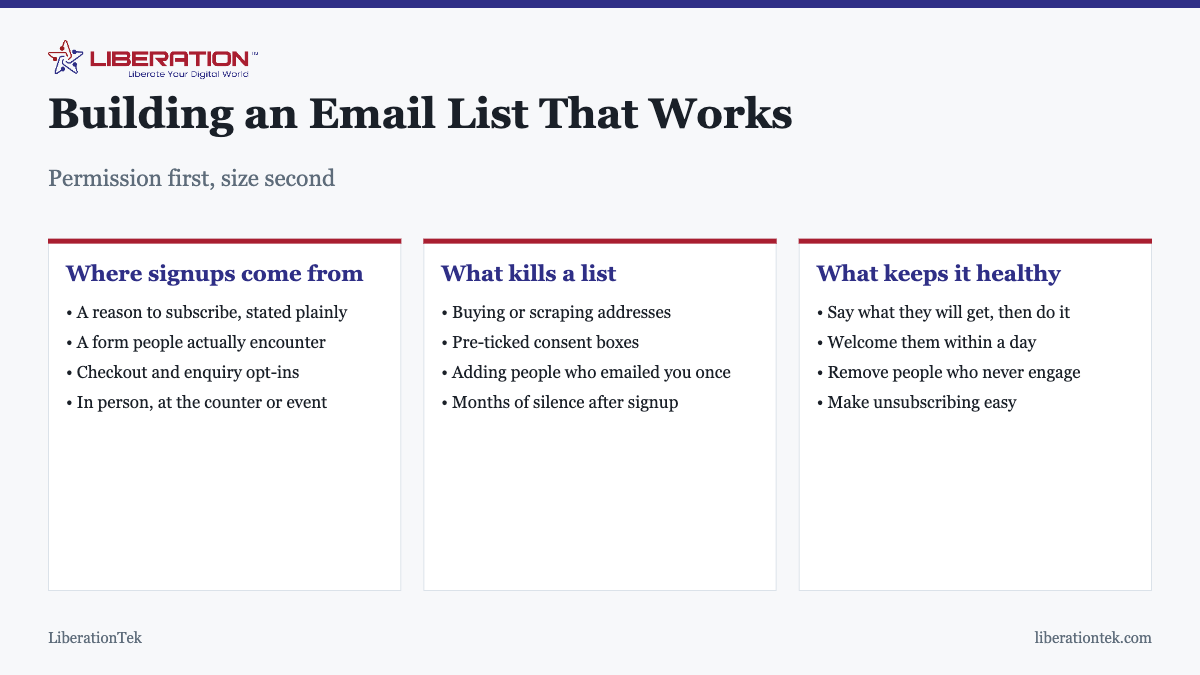
Start with the reason, not the form
“Subscribe to our newsletter” asks for something and offers nothing. The question in the reader’s mind is what they get and how often, and if the form does not answer it, most people decline by default.
Being specific converts far better: what the emails contain, how often they arrive, and who they are for. “Monthly notes on keeping a small business site secure, no more than one email a month” tells someone exactly what they are agreeing to. It also sets the expectation you then have to meet, which is what keeps complaint rates low later.
Where subscribers actually come from
For most small businesses, in rough order of value:
- Existing customers. People who have already bought are the most likely to want to hear from you and the least likely to complain. Ask them, with a clear opt-in.
- Enquiries that did not convert. Someone who asked about your services and did not buy this time is a genuine prospect. Ask at the point the enquiry is resolved.
- Your own content. A form at the end of something useful reaches people at the moment they have just found you helpful, which is the best moment there is.
- Checkout. A clearly labeled, unticked option during purchase.
- In person. At the counter, at an event, on a form. Still works, still undervalued.
The common thread is that every one of these reaches someone who already has a relationship with you. That is why they produce a list that opens things.
What destroys a list before it starts
Buying or scraping addresses
The most damaging thing available to you, and worth being explicit about. Purchased contacts never asked to hear from you. Complaint rates are high, bounce rates are high, and both are read directly as signals that you are mailing a list you have no business mailing.
The consequence extends past the campaign. Damaging your domain’s sending reputation affects your ordinary business mail, so your invoices, quotes and order confirmations start landing in spam folders too. You are trading a working email domain for a list of people who do not want to hear from you.
Pre-ticked boxes and silent additions
Consent obtained by default is not consent, and in most jurisdictions it does not meet the legal standard either. Practically, it produces subscribers who do not remember agreeing and who report the next email as spam.
Adding anyone who has ever emailed you
A supplier, a job applicant, someone asking a question. None of them agreed to marketing. This feels harmless and is one of the more common sources of complaints.
Silence after signup
Someone subscribes, hears nothing for four months, then receives a campaign. They do not remember you. This is why the first email matters as much as the acquisition.
The first email decides a lot
Send something within a day of signup, while you are still fresh in mind. It does not need to be elaborate:
- Confirm what they signed up for and how often it will arrive.
- Deliver whatever you promised, immediately, if you offered something.
- Give them something useful now, so the first impression is value rather than a receipt.
- Tell them how to reach a person, and send from an address that accepts replies.
A welcome email typically gets far more attention than anything you send later, because interest is at its peak. Using it purely to say “thanks for subscribing” wastes the best moment you will get.
Keeping it healthy
| Habit | Why it matters |
|---|---|
| Send what you promised, at the promised frequency | Expectation mismatch is the main cause of complaints |
| Make unsubscribing easy | An unsubscribe is far better than a spam report |
| Remove contacts who never engage | They cost money and drag down deliverability |
| Remove hard bounces promptly | Repeatedly mailing dead addresses is a strong negative signal |
| Offer a lower frequency option | Converts would-be unsubscribes into retained contacts |
| Keep authentication correct | A perfect list still fails if mail does not arrive |
That last row is worth its own emphasis. A carefully built list is wasted if your domain is not authenticated properly, because the mail simply will not reach inboxes. The setup is covered in what SPF, DKIM and DMARC are, and the diagnostic sequence in why emails go to spam.
The legal minimum, briefly
Rules differ by jurisdiction and this is not legal advice, but a few requirements are near-universal across the US, UK and EU regimes, and meeting them also happens to be what keeps complaint rates low:
- Be identifiable. Your business name and a real postal address in the email. Not optional in most regimes.
- Make unsubscribing work. A clear mechanism, honored promptly, without making the person log in or explain themselves.
- Do not mislead in the subject line or the From address about who is writing or what the message is.
- Keep a record of consent where your regime requires it: when they subscribed, and by what route. Most platforms store this automatically, which is a good reason to use one.
- Treat existing customers carefully. Several regimes allow marketing to existing customers about similar products without separate consent, but the exemption is narrower than people assume and does not cover buying a list.
If you sell internationally, the practical approach is to work to the strictest standard that applies to your audience rather than maintaining several. It is simpler, and it is close to what good practice looks like anyway.
Size is the wrong target
Treating subscriber count as the metric leads directly to every bad practice above, because the fastest way to grow a number is to stop caring who is in it.
Better measures: how many people open and act, how many reply, how many become customers. A list of three hundred engaged people routinely outperforms three thousand indifferent ones commercially, while costing less to hold and doing no damage to your sending reputation.
The frequency question is covered in how often to send marketing emails and the budgeting side in how much email marketing costs. For the business email underneath it, LiberationTek Email starts at $1.95 per user per month with no long-term contract.
A Simple Plan to Build an Email List in 30 Days
If you want to build an email list without paid tricks, a plan on one page beats a dozen tactics. Here is a realistic first month for a small business that wants to build an email list the honest way.

- Week one: write down why anyone would want to hear from you, then use that sentence on your signup form.
- Week two: add one form to your website, placed where visitors already read, and test it on a phone.
- Week three: invite existing customers, who have a real relationship with you, to subscribe.
- Week four: send a short welcome message and look at who replies, opens and unsubscribes.
To build an email list that lasts, keep each step small. You can build an email list of a few hundred real subscribers in a month, and that is a better result than a bigger list that nobody wants to hear from.
The FTC explains the sending rules in its CAN-SPAM compliance guide for business. Read it before your first campaign. It is general information, not legal advice, and rules differ by country.
Tools and Habits That Help You Build an Email List
You do not need complicated software to build an email list. A signup form, a sending tool you trust and a calendar are enough. What matters is the habit of doing the same few things each week.

- Put the signup form on your homepage, your contact page and the end of useful articles.
- Say what people will receive and how often, in one plain sentence.
- Send a welcome message right away so the address is confirmed and your name is familiar.
- Remove bounced addresses and people who stopped engaging every few months.
When you build an email list from your own website visitors, send from a domain you control and set up authentication, as covered in our guide to SPF, DKIM and DMARC. Any effort to build an email list is only useful if the messages reach the inbox, so also read why emails go to spam and how often to send marketing emails.
Churches and nonprofits can build an email list with the same steps, and LiberationTek offers 15% off for churches and nonprofits. Whatever your size, build an email list slowly, ask permission every time, and treat each subscriber as a person who chose to hear from you.
Frequently asked questions
How do I build an email list from scratch?
Give people a clear reason to subscribe, put the form where they will actually encounter it, and start with the customers and enquiries you already have. A list grows from people who have a reason to hear from you again. Size follows from that; it cannot be manufactured first and given a purpose later.
Can I buy an email list?
You can, and it is close to the worst thing you can do to your own domain. Purchased contacts never asked to hear from you, so complaint and bounce rates are high, and both damage your sender reputation. That damage affects your ordinary business email too, so invoices and quotes start landing in spam.
Can I add people who have emailed me before?
Only with care. Someone emailing an enquiry has not consented to marketing, and adding them silently is both a legal problem in most jurisdictions and a practical one, because they are likely to mark it as spam.
Ask instead, at a natural moment such as when the enquiry is resolved.
What is a lead magnet and do I need one?
A lead magnet is something useful offered in exchange for an email address: a guide, a checklist, a template. You do not strictly need one if your regular content is reason enough. Where they help most is when the value of subscribing is otherwise abstract. Make sure it attracts your actual customers rather than anyone who likes free things.
Where should I put the signup form?
Somewhere people reach when they are already interested, which is rarely only the footer. The end of useful content, the checkout, the enquiry form as a clearly optional tick box, and a dedicated page you can link to all work. One well-placed form outperforms four ignored ones.
How fast should an email list grow?
Slowly, and that is fine. A list of a few hundred people who genuinely opted in is worth more commercially than several thousand assembled addresses, and it costs less to hold. Steady growth from real interest compounds; purchased growth degrades your deliverability from the first send.
Should I remove subscribers who never open anything?
Yes, periodically. Unengaged contacts cost money on contact-priced platforms, drag down your engagement metrics, and gradually worsen inbox placement for everyone on the list. Try a re-engagement email first, then remove those who do not respond. A smaller engaged list performs better on every measure.
Why does my marketing email look wrong in dark mode?
Email apps change colors automatically, which can hide logos or make text hard to read. See the fixes for email dark mode issues.