
Send as often as you have something worth reading and can keep up indefinitely. For most small businesses that is monthly, occasionally fortnightly. Consistency beats frequency: a monthly email that always arrives outperforms a weekly one abandoned after six weeks, and sending too rarely causes more deliverability damage than sending often.
How often should you send marketing emails is one of the few marketing questions where the published benchmarks actively mislead. They are close to useless, because they average across retailers emailing daily and consultancies emailing quarterly, then present the midpoint as though it were advice.
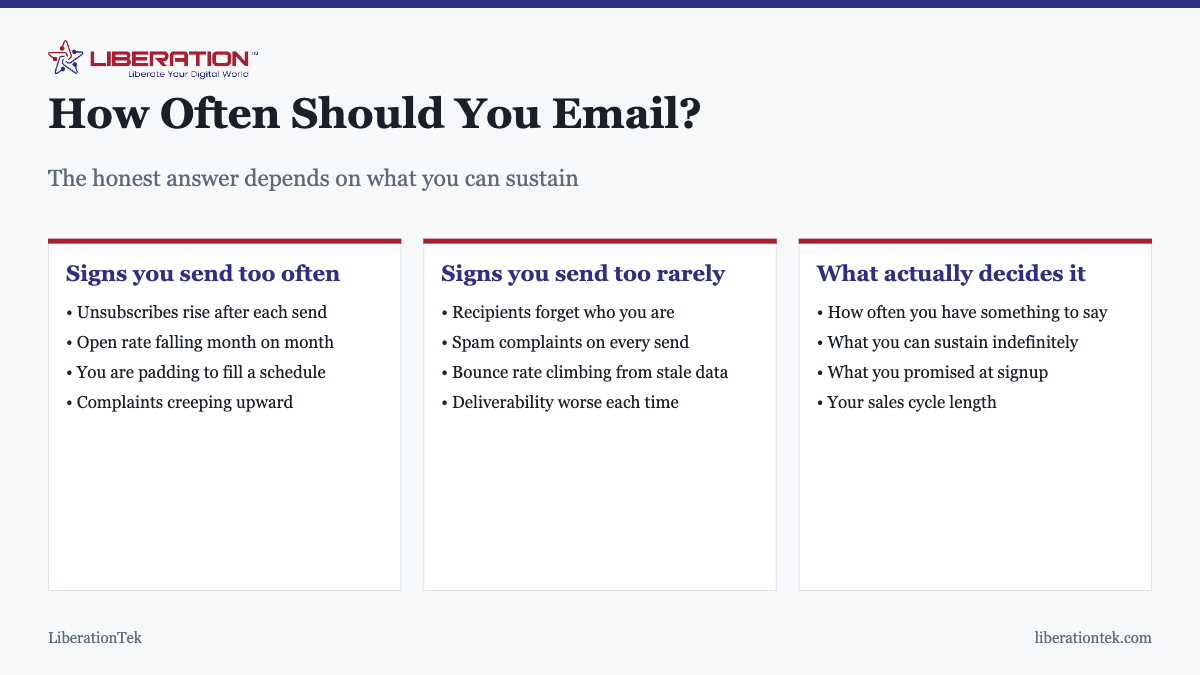
Why sending too rarely is the bigger risk
Most advice treats over-emailing as the danger. In practice, small businesses far more often err the other way, and the consequences are worse than they look.
When months pass between sends, people forget they subscribed. The next email arrives as an unexpected message from an unfamiliar sender, and a meaningful share mark it as spam rather than unsubscribing. Complaint rate is the single strongest negative deliverability signal there is.
Meanwhile the list decays. People change jobs and addresses stop existing, so bounce rate climbs. High bounces plus high complaints tells providers you are mailing a list you do not maintain, and inbox placement suffers accordingly, including sometimes for your ordinary business mail.
The uncomfortable conclusion: emailing quarterly can produce worse deliverability than emailing weekly.
What should actually decide your frequency
| Factor | Points to less often | Points to more often |
|---|---|---|
| What you sell | Considered, infrequent purchases | Consumables, repeat purchases |
| Sales cycle | Months | Days |
| What you have to say | Occasional genuine news | A steady stream of useful material |
| Who writes it | You, between other work | Someone whose job it is |
| What you promised at signup | “Occasional updates” | “Weekly tips” |
| Audience expectation | Professional services | Retail, events, deals |
The row people skip is what you promised at signup. If the form said monthly, emailing weekly is a broken promise and the complaint rate will reflect that, regardless of how good the content is.
Frequency is not one number
The question assumes a single cadence for everyone on your list, and that assumption is what makes it hard to answer. Once a list reaches any size, the people on it are in genuinely different situations, and treating them identically means being wrong for most of them.
A few splits worth making, in rough order of how much they repay the effort:
- New subscribers versus everyone else. Someone who signed up last week is more interested in you than they will ever be again. A short welcome sequence over the first fortnight earns far more attention than the same content sent months later in a regular newsletter.
- Engaged versus dormant. People who open regularly can take more frequent mail. People who have not opened in six months should receive less, not more, whatever the instinct says.
- Customers versus prospects. These usually want different things at different rhythms, and sending both the same email means writing something that fits neither.
- Time-sensitive versus routine. A genuine deadline justifies breaking your normal cadence. Manufacturing urgency to justify an extra send does not, and recipients tell the difference quickly.
None of this requires elaborate automation. Two segments and a welcome sequence covers most of the available benefit, and it turns the frequency question from one uncomfortable compromise into a few reasonable decisions.
The sustainability test
Before committing to a schedule, ask whether you could keep it up for a year during a busy period, with no help. If not, pick the next step down.
This matters because the failure mode of an over-ambitious schedule is not a slightly thinner email. It is that you miss one, then two, then stop entirely, and six months later you are the sender whose list has gone cold. A monthly cadence you can sustain indefinitely beats a weekly one you sustain for six weeks, by a wide margin.
One more thing worth saying about consistency
A predictable rhythm does something that no individual email can: it makes you expected. Recipients who know roughly when to hear from you are far less likely to treat the message as an intrusion, and that single fact does more for complaint rate and long-term deliverability than any amount of subject-line optimization. Pick a cadence, publish it at signup, and then protect it.
Reading the signals
Judge over several sends rather than reacting to one. The patterns worth acting on:
- Unsubscribes rising while opens fall, consistently. Too often, or the content has drifted from what was promised.
- Complaints creeping up. Act quickly. This one damages deliverability for everyone on the list.
- Opens fine but clicks falling. Not a frequency problem. The subject lines are working and the content is not delivering.
- Bounce rate climbing. The list is stale, which usually means you have not sent for too long.
- You are padding to fill the slot. The most reliable signal of all, and it does not require any analytics.
Let people choose, where you can
A preference option in the footer, offering monthly instead of weekly, converts people who would otherwise leave into less frequent recipients. An unsubscribe is permanent. A frequency reduction is not, and the relationship survives.
The same applies at signup. Telling people what to expect, and then matching it, sets the expectation that makes the rest of this straightforward.
Restarting a cold list
If it has been a year, do not send a normal campaign to everyone. That is how businesses generate a complaint spike and damage their domain’s reputation in a single afternoon.
- Start with your most recently engaged contacts, not the whole list.
- Remind them who you are and how they signed up, in the first line.
- Make unsubscribing easy and obvious. You want the people who no longer want you to leave quietly rather than complain.
- Watch complaints and bounces closely before widening.
- Work outward in batches over a few weeks.
- Remove anyone who does not engage across several sends.
Before any of this, confirm your authentication is correct, because a cold list plus weak authentication is the worst combination available. The detail is in what SPF, DKIM and DMARC are and why emails go to spam. The budgeting side is covered in how much email marketing costs, and if you would rather hand it over, our marketing team runs email campaigns.
A simple schedule to send marketing emails on
Most small organizations should send marketing emails on a schedule that a single person can keep up with for a year. Consistency matters more than the exact number. If you can only write one good message a week, send marketing emails weekly and do it well, rather than promising three and falling silent.
As a starting point, many senders choose one of these rhythms when they send marketing emails:
- Once a month is the floor for a newsletter. Below that, subscribers forget who you are.
- Once a week suits most businesses, churches and nonprofits that have regular news to share.
- Two or three times a week works only when every message gives the reader something useful.
- Daily sending is best kept for people who asked for it, such as a daily briefing.
Whichever pace you choose, tell new subscribers what to expect at sign up. When you send marketing emails exactly as promised, complaints drop and trust grows.
How to test how often you send marketing emails
You do not have to guess. You can test how often to send marketing emails by changing one thing at a time and watching what happens. Raise the pace for a month, then compare opens, clicks and unsubscribes against the previous month. If unsubscribes jump while clicks stay flat, you are sending too much. If clicks rise and unsubscribes stay steady, you have room to send marketing emails a little more often.
Keep each test long enough to be fair. A single week tells you very little, because one strong or weak message can skew the numbers. Give each pace at least four sends before you decide. Segment your list too, so that engaged readers get more and quiet readers get less. Sending the same schedule to everyone is the easiest way to annoy your best customers.
Deliverability matters as well. If you suddenly send marketing emails far more often from a new or quiet domain, mailbox providers can treat it as suspicious. Read our guide on why emails go to spam and set up authentication as explained in SPF, DKIM and DMARC explained. Our overview of email marketing costs can help you plan the tools you need.
Finally, follow the law. In the United States, the FTC CAN-SPAM compliance guide explains what every commercial message needs, including a clear way to opt out and your physical address. This is general information, not legal advice. Whatever pace you choose, honor unsubscribe requests promptly every time you send marketing emails.
To sum up, send marketing emails at a pace you can sustain, tell people what to expect, test changes slowly, and let the numbers guide you. A reader who chooses to hear from you often will forgive a busy week. A reader who feels spammed will not come back.
Common mistakes when you send marketing emails
The most common mistake is changing the pace without warning. If you normally send marketing emails once a week and suddenly send them daily for a sale, expect more unsubscribes. Another mistake is sending only when you need something. People who see a message only at fundraising time or at the end of a quarter learn to ignore it. A steady rhythm of useful messages makes the occasional ask far more effective.
A third mistake is ignoring time zones and habits. Pick a consistent day and hour to send marketing emails, then check which slots earn the most clicks. Over a few months this small habit tells you a lot about your audience, and it keeps your plan to send marketing emails simple enough to maintain. If you send marketing emails to more than one kind of audience, give each group its own schedule.
Frequently asked questions
How often should you send marketing emails?
As often as you have something worth reading and can sustain indefinitely. For most small businesses that is monthly, sometimes fortnightly. Consistency matters more than frequency: a monthly email that always arrives outperforms a weekly one that stops after six weeks, and it does less damage to your sender reputation.
Is sending too rarely actually a problem?
Yes, and it is underrated. If months pass between sends, recipients forget they subscribed and mark the next one as spam. Address data also goes stale, so bounce rates climb. Both signals damage deliverability, which means the infrequent sender can end up with worse inbox placement than someone emailing weekly.
How do I know if I am emailing too often?
Watch unsubscribe rate and open rate together over several sends rather than reacting to one. Rising unsubscribes with falling opens after each send is the clear signal. A more honest test: if you are struggling to find something to say and padding the email to fill a slot, you are sending too often regardless of the numbers.
What is the best day and time to send marketing emails?
There is no universal answer, and the published studies contradict each other because they average across wildly different audiences. Your own data beats any benchmark. Pick a reasonable time, keep it consistent for several months, then test one variable. Consistency is worth more than finding a theoretically optimal slot.
Should I let subscribers choose how often they hear from me?
If your platform supports it, yes. A preference option at signup or in the footer converts people who would otherwise unsubscribe into less frequent recipients, which keeps the relationship and protects your reputation. An unsubscribe is permanent; a reduced frequency is not.
Does sending more emails make more sales?
Up to a point, and past it the effect reverses. More sends mean more opportunities, but also more unsubscribes, more complaints and declining engagement, and engagement decline gradually worsens inbox placement for everyone on the list. The volume that maximizes short-term sales is usually higher than the volume that maximizes them over a year.
What should I do if I have not emailed my list in a year?
Do not send a normal campaign to the whole list. Send a short re-introduction to your most recently engaged contacts first, reminding them who you are and how they signed up, and make unsubscribing easy. Watch the results, then work outward gradually. Mailing a year-old list all at once is a reliable way to generate complaints and damage deliverability.
How often should you send marketing emails to a small list?
For small lists, one or two emails a month is a safe start, and weekly works if each email is useful. Watch unsubscribe and open rates and adjust if they change.
How often should you email new subscribers?
Send a welcome email right away, then a short series over the first two weeks. After that, move them to your normal schedule.